QUESTION IMAGE
Question
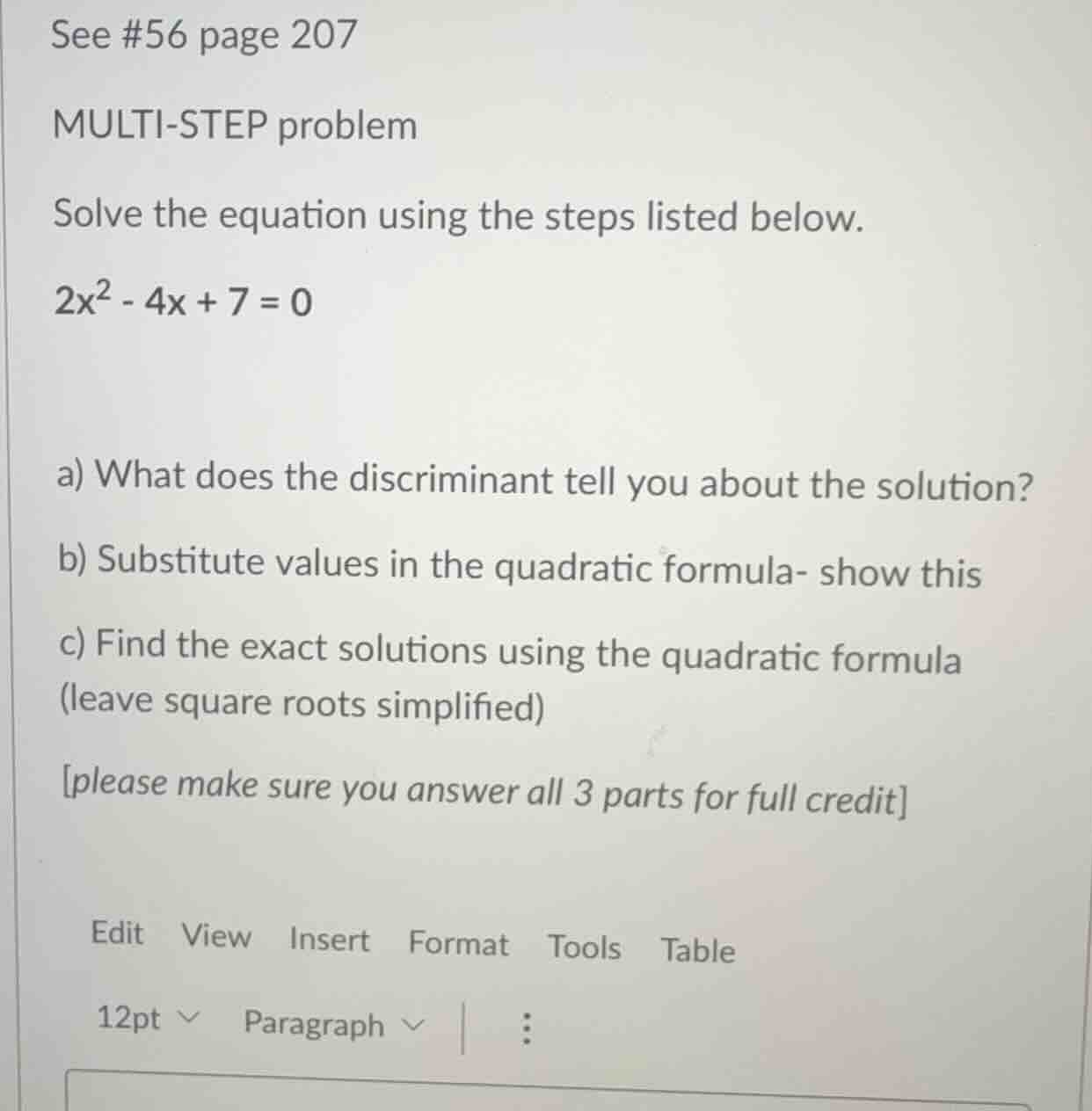
see #56 page 207
multi-step problem
solve the equation using the steps listed below.
$2x^2 - 4x + 7 = 0$
a) what does the discriminant tell you about the solution?
b) substitute values in the quadratic formula- show this
c) find the exact solutions using the quadratic formula (leave square roots simplified)
please make sure you answer all 3 parts for full credit
Part (a)
Step1: Recall discriminant formula
For a quadratic equation \(ax^2 + bx + c = 0\), the discriminant \(D = b^2 - 4ac\).
Step2: Identify coefficients
In \(2x^2 - 4x + 7 = 0\), \(a = 2\), \(b = -4\), \(c = 7\).
Step3: Calculate discriminant
\(D = (-4)^2 - 4\times2\times7 = 16 - 56 = -40\).
Step4: Analyze discriminant
Since \(D < 0\), the quadratic equation has no real solutions, but two complex conjugate solutions.
Part (b)
Step1: Recall quadratic formula
The quadratic formula is \(x = \frac{-b \pm \sqrt{b^2 - 4ac}}{2a}\).
Step2: Substitute values
Substitute \(a = 2\), \(b = -4\), \(c = 7\) into the formula:
\(x = \frac{-(-4) \pm \sqrt{(-4)^2 - 4\times2\times7}}{2\times2}\)
\(x = \frac{4 \pm \sqrt{16 - 56}}{4}\)
Part (c)
Step1: Simplify the square root
From part (a), the discriminant is \(-40\), so \(\sqrt{-40} = \sqrt{40}\times\sqrt{-1} = 2\sqrt{10}i\) (where \(i\) is the imaginary unit, \(i^2 = -1\)).
Step2: Substitute back into the formula
\(x = \frac{4 \pm 2\sqrt{10}i}{4}\)
Step3: Simplify the fraction
Divide numerator and denominator by 2:
\(x = \frac{2 \pm \sqrt{10}i}{2}\)

Snap & solve any problem in the app
Get step-by-step solutions on Sovi AI
Photo-based solutions with guided steps
Explore more problems and detailed explanations
s:
a) The discriminant \(D = -40\) (negative), so the equation has no real solutions, only two complex conjugate solutions.
b) Substituted quadratic formula: \(x = \frac{4 \pm \sqrt{16 - 56}}{4}\)
c) Exact solutions: \(x = \frac{2 + \sqrt{10}i}{2}\) and \(x = \frac{2 - \sqrt{10}i}{2}\) (or \(x = 1 + \frac{\sqrt{10}}{2}i\) and \(x = 1 - \frac{\sqrt{10}}{2}i\))