QUESTION IMAGE
Question
select the correct answer.
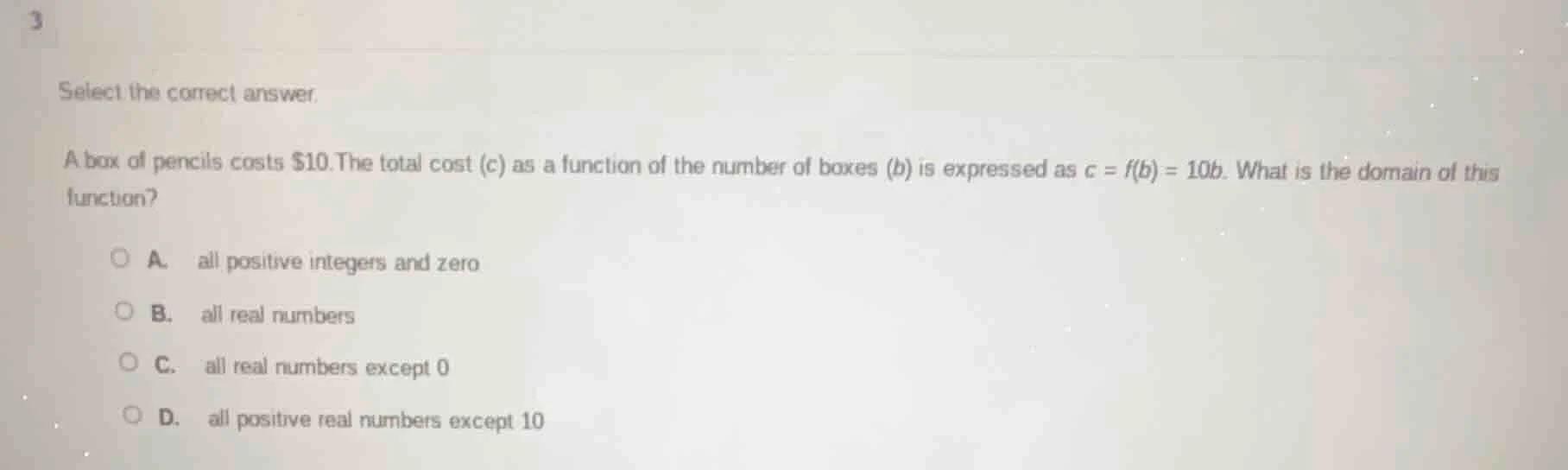
a box of pencils costs $10. the total cost (c) as a function of the number of boxes (b) is expressed as $c = f(b) = 10b$. what is the domain of this function?
a. all positive integers and zero
b. all real numbers
c. all real numbers except 0
d. all positive real numbers except 10
Step1: Understand the context
The function \( c = f(b)=10b \) represents the total cost of \( b \) boxes of pencils, where each box costs \$10. The variable \( b \) is the number of boxes.
Step2: Analyze possible values of \( b \)
In a real - world context, the number of boxes \( b \) cannot be a negative number (you can't buy a negative number of boxes), and it also can't be a non - integer in this context (you can't buy a fraction of a box of pencils). So \( b \) can be 0 (if you buy no boxes) or any positive integer (1, 2, 3, \(\cdots\)).
Step3: Evaluate the options
- Option A: "all positive integers and zero" matches our analysis of the possible values of \( b \).
- Option B: "all real numbers" is incorrect because \( b \) can't be a negative number or a non - integer (like 1.5) in this real - world context of buying boxes of pencils.
- Option C: "all real numbers except 0" is incorrect. We can have \( b = 0\) (buying no boxes) and also \( b \) can't be all real numbers (as explained above).
- Option D: "all positive real numbers except 10" is incorrect. The number of boxes has nothing to do with the value 10, and also \( b \) should be integers (including zero) and not all positive real numbers.

Snap & solve any problem in the app
Get step-by-step solutions on Sovi AI
Photo-based solutions with guided steps
Explore more problems and detailed explanations
A. all positive integers and zero