QUESTION IMAGE
Question
2
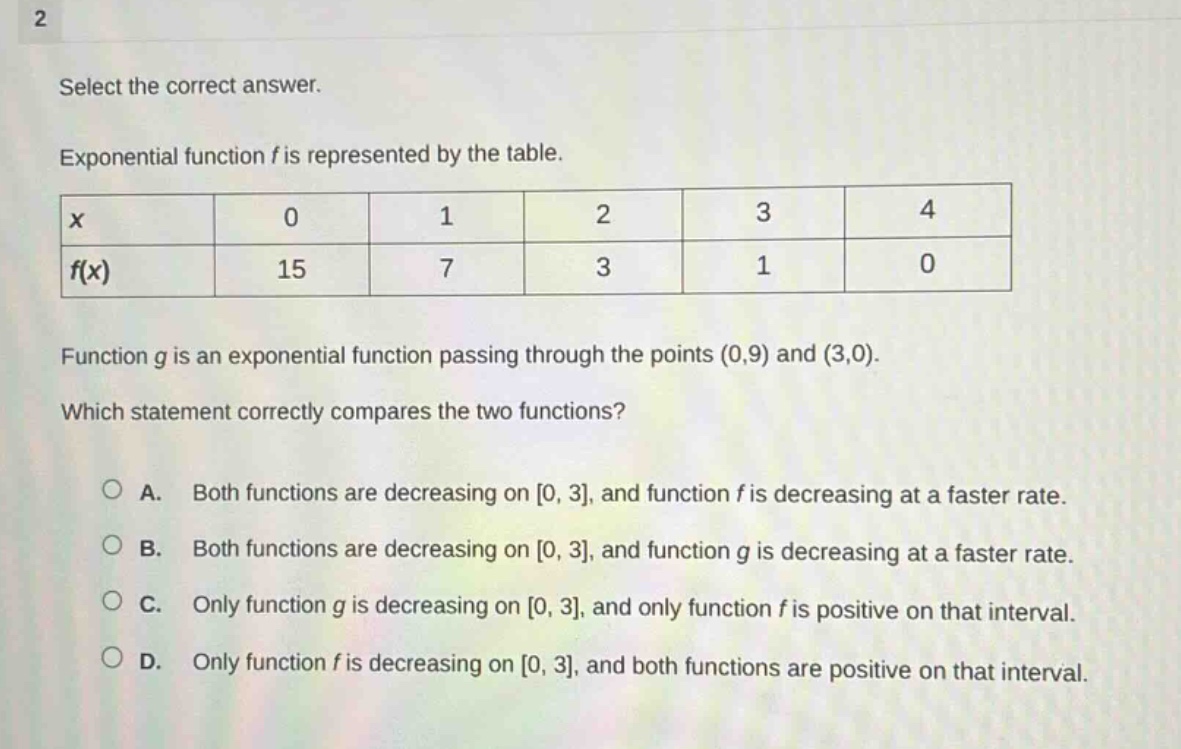
select the correct answer.
exponential function f is represented by the table.
| x | 0 | 1 | 2 | 3 | 4 |
|---|
function g is an exponential function passing through the points (0,9) and (3,0).
which statement correctly compares the two functions?
a. both functions are decreasing on 0, 3, and function f is decreasing at a faster rate.
b. both functions are decreasing on 0, 3, and function g is decreasing at a faster rate.
c. only function g is decreasing on 0, 3, and only function f is positive on that interval.
d. only function f is decreasing on 0, 3, and both functions are positive on that interval.
- Analyze function \( f \):
- For \( f(x) \), when \( x \) increases from 0 to 3, \( f(x) \) decreases from 15 to 1. The rate of change can be approximated by the difference in values. From \( x = 0 \) to \( x = 3 \), the change in \( f(x) \) is \( 1 - 15=- 14 \) over an interval of length 3.
- The values of \( f(x) \) at \( x = 0,1,2,3 \) are 15, 7, 3, 1 respectively, all positive in \([0,3]\) and decreasing.
- Analyze function \( g \):
- Function \( g \) is exponential, passes through \((0,9)\) and \((3,0)\). So when \( x \) increases from 0 to 3, \( g(x) \) decreases from 9 to 0. The change in \( g(x) \) is \( 0 - 9=-9 \) over an interval of length 3.
- Since \( g(x) \) is exponential and passes through \((0,9)\) and \((3,0)\), it is decreasing on \([0,3]\) (as the output decreases as input increases) and all values of \( g(x) \) in \([0,3]\) are positive (since at \( x = 0 \) it's 9 and at \( x = 3 \) it's 0, and exponential functions are continuous, so it's positive in between).
- Compare the rates:
- The absolute value of the change of \( f(x) \) over \([0,3]\) is \( \frac{\vert1 - 15\vert}{3}=\frac{14}{3}\approx4.67 \)
- The absolute value of the change of \( g(x) \) over \([0,3]\) is \( \frac{\vert0 - 9\vert}{3} = 3\)
- Since \( \frac{14}{3}>3 \), \( f \) is decreasing at a faster rate. Also, both functions are decreasing on \([0,3]\) and positive on that interval. So option A is correct.

Snap & solve any problem in the app
Get step-by-step solutions on Sovi AI
Photo-based solutions with guided steps
Explore more problems and detailed explanations
A. Both functions are decreasing on \([0, 3]\), and function \( f \) is decreasing at a faster rate.