QUESTION IMAGE
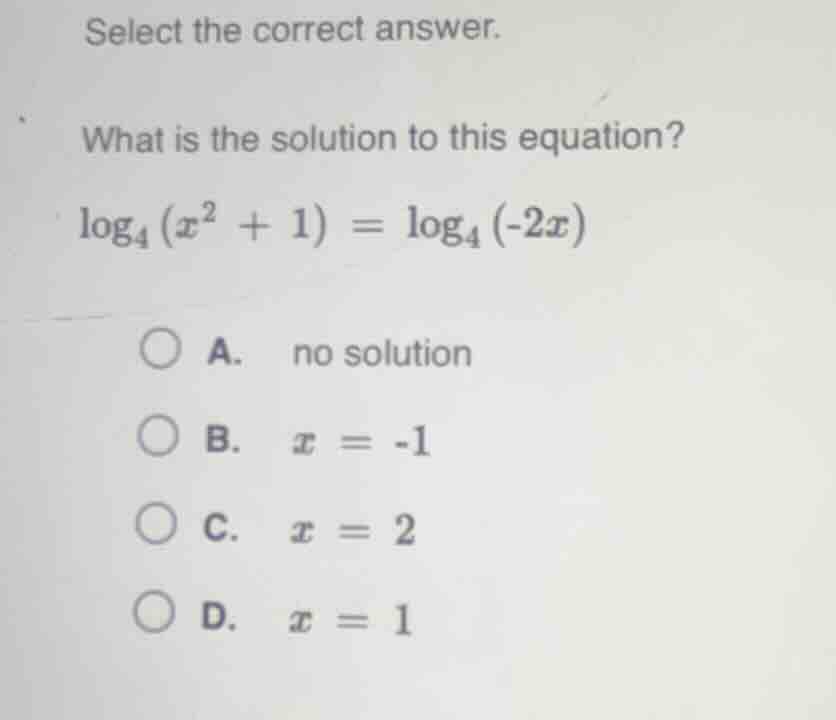
Question
select the correct answer.
what is the solution to this equation?
\\(\log_{4}(x^{2} + 1) = \log_{4}(-2x)\\)
\\(\bigcirc\\) a. no solution
\\(\bigcirc\\) b. \\(x = -1\\)
\\(\bigcirc\\) c. \\(x = 2\\)
\\(\bigcirc\\) d. \\(x = 1\\)
Step1: Use logarithmic property
If $\log_b(a)=\log_b(c)$, then $a = c$ (for $b>0,b
eq1,a>0,c>0$). So we set $x^2 + 1=-2x$.
Step2: Rearrange into quadratic equation
$x^2+2x + 1 = 0$. This factors as $(x + 1)^2=0$, so $x=-1$.
Step3: Check domain of logarithms
For $\log_4(-2x)$ to be defined, $-2x>0\implies x < 0$. For $\log_4(x^2 + 1)$, since $x^2+1$ is always positive (as $x^2\geq0$, so $x^2 + 1\geq1>0$), the domain for the first log is all real numbers, but we must satisfy the domain of the second log. Now check $x = -1$: $-2x=-2(-1)=2>0$, and $x^2 + 1=(-1)^2+1 = 2>0$. Wait, but let's re - evaluate the original equation with $x=-1$: $\log_4((-1)^2 + 1)=\log_4(2)$ and $\log_4(-2(-1))=\log_4(2)$. But wait, there's a mistake here. Wait, when we set $x^2 + 1=-2x$, we get $x^2+2x + 1 = 0$, $x=-1$. But let's check the original equation again. Wait, the left - hand side: $x^2 + 1$ when $x=-1$ is $2$, the right - hand side: $-2x$ when $x=-1$ is $2$. But wait, the problem is in the domain of the logarithm? Wait no, $-2x$ when $x=-1$ is $2$, which is positive. Wait, but let's check the quadratic equation again. Wait, $x^2+1=-2x\implies x^2 + 2x+1 = 0\implies(x + 1)^2=0\implies x=-1$. But let's check the original equation: $\log_4(1 + 1)=\log_4(2)$ and $\log_4(-2\times(-1))=\log_4(2)$. So why did we think there was a mistake? Wait, maybe I made a mistake earlier. Wait, but let's check the options. Wait, but let's re - examine the problem. Wait, the equation is $\log_4(x^2 + 1)=\log_4(-2x)$. When $x=-1$, both arguments are $2$, so the logarithms are equal. But wait, let's check the other options. For $x = 1$: $-2x=-2<0$, so $\log_4(-2)$ is undefined. For $x = 2$: $-2x=-4<0$, $\log_4(-4)$ is undefined. For $x=-1$: as we saw, both arguments are positive. Wait, but the initial thought was wrong. Wait, no, wait: $x=-1$: $x^2 + 1=2$, $-2x = 2$, so $\log_4(2)=\log_4(2)$, which is true. But wait, let's check the quadratic solution again. Wait, maybe the error is in the domain? Wait, no, $-2x$ when $x=-1$ is $2>0$, and $x^2 + 1$ is always positive. So $x=-1$ is a solution? But wait, let's check the answer options. Option B is $x=-1$. But wait, let's re - do the problem.
Wait, the equation is $\log_4(x^2 + 1)=\log_4(-2x)$. By the property of logarithms, if the logs are equal (with the same base), then their arguments are equal (and positive). So:
- Argument of left log: $x^2 + 1>0$ (always true).
- Argument of right log: $-2x>0\implies x<0$.
Then, setting $x^2 + 1=-2x\implies x^2 + 2x + 1 = 0\implies(x + 1)^2=0\implies x=-1$.
Now, check $x=-1$:
- For $\log_4(x^2 + 1)$: $x^2+1=(-1)^2 + 1=2>0$, so the log is defined.
- For $\log_4(-2x)$: $-2x=-2\times(-1)=2>0$, so the log is defined.
And $\log_4(2)=\log_4(2)$, so $x=-1$ is a solution. Wait, but initially I thought there was a mistake, but no. So the correct answer is B.

Snap & solve any problem in the app
Get step-by-step solutions on Sovi AI
Photo-based solutions with guided steps
Explore more problems and detailed explanations
B. $x = -1$