QUESTION IMAGE
Question
select the correct answer.
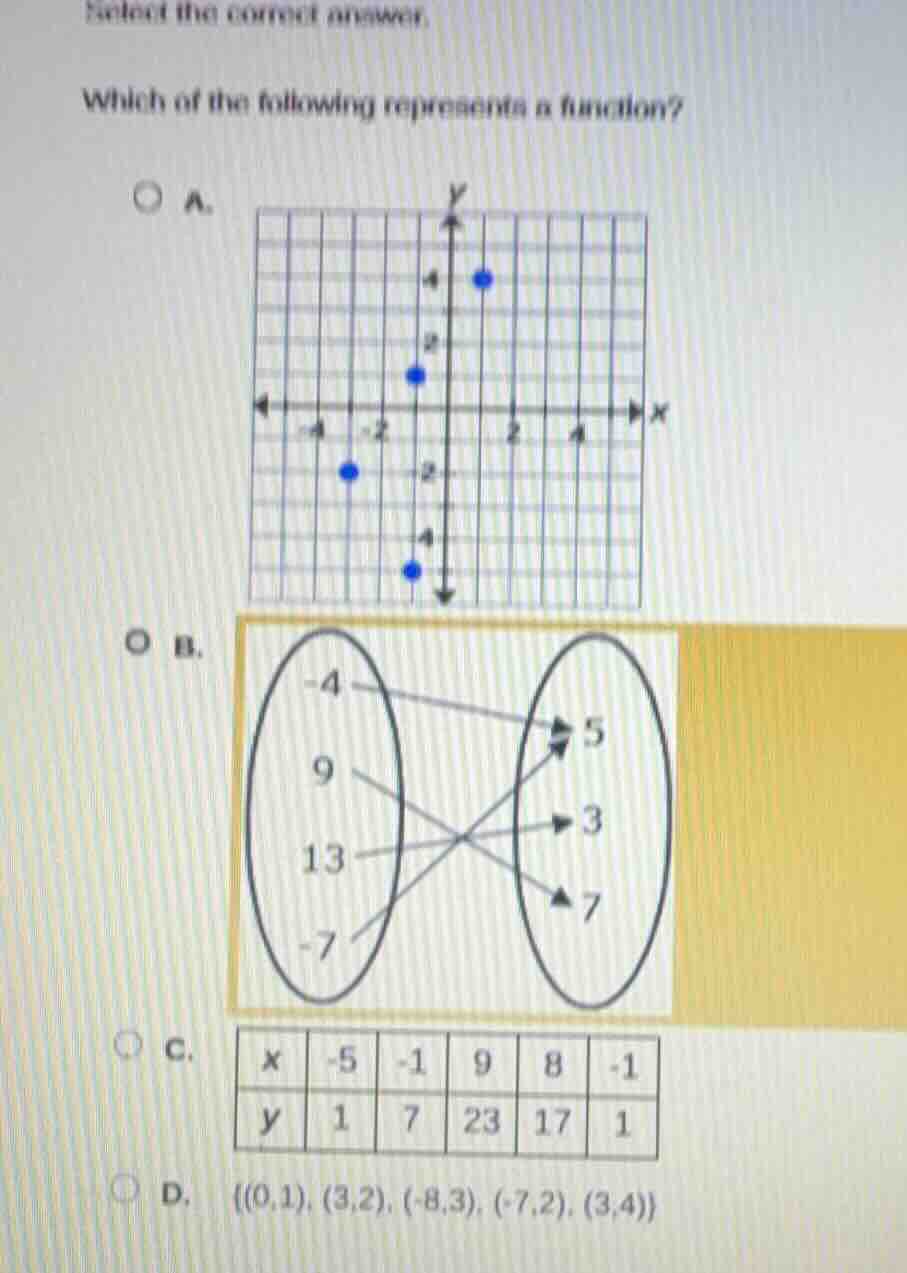
which of the following represents a function?
a. image of a coordinate plane with points
b. image of a mapping diagram
c.
| x | -5 | -1 | 9 | 8 | -1 |
| y | 1 | 7 | 23 | 17 | 1 |
d. {(0,1), (3,2), (-8,3), (-7,2), (3,4)}
To determine which represents a function, we use the definition: a function is a relation where each input (x - value) has exactly one output (y - value).
Step 1: Analyze Option A
For the graph in Option A, we check the x - values of each point. Let's assume the points have x - coordinates (from left to right) $x=-3$, $x = - 1$, $x=1$, $x=-1$? Wait, no, looking at the grid: the points seem to have distinct x - values? Wait, no, let's list the x - coordinates. The points: one at $x=-3$ (y=-2), one at $x=-1$ (y = 1), one at $x = 1$ (y = 4), one at $x=-1$ (y=-5)? Wait, no, maybe I misread. Wait, actually, in a function, we use the vertical line test. If we draw a vertical line through the graph, it should intersect the graph at most once. For the graph in A, when we check the x - values, each x - value has only one y - value. Wait, let's check other options first.
Step 2: Analyze Option B
In the mapping diagram (Option B), the input - 4 maps to 5, 9 maps to 3, 13 maps to 5, - 7 maps to 7? Wait, no, the mapping: - 4→5, 9→3, 13→5, - 7→7? Wait, no, actually, each input (left oval) has exactly one output (right oval). Wait, no, wait the left oval has - 4, 9, 13, - 7. Wait, no, maybe I missee. Wait, no, in a function, each input must have exactly one output. Wait, no, in Option B, let's check: - 4 maps to 5, 9 maps to 3, 13 maps to 5, - 7 maps to 7? Wait, no, maybe the mapping is - 4→5, 9→3, 13→5, - 7→7? Wait, no, actually, each input (element in the left set) has exactly one output (element in the right set). Wait, but wait, maybe I made a mistake. Wait, no, let's check Option C.
Step 3: Analyze Option C
In the table for Option C, the x - values are - 5, - 1, 9, 8, - 1. The x - value - 1 appears twice. When $x=-1$, we have $y = 7$ and $y = 1$. So one input ($x=-1$) has two outputs, so it is not a function.
Step 4: Analyze Option D
In the set of ordered pairs for Option D: $\{(0,1),(3,2),(-8,3),(-7,2),(3,4)\}$. The x - value 3 appears twice, with $y = 2$ and $y = 4$. So one input ($x = 3$) has two outputs, so it is not a function.
Step 5: Re - analyze Option A (using vertical line test)
For the graph in Option A, if we apply the vertical line test (draw a vertical line at any x - value), it will intersect the graph at most once. So each x - value has exactly one y - value. Wait, but earlier I thought maybe a repeat, but maybe I misread. Wait, no, let's re - check Option B. Wait, in Option B, the mapping: - 4→5, 9→3, 13→5, - 7→7? Wait, no, the arrows: - 4 points to 5, 9 points to 3, 13 points to 5, - 7 points to 7? Wait, no, maybe the mapping is - 4→5, 9→3, 13→5, - 7→7? Wait, no, actually, in a function, each input must have exactly one output. Wait, in Option B, does any input have more than one output? Let's see: - 4 has one output (5), 9 has one output (3), 13 has one output (5), - 7 has one output (7). Wait, but earlier I thought Option A. Wait, no, I think I made a mistake. Wait, no, let's go back.
Wait, the vertical line test for Option A: if the graph has points with distinct x - values, then it passes the vertical line test. For Option B, the mapping: each input (left set) has exactly one output (right set). Wait, no, maybe I messed up. Wait, no, let's re - check the options.
Wait, Option C: x = - 1 appears twice (with y = 7 and y = 1) → not a function. Option D: x = 3 appears twice (with y = 2 and y = 4) → not a function. Option B: let's see the mapping. The left set: - 4, 9, 13, - 7. The right set: 5, 3, 7. - 4→5, 9→3, 13→5, - 7→7. Wait, each input has exactly one output. But wait, is that correct? Wait, no, in…

Snap & solve any problem in the app
Get step-by-step solutions on Sovi AI
Photo-based solutions with guided steps
Explore more problems and detailed explanations
A