QUESTION IMAGE
Question
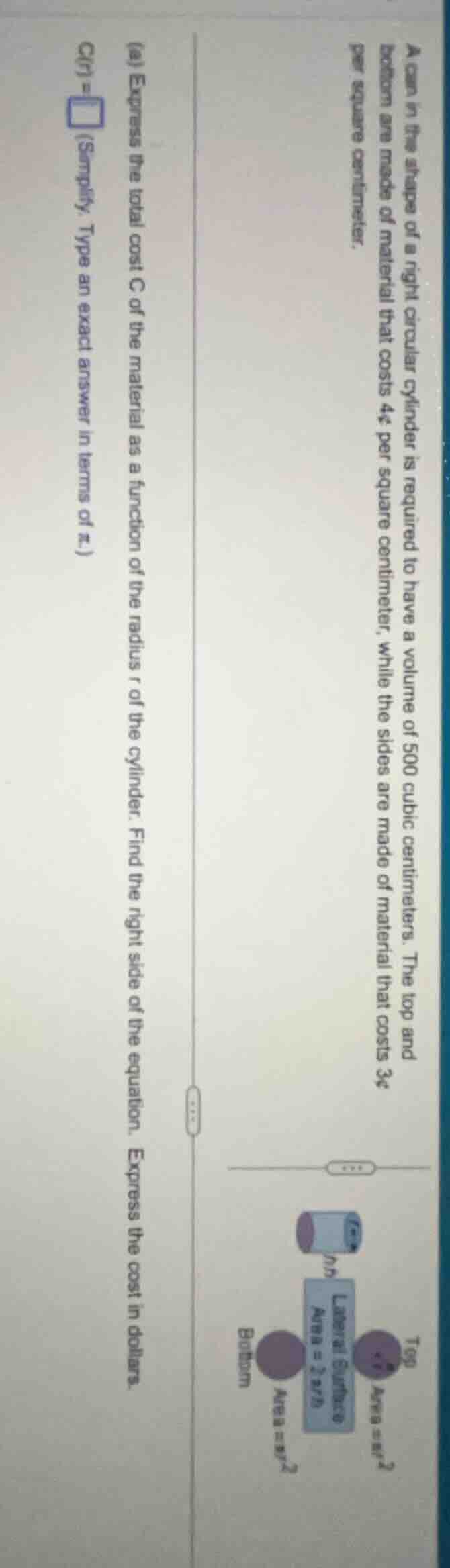
a can in the shape of a right circular cylinder is required to have a volume of 500 cubic centimeters. the top and bottom are made of material that costs 4¢ per square centimeter, while the sides are made of material that costs 3¢ per square centimeter.
(a) express the total cost ( c ) of the material as a function of the radius ( r ) of the cylinder. find the right side of the equation. express the cost in dollars.
( c(r) = square ) (simplify. type an exact answer in terms of ( pi ))
Step 1: Recall Volume Formula of Cylinder
The volume \( V \) of a right circular cylinder is given by \( V=\pi r^{2}h \). We know \( V = 500 \) cubic centimeters, so we can solve for \( h \):
\( 500=\pi r^{2}h \)
\( h=\frac{500}{\pi r^{2}} \)
Step 2: Calculate Cost of Top and Bottom
The top and bottom each have an area of \( \pi r^{2} \), so the total area for top and bottom is \( 2\pi r^{2} \). The cost per square centimeter for top and bottom is \( 4 \) cents, so the cost for top and bottom (in cents) is \( 4\times2\pi r^{2}=8\pi r^{2} \).
Step 3: Calculate Cost of Lateral Surface
The lateral (side) surface area of a cylinder is \( 2\pi rh \). We already found \( h = \frac{500}{\pi r^{2}} \), so substitute \( h \) into the lateral surface area formula:
\( 2\pi r\times\frac{500}{\pi r^{2}}=\frac{1000}{r} \)
The cost per square centimeter for the side is \( 3 \) cents, so the cost for the side (in cents) is \( 3\times\frac{1000}{r}=\frac{3000}{r} \).
Step 4: Total Cost Function
The total cost \( C(r) \) (in cents) is the sum of the cost of top/bottom and the cost of the side. To convert to dollars, we divide by 100 (since 1 dollar = 100 cents). Wait, no, the problem says "Express the cost in dollars". Wait, the cost for top/bottom is 4 cents per square cm, side is 3 cents per square cm. So first, calculate total cost in cents, then convert to dollars (divide by 100). Wait, no, maybe the problem has a typo? Wait, the original problem: "the top and bottom are made of material that costs 4¢ per square centimeter, while the sides are made of material that costs 3¢ per square centimeter. Express the cost in dollars."
Wait, let's re - do:
Cost of top and bottom (in cents): \( 4\times(\pi r^{2}+\pi r^{2})=4\times2\pi r^{2}=8\pi r^{2} \) cents.
Cost of lateral surface (in cents): \( 3\times(2\pi rh) \). Substitute \( h=\frac{500}{\pi r^{2}} \) into this:
\( 3\times2\pi r\times\frac{500}{\pi r^{2}}=3\times\frac{1000}{r}=\frac{3000}{r} \) cents.
Total cost in cents: \( 8\pi r^{2}+\frac{3000}{r} \)
To convert to dollars, divide by 100:
\( C(r)=\frac{8\pi r^{2}}{100}+\frac{3000}{100r}=\frac{2\pi r^{2}}{25}+\frac{30}{r} \)
Wait, but maybe the problem wants the cost in cents? Wait, the problem says "Express the cost in dollars". Wait, let's check the problem statement again: "Express the total cost \( C \) of the material as a function of the radius \( r \) of the cylinder. Find the right side of the equation. Express the cost in dollars."
Wait, maybe I misread the cost units. Let's assume that the cost is in dollars? No, 4¢ is 4 cents. So to get dollars, we need to divide by 100.
Wait, let's start over:
- Volume of cylinder: \( V = \pi r^{2}h=500\implies h=\frac{500}{\pi r^{2}} \)
- Area of top: \( \pi r^{2} \), area of bottom: \( \pi r^{2} \), total area for top and bottom: \( 2\pi r^{2} \)
Cost for top and bottom: if cost is \( 4 \) dollars per square cm? No, that would be too expensive. Wait, the problem says "4¢ per square centimeter" (4 cents) and "3¢ per square centimeter" (3 cents). So to get dollars, we have to divide by 100.
Cost for top and bottom (in dollars): \( 0.04\times2\pi r^{2}=0.08\pi r^{2} \)
Cost for lateral surface: area of lateral surface is \( 2\pi rh \), substitute \( h=\frac{500}{\pi r^{2}} \), so lateral surface area is \( 2\pi r\times\frac{500}{\pi r^{2}}=\frac{1000}{r} \)
Cost for lateral surface (in dollars): \( 0.03\times\frac{1000}{r}=\frac{30}{r} \)
Total cost \( C(r)=0.08\pi r^{2}+\frac{30}{r} \)
But let's check the units again. If the cost is in cents, then:…

Snap & solve any problem in the app
Get step-by-step solutions on Sovi AI
Photo-based solutions with guided steps
Explore more problems and detailed explanations
\( C(r)=\frac{2\pi r^{2}}{25}+\frac{30}{r} \)