QUESTION IMAGE
Question
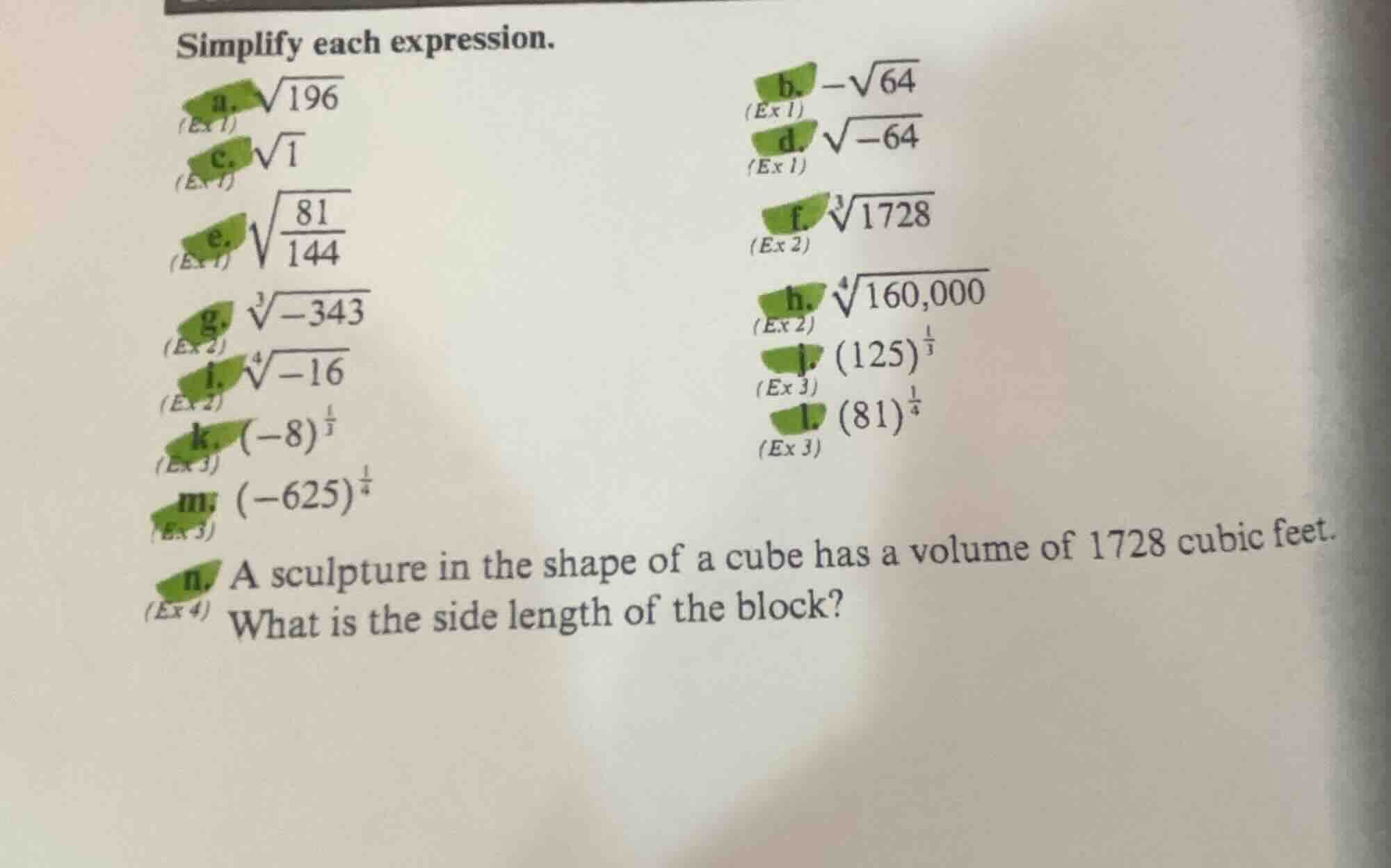
simplify each expression.
a. \\(\sqrt{196}\\)\
b. \\(-\sqrt{64}\\)\
c. \\(\sqrt{1}\\)\
d. \\(\sqrt{-64}\\)\
e. \\(\sqrt{\frac{81}{144}}\\)\
f. \\(\sqrt3{1728}\\)\
g. \\(\sqrt3{-343}\\)\
h. \\(\sqrt4{160000}\\)\
i. \\(\sqrt4{-16}\\)\
j. \\((125)^{\frac{1}{3}}\\)\
k. \\((-8)^{\frac{1}{3}}\\)\
l. \\((81)^{\frac{1}{4}}\\)\
m. \\((-625)^{\frac{1}{4}}\\)\
n. a sculpture in the shape of a cube has a volume of 1728 cubic feet. what is the side length of the block?
Part a: Simplify $\boldsymbol{\sqrt{196}}$
Step1: Recall square of 14
We know that $14\times14 = 196$, so $\sqrt{196}$ is the number whose square is 196.
$\sqrt{196}=\sqrt{14^2}$
Step2: Apply square - root property
For a non - negative real number $a$, $\sqrt{a^2}=a$. Since $14\geq0$, we have $\sqrt{14^2} = 14$.
Step1: Recall square of 8
We know that $8\times8=64$, so $\sqrt{64}=\sqrt{8^2}$.
Step2: Apply square - root property and consider the negative sign
For a non - negative real number $a$, $\sqrt{a^2}=a$. So $\sqrt{8^2} = 8$, and then $-\sqrt{64}=-8$.
Step1: Recall square of 1
We know that $1\times1 = 1$, so $\sqrt{1}=\sqrt{1^2}$.
Step2: Apply square - root property
For a non - negative real number $a$, $\sqrt{a^2}=a$. Since $1\geq0$, $\sqrt{1^2}=1$.

Snap & solve any problem in the app
Get step-by-step solutions on Sovi AI
Photo-based solutions with guided steps
Explore more problems and detailed explanations
$14$