QUESTION IMAGE
Question
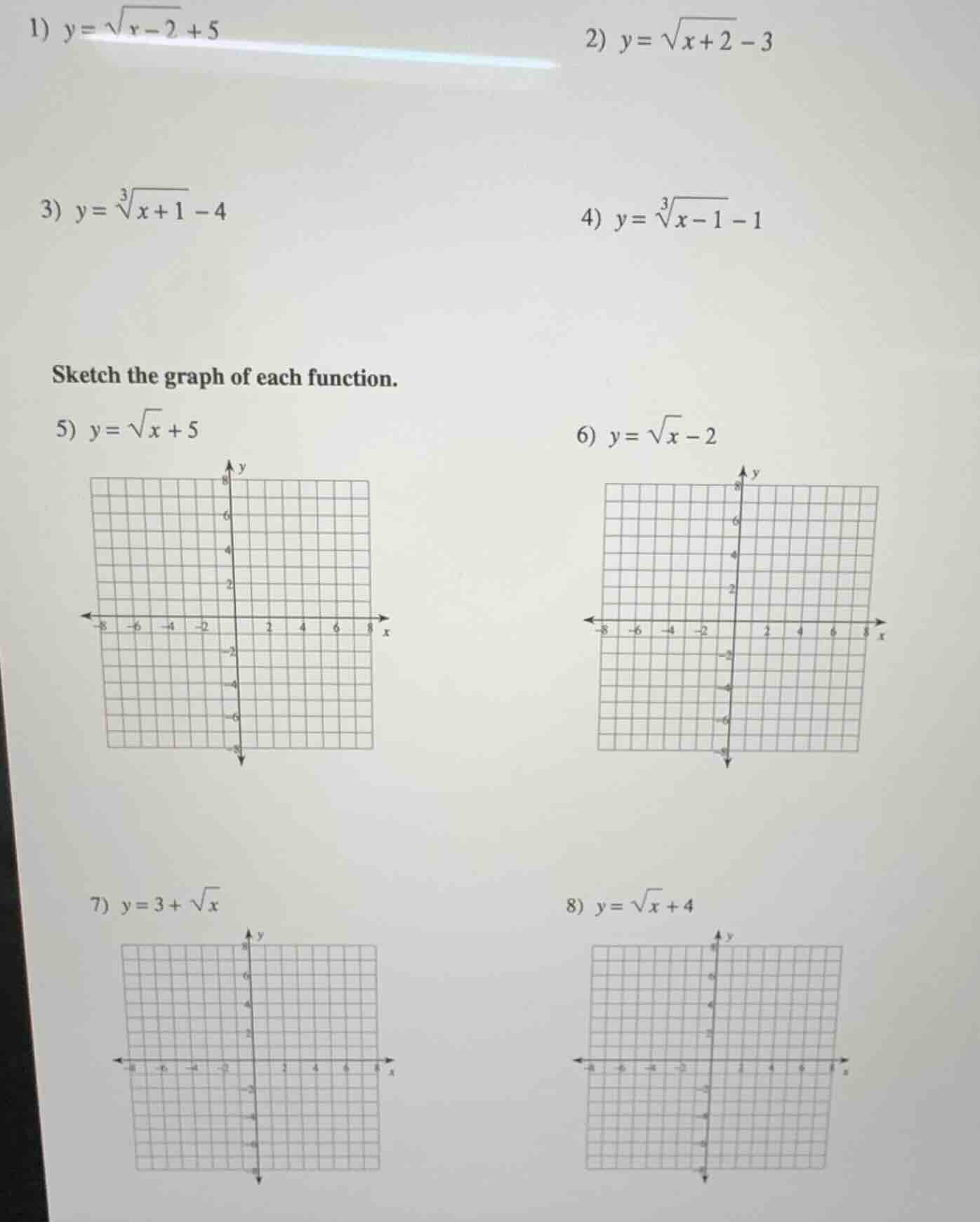
- $y = \sqrt{x - 2} + 5$
- $y = \sqrt{x + 2} - 3$
- $y = \sqrt3{x + 1} - 4$
- $y = \sqrt3{x - 1} - 1$
sketch the graph of each function.
- $y = \sqrt{x} + 5$
- $y = \sqrt{x} - 2$
- $y = 3 + \sqrt{x}$
- $y = \sqrt{x} + 4$
To sketch the graph of each function, we can use the transformation of the parent function \( y = \sqrt{x} \) or \( y = \sqrt[3]{x} \). Here, we'll focus on the square root functions (5 - 8) and cube root functions (1 - 4).
Function 5: \( y = \sqrt{x} + 5 \)
The parent function is \( y = \sqrt{x} \) (domain: \( x \geq 0 \), range: \( y \geq 0 \)).
- Transformation: Vertical shift up by 5 units.
- Key Points:
- For \( x = 0 \): \( y = \sqrt{0} + 5 = 5 \) (point: \( (0, 5) \)).
- For \( x = 1 \): \( y = \sqrt{1} + 5 = 6 \) (point: \( (1, 6) \)).
- For \( x = 4 \): \( y = \sqrt{4} + 5 = 7 \) (point: \( (4, 7) \)).
- Graph: Plot these points and draw a curve starting at \( (0, 5) \) and increasing slowly, matching the shape of \( y = \sqrt{x} \) but shifted up.
Function 6: \( y = \sqrt{x} - 2 \)
Parent function: \( y = \sqrt{x} \).
- Transformation: Vertical shift down by 2 units.
- Key Points:
- For \( x = 0 \): \( y = \sqrt{0} - 2 = -2 \) (point: \( (0, -2) \)).
- For \( x = 1 \): \( y = \sqrt{1} - 2 = -1 \) (point: \( (1, -1) \)).
- For \( x = 4 \): \( y = \sqrt{4} - 2 = 0 \) (point: \( (4, 0) \)).
- Graph: Plot these points and draw a curve starting at \( (0, -2) \) and increasing, similar to \( y = \sqrt{x} \) but shifted down.
Function 7: \( y = 3 + \sqrt{x} \) (or \( y = \sqrt{x} + 3 \))
Parent function: \( y = \sqrt{x} \).
- Transformation: Vertical shift up by 3 units.
- Key Points:
- For \( x = 0 \): \( y = \sqrt{0} + 3 = 3 \) (point: \( (0, 3) \)).
- For \( x = 1 \): \( y = \sqrt{1} + 3 = 4 \) (point: \( (1, 4) \)).
- For \( x = 4 \): \( y = \sqrt{4} + 3 = 5 \) (point: \( (4, 5) \)).
- Graph: Plot these points and draw a curve starting at \( (0, 3) \) and increasing, shifted up from \( y = \sqrt{x} \).
Function 8: \( y = \sqrt{x} + 4 \)
Parent function: \( y = \sqrt{x} \).
- Transformation: Vertical shift up by 4 units.
- Key Points:
- For \( x = 0 \): \( y = \sqrt{0} + 4 = 4 \) (point: \( (0, 4) \)).
- For \( x = 1 \): \( y = \sqrt{1} + 4 = 5 \) (point: \( (1, 5) \)).
- For \( x = 4 \): \( y = \sqrt{4} + 4 = 6 \) (point: \( (4, 6) \)).
- Graph: Plot these points and draw a curve starting at \( (0, 4) \) and increasing, shifted up from \( y = \sqrt{x} \).
Cube Root Functions (1 - 4)
For cube root functions (e.g., \( y = \sqrt[3]{x + 1} - 4 \), \( y = \sqrt[3]{x - 1} - 1 \)):
- The parent function is \( y = \sqrt[3]{x} \) (domain: all real \( x \), range: all real \( y \)).
- Transformations:
- Horizontal shift: \( \sqrt[3]{x - h} \) shifts right by \( h \); \( \sqrt[3]{x + h} \) shifts left by \( h \).
- Vertical shift: \( \sqrt[3]{x} + k \) shifts up by \( k \); \( \sqrt[3]{x} - k \) shifts down by \( k \).
For example, \( y = \sqrt[3]{x + 1} - 4 \):
- Shift \( y = \sqrt[3]{x} \) left by 1 unit, then down by 4 units.
- Key points: \( (-1, -4) \) (vertex), \( (0, -3) \) (since \( \sqrt[3]{0 + 1} - 4 = -3 \)), \( (7, -2) \) (since \( \sqrt[3]{7 + 1} - 4 = 2 - 4 = -2 \)).
General Sketching Tips
- Identify the parent function (square root or cube root).
- Determine horizontal/vertical shifts, stretches, or reflections.
- Plot key points (vertex, intercepts, points from the parent function shifted).
- Draw the curve to match the shape of the parent function, adjusted for transformations.
For the grid graphs (5 - 8), use the provided coordinate planes to plot the key points and draw the curve. For example, for \( y = \sqrt{x} + 5 \), mark \( (0, 5) \), \( (1, 6) \), \( (4, 7) \), and connect th…

Snap & solve any problem in the app
Get step-by-step solutions on Sovi AI
Photo-based solutions with guided steps
Explore more problems and detailed explanations
To sketch the graph of each function, we can use the transformation of the parent function \( y = \sqrt{x} \) or \( y = \sqrt[3]{x} \). Here, we'll focus on the square root functions (5 - 8) and cube root functions (1 - 4).
Function 5: \( y = \sqrt{x} + 5 \)
The parent function is \( y = \sqrt{x} \) (domain: \( x \geq 0 \), range: \( y \geq 0 \)).
- Transformation: Vertical shift up by 5 units.
- Key Points:
- For \( x = 0 \): \( y = \sqrt{0} + 5 = 5 \) (point: \( (0, 5) \)).
- For \( x = 1 \): \( y = \sqrt{1} + 5 = 6 \) (point: \( (1, 6) \)).
- For \( x = 4 \): \( y = \sqrt{4} + 5 = 7 \) (point: \( (4, 7) \)).
- Graph: Plot these points and draw a curve starting at \( (0, 5) \) and increasing slowly, matching the shape of \( y = \sqrt{x} \) but shifted up.
Function 6: \( y = \sqrt{x} - 2 \)
Parent function: \( y = \sqrt{x} \).
- Transformation: Vertical shift down by 2 units.
- Key Points:
- For \( x = 0 \): \( y = \sqrt{0} - 2 = -2 \) (point: \( (0, -2) \)).
- For \( x = 1 \): \( y = \sqrt{1} - 2 = -1 \) (point: \( (1, -1) \)).
- For \( x = 4 \): \( y = \sqrt{4} - 2 = 0 \) (point: \( (4, 0) \)).
- Graph: Plot these points and draw a curve starting at \( (0, -2) \) and increasing, similar to \( y = \sqrt{x} \) but shifted down.
Function 7: \( y = 3 + \sqrt{x} \) (or \( y = \sqrt{x} + 3 \))
Parent function: \( y = \sqrt{x} \).
- Transformation: Vertical shift up by 3 units.
- Key Points:
- For \( x = 0 \): \( y = \sqrt{0} + 3 = 3 \) (point: \( (0, 3) \)).
- For \( x = 1 \): \( y = \sqrt{1} + 3 = 4 \) (point: \( (1, 4) \)).
- For \( x = 4 \): \( y = \sqrt{4} + 3 = 5 \) (point: \( (4, 5) \)).
- Graph: Plot these points and draw a curve starting at \( (0, 3) \) and increasing, shifted up from \( y = \sqrt{x} \).
Function 8: \( y = \sqrt{x} + 4 \)
Parent function: \( y = \sqrt{x} \).
- Transformation: Vertical shift up by 4 units.
- Key Points:
- For \( x = 0 \): \( y = \sqrt{0} + 4 = 4 \) (point: \( (0, 4) \)).
- For \( x = 1 \): \( y = \sqrt{1} + 4 = 5 \) (point: \( (1, 5) \)).
- For \( x = 4 \): \( y = \sqrt{4} + 4 = 6 \) (point: \( (4, 6) \)).
- Graph: Plot these points and draw a curve starting at \( (0, 4) \) and increasing, shifted up from \( y = \sqrt{x} \).
Cube Root Functions (1 - 4)
For cube root functions (e.g., \( y = \sqrt[3]{x + 1} - 4 \), \( y = \sqrt[3]{x - 1} - 1 \)):
- The parent function is \( y = \sqrt[3]{x} \) (domain: all real \( x \), range: all real \( y \)).
- Transformations:
- Horizontal shift: \( \sqrt[3]{x - h} \) shifts right by \( h \); \( \sqrt[3]{x + h} \) shifts left by \( h \).
- Vertical shift: \( \sqrt[3]{x} + k \) shifts up by \( k \); \( \sqrt[3]{x} - k \) shifts down by \( k \).
For example, \( y = \sqrt[3]{x + 1} - 4 \):
- Shift \( y = \sqrt[3]{x} \) left by 1 unit, then down by 4 units.
- Key points: \( (-1, -4) \) (vertex), \( (0, -3) \) (since \( \sqrt[3]{0 + 1} - 4 = -3 \)), \( (7, -2) \) (since \( \sqrt[3]{7 + 1} - 4 = 2 - 4 = -2 \)).
General Sketching Tips
- Identify the parent function (square root or cube root).
- Determine horizontal/vertical shifts, stretches, or reflections.
- Plot key points (vertex, intercepts, points from the parent function shifted).
- Draw the curve to match the shape of the parent function, adjusted for transformations.
For the grid graphs (5 - 8), use the provided coordinate planes to plot the key points and draw the curve. For example, for \( y = \sqrt{x} + 5 \), mark \( (0, 5) \), \( (1, 6) \), \( (4, 7) \), and connect them smoothly.