QUESTION IMAGE
Question
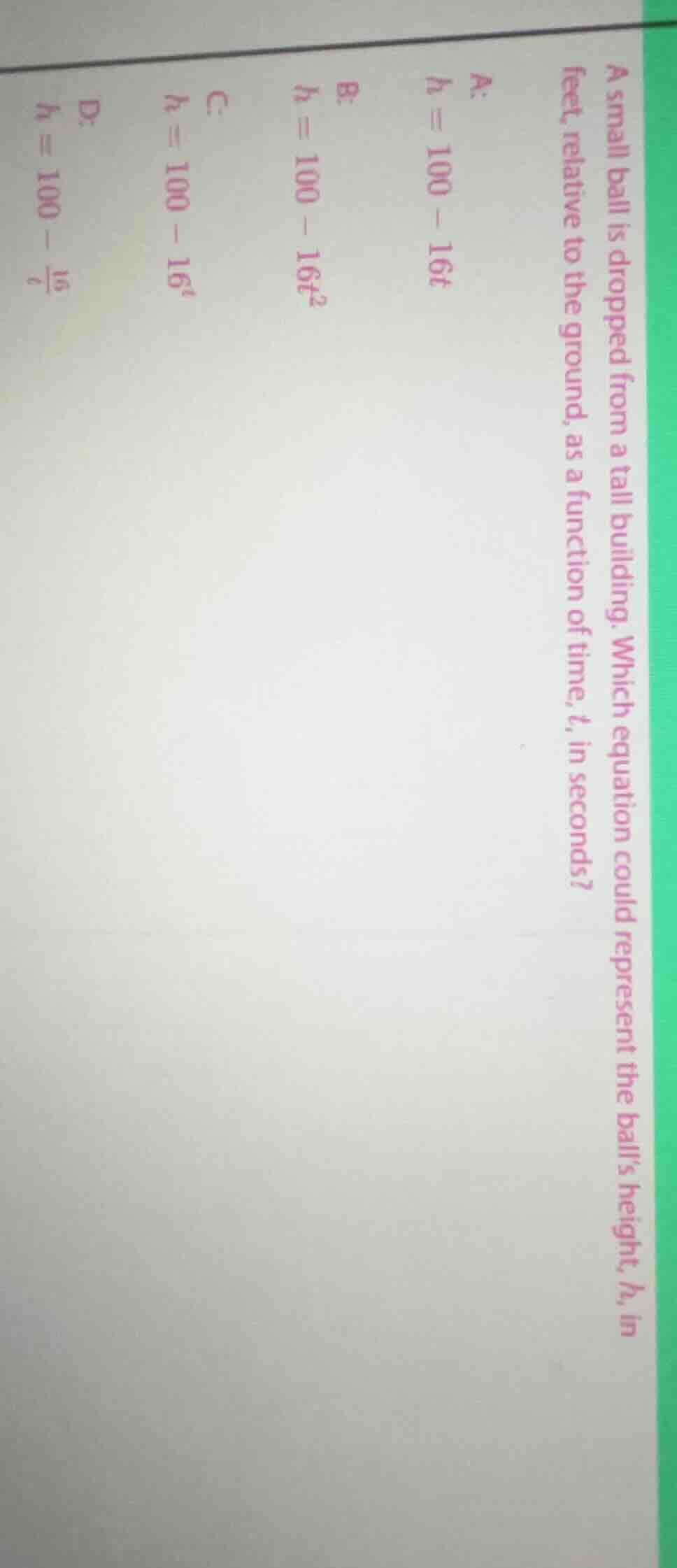
a small ball is dropped from a tall building. which equation could represent the ball’s height, h, in feet, relative to the ground, as a function of time, t, in seconds? a: $h = 100 - 16t$ b: $h = 100 - 16t^{2}$ c: $h = 100 - 16t^{2}$ d: $h = 100 - \frac{16}{t}$
Step1: Recall free - fall motion formula
The height of an object in free - fall (neglecting air resistance) is given by the formula \(h = h_0-\frac{1}{2}gt^2\), where \(h_0\) is the initial height, \(g\) is the acceleration due to gravity, and \(t\) is the time. In the English system, the acceleration due to gravity \(g = 32\space ft/s^2\), so \(\frac{1}{2}g=16\space ft/s^2\).
Step2: Analyze the initial conditions
The ball is dropped from a tall building, so the initial height \(h_0 = 100\) feet (assuming the building is 100 feet tall). The height \(h\) of the ball at time \(t\) should be the initial height minus the distance it has fallen. The distance fallen \(d=\frac{1}{2}gt^2 = 16t^2\) (since \(\frac{1}{2}g = 16\) in the English system). So the height \(h\) as a function of time \(t\) is \(h=100 - 16t^2\).
Let's analyze the other options:
- Option A: \(h = 100-16t\) would be the case if the distance fallen was linear in time (constant velocity), but the ball is in free - fall, so the distance fallen should be quadratic in time (since it's accelerating), so A is incorrect.
- Option D: \(h = 100-\frac{16}{t}\) has a non - physical form for a free - fall motion (the height would increase as \(t\) increases which is not possible), so D is incorrect.
- Option C: The expression \(h = 100 - 16t^2\) (wait, B and C look similar? Wait, maybe a typo, but assuming the correct form is \(h=100 - 16t^2\) (since B and C might have a typo in the original, but the standard free - fall height formula with \(g = 32\) gives \(h=h_0 - 16t^2\) when \(h_0 = 100\)). So the correct equation is \(h = 100-16t^2\) (assuming B and C are the same with a possible typo, and this is the standard free - fall height formula for this situation).

Snap & solve any problem in the app
Get step-by-step solutions on Sovi AI
Photo-based solutions with guided steps
Explore more problems and detailed explanations
B. \(h = 100 - 16t^2\) (or C if B and C are the same, but based on the free - fall formula, this is the correct form)