QUESTION IMAGE
Question
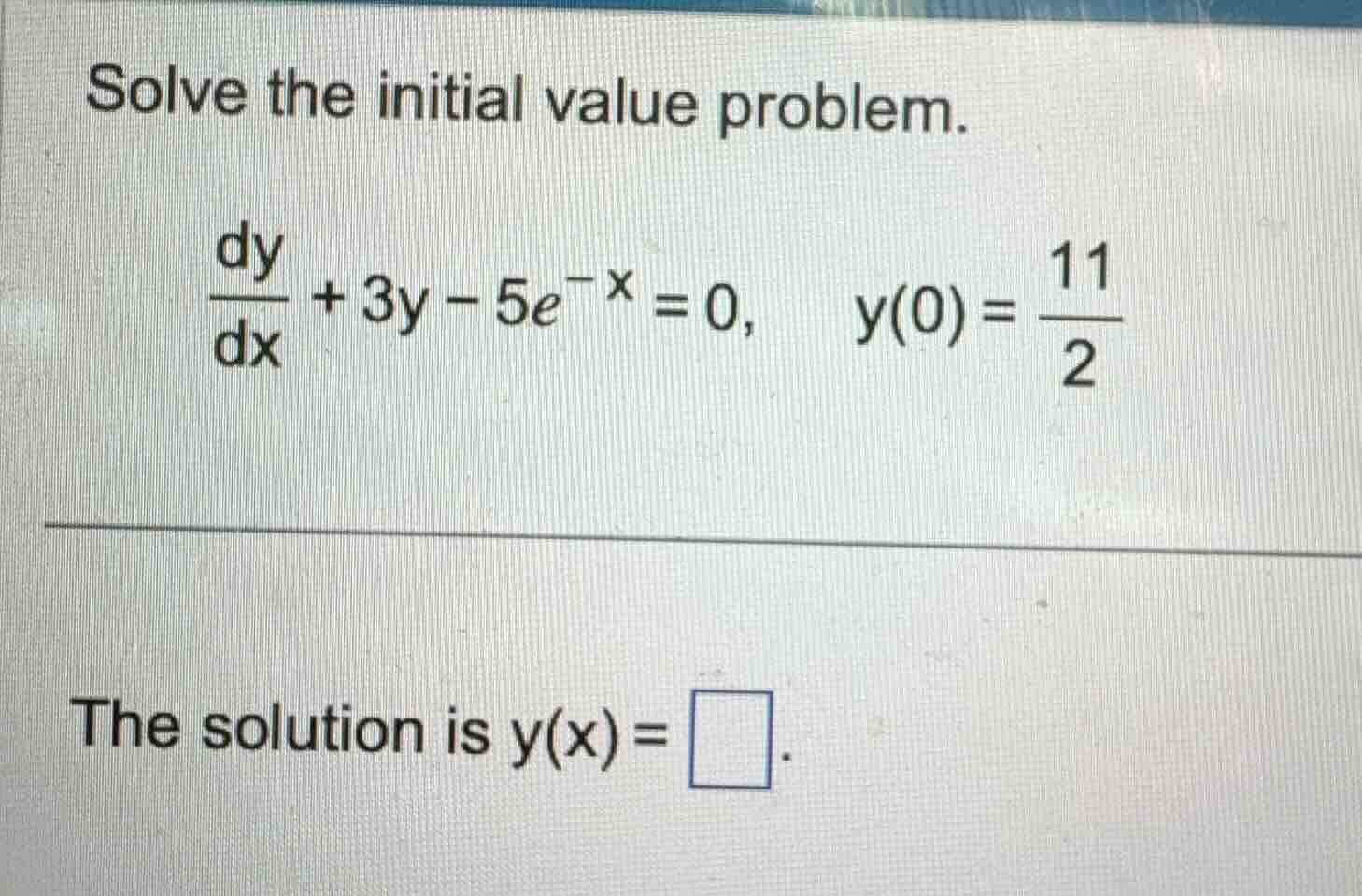
solve the initial value problem.\\(\frac{dy}{dx} + 3y - 5e^{-x} = 0,\quad y(0) = \frac{11}{2}\\)\\(\\)\\(\\)the solution is \\(y(x) = \square\\).
Step1: Rewrite the differential equation
First, rewrite the given differential equation \(\frac{dy}{dx}+3y - 5e^{-x}=0\) in the standard linear differential equation form \(\frac{dy}{dx}+P(x)y = Q(x)\). We get \(\frac{dy}{dx}+3y=5e^{-x}\), where \(P(x) = 3\) and \(Q(x)=5e^{-x}\).
Step2: Find the integrating factor
The integrating factor \(\mu(x)\) for a linear differential equation \(\frac{dy}{dx}+P(x)y = Q(x)\) is given by \(\mu(x)=e^{\int P(x)dx}\). For \(P(x) = 3\), we have \(\int P(x)dx=\int3dx = 3x\), so \(\mu(x)=e^{3x}\).
Step3: Multiply the differential equation by the integrating factor
Multiply the entire differential equation \(\frac{dy}{dx}+3y=5e^{-x}\) by \(e^{3x}\):
\[
e^{3x}\frac{dy}{dx}+3e^{3x}y = 5e^{-x}\cdot e^{3x}
\]
The left - hand side is the derivative of the product \(\mu(x)y\) by the product rule, i.e., \(\frac{d}{dx}(e^{3x}y)\). The right - hand side simplifies to \(5e^{2x}\) (since \(e^{a}\cdot e^{b}=e^{a + b}\), so \(e^{-x}\cdot e^{3x}=e^{2x}\)). So we have \(\frac{d}{dx}(e^{3x}y)=5e^{2x}\).
Step4: Integrate both sides
Integrate both sides with respect to \(x\):
\[
\int\frac{d}{dx}(e^{3x}y)dx=\int5e^{2x}dx
\]
The left - hand side integrates to \(e^{3x}y\). For the right - hand side, \(\int5e^{2x}dx = 5\cdot\frac{1}{2}e^{2x}+C=\frac{5}{2}e^{2x}+C\) (using the formula \(\int e^{ax}dx=\frac{1}{a}e^{ax}+C\) for \(a = 2\)). So we have \(e^{3x}y=\frac{5}{2}e^{2x}+C\).
Step5: Solve for \(y\)
Divide both sides by \(e^{3x}\) to solve for \(y\):
\[
y=\frac{\frac{5}{2}e^{2x}+C}{e^{3x}}=\frac{5}{2}e^{-x}+Ce^{-3x}
\]
Step6: Apply the initial condition
We are given the initial condition \(y(0)=\frac{11}{2}\). Substitute \(x = 0\) and \(y=\frac{11}{2}\) into the equation \(y=\frac{5}{2}e^{-x}+Ce^{-3x}\):
\[
\frac{11}{2}=\frac{5}{2}e^{0}+Ce^{0}
\]
Since \(e^{0}=1\), the equation becomes \(\frac{11}{2}=\frac{5}{2}+C\). Subtract \(\frac{5}{2}\) from both sides: \(C=\frac{11}{2}-\frac{5}{2}=\frac{11 - 5}{2}=3\).
Step7: Write the final solution
Substitute \(C = 3\) back into the equation for \(y\):
\[
y(x)=\frac{5}{2}e^{-x}+3e^{-3x}
\]

Snap & solve any problem in the app
Get step-by-step solutions on Sovi AI
Photo-based solutions with guided steps
Explore more problems and detailed explanations
\(y(x)=\frac{5}{2}e^{-x}+3e^{-3x}\)