QUESTION IMAGE
Question
solving systems of equations
by graphing\t\t\t\t\tname:
\t\t\t\t\t\t\t\t\t\t\tdate:
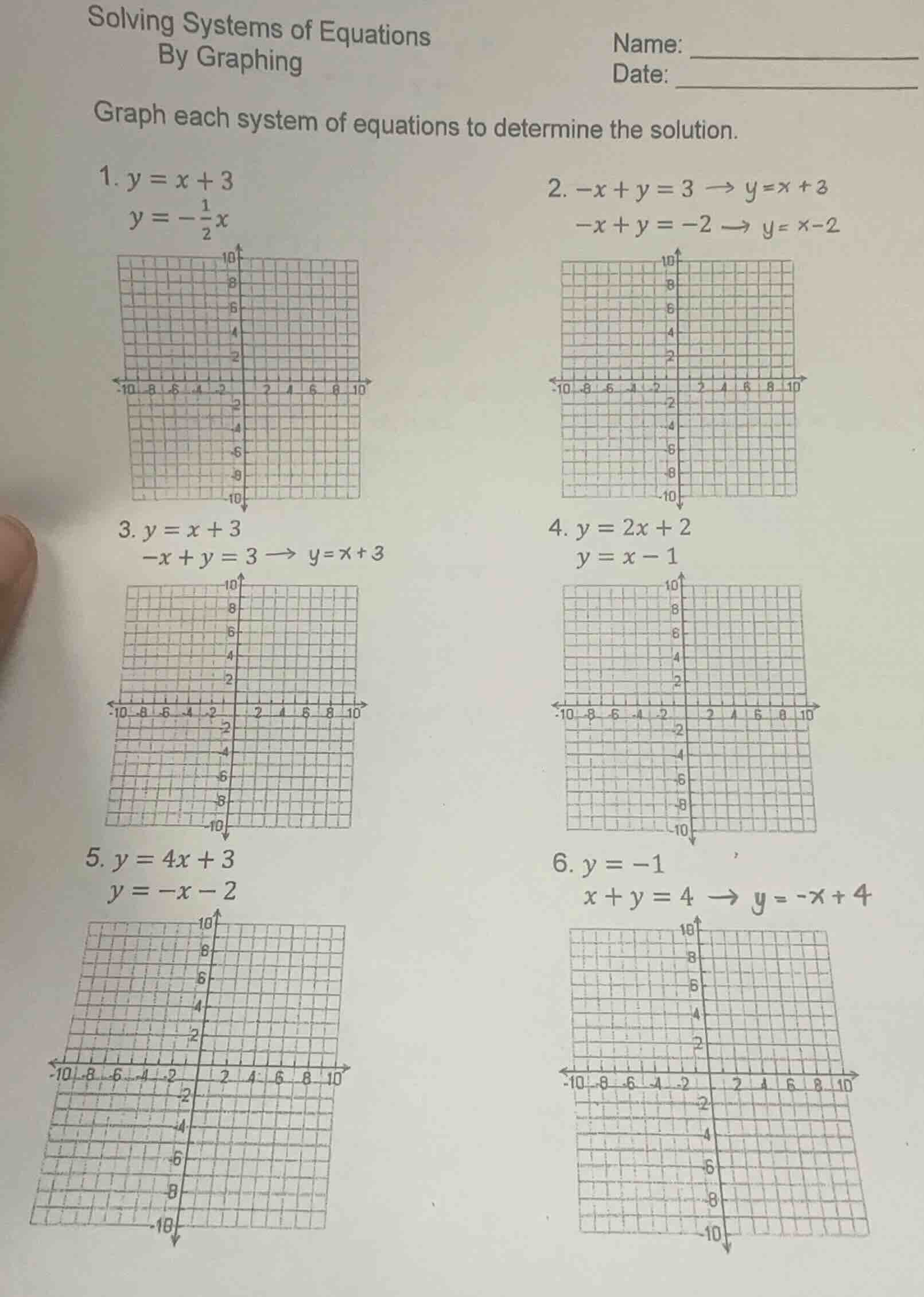
graph each system of equations to determine the solution.
- $y = x + 3$
$y = -\frac{1}{2}x$
- $-x + y = 3 \
ightarrow y = x + 3$
$-x + y = -2 \
ightarrow y = x - 2$
- $y = x + 3$
$-x + y = 3 \
ightarrow y = x + 3$
- $y = 2x + 2$
$y = x - 1$
- $y = 4x + 3$
$y = -x - 2$
- $y = -1$
$x + y = 4 \
ightarrow y = -x + 4$
Problem 1:
Step1: Analyze the first equation \( y = x + 3 \)
This is a linear equation in slope - intercept form (\( y=mx + b \)) with slope \( m = 1 \) and y - intercept \( b = 3 \). To graph it, we can start by plotting the y - intercept at \( (0,3) \). Then, using the slope (rise over run = 1/1), we can find another point. From \( (0,3) \), moving 1 unit up and 1 unit to the right gives us the point \( (1,4) \).
Step2: Analyze the second equation \( y=-\frac{1}{2}x \)
This is also a linear equation in slope - intercept form with slope \( m=-\frac{1}{2} \) and y - intercept \( b = 0 \) (since when \( x = 0 \), \( y = 0 \)). To graph it, we start at the origin \( (0,0) \). Using the slope (rise over run=- 1/2), from \( (0,0) \), moving 1 unit down and 2 units to the right gives us the point \( (2,-1) \), or 1 unit up and 2 units to the left gives us the point \( (-2,1) \).
Step3: Find the intersection point
The solution to the system of equations is the point where the two lines intersect. By graphing the two lines, we can see that they intersect at \( x=-2 \) and \( y = 1 \). We can also solve it algebraically to verify:
Set \( x + 3=-\frac{1}{2}x \)
Add \( \frac{1}{2}x \) to both sides: \( x+\frac{1}{2}x+3=0 \)
Combine like terms: \( \frac{3}{2}x+3 = 0 \)
Subtract 3 from both sides: \( \frac{3}{2}x=-3 \)
Multiply both sides by \( \frac{2}{3} \): \( x=-2 \)
Substitute \( x = - 2 \) into \( y=x + 3 \), we get \( y=-2 + 3=1 \)
Step1: Analyze the first equation \( y=x + 3 \)
Slope - intercept form with slope \( m = 1 \) and y - intercept \( b = 3 \). Plot the y - intercept at \( (0,3) \), and use the slope to find other points (e.g., \( (1,4) \)).
Step2: Analyze the second equation \( y=x - 2 \)
Slope - intercept form with slope \( m = 1 \) and y - intercept \( b=-2 \). Plot the y - intercept at \( (0,-2) \), and use the slope to find other points (e.g., \( (1,-1) \)).
Step3: Determine the relationship between the lines
Since the two lines have the same slope (\( m = 1 \)) but different y - intercepts (\( 3
eq - 2 \)), the lines are parallel. Parallel lines never intersect, so there is no solution.
Step1: Analyze the first equation \( y=x + 3 \)
Slope - intercept form with slope \( m = 1 \) and y - intercept \( b = 3 \).
Step2: Analyze the second equation \( y=x + 3 \)
This is the same as the first equation. So, the two equations represent the same line.
Step3: Determine the solution
When two equations represent the same line, there are infinitely many solutions (all the points on the line \( y=x + 3 \)).

Snap & solve any problem in the app
Get step-by-step solutions on Sovi AI
Photo-based solutions with guided steps
Explore more problems and detailed explanations
The solution is \( (-2,1) \)