QUESTION IMAGE
Question
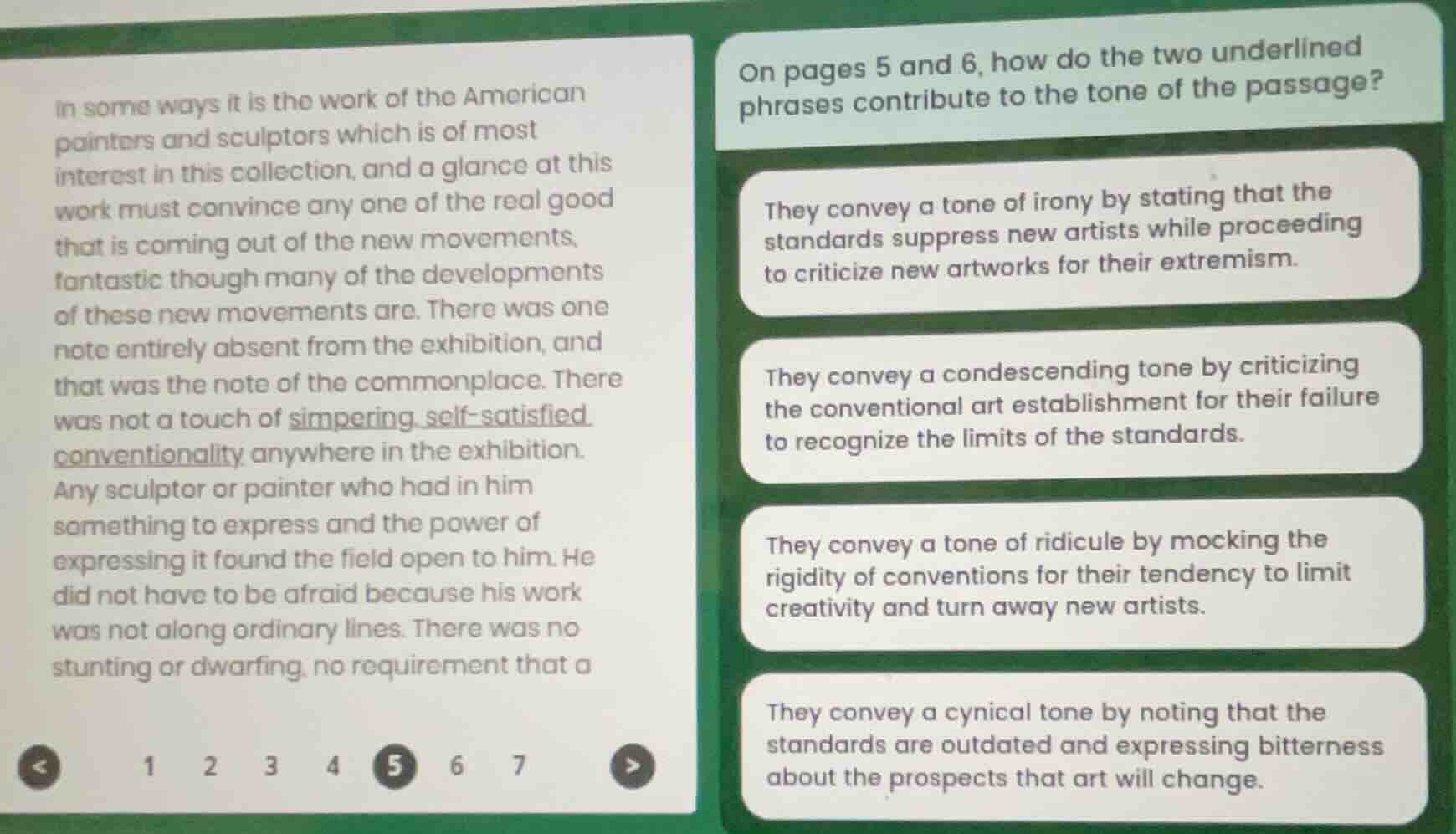
in some ways it is the work of the american painters and sculptors which is of most interest in this collection, and a glance at this work must convince any one of the real good that is coming out of the new movements, fantastic though many of the developments of these new movements are. there was one note entirely absent from the exhibition, and that was the note of the commonplace. there was not a touch of simpering, self - satisfied conventionality anywhere in the exhibition. any sculptor or painter who had in him something to express and the power of expressing it found the field open to him. he did not have to be afraid because his work was not along ordinary lines. there was no stunting or dwarfing, no requirement that a
on pages 5 and 6, how do the two underlined phrases contribute to the tone of the passage?
they convey a tone of irony by stating that the standards suppress new artists while proceeding to criticize new artworks for their extremism.
they convey a condescending tone by criticizing the conventional art establishment for their failure to recognize the limits of the standards.
they convey a tone of ridicule by mocking the rigidity of conventions for their tendency to limit creativity and turn away new artists.
they convey a cynical tone by noting that the standards are outdated and expressing bitterness about the prospects that art will change.
The underlined phrase "simpering, self-satisfied" is used to describe conventionality that is entirely absent from the exhibition of new American art movements. The passage frames this conventionality as a negative, closed-minded force, while the new art space is open to creative expression. The phrase mocks the rigid, uncreative nature of traditional artistic conventions, which aligns with conveying a tone of ridicule for their limiting effect on creativity and exclusion of new artists. The other options do not fit: there is no irony about suppressing artists while criticizing extremism, no condescension toward the establishment's failure to recognize limits, and no cynical bitterness about art's inability to change.

Snap & solve any problem in the app
Get step-by-step solutions on Sovi AI
Photo-based solutions with guided steps
Explore more problems and detailed explanations
They convey a tone of ridicule by mocking the rigidity of conventions for their tendency to limit creativity and turn away new artists.