QUESTION IMAGE
Question
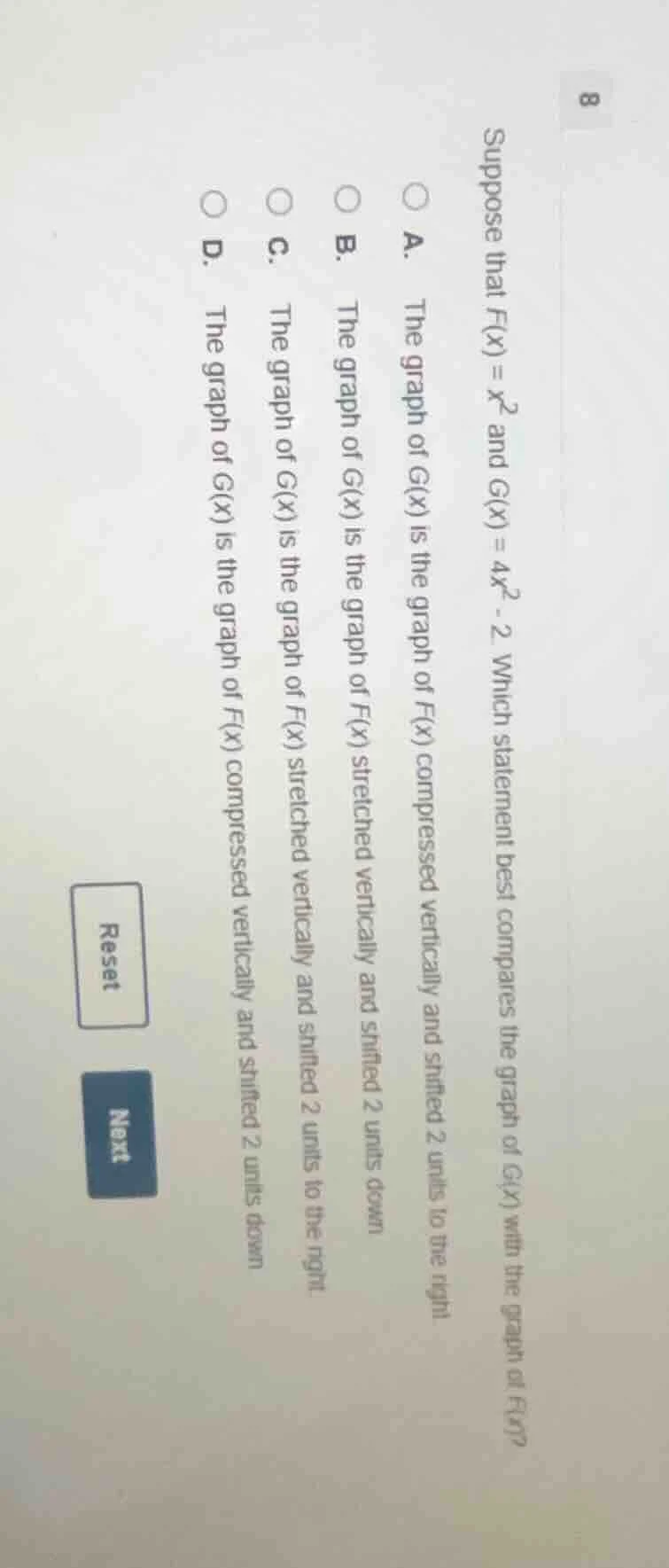
suppose that ( f(x) = x^2 ) and ( g(x) = 4x^2 - 2 ). which statement best compares the graph of ( g(x) ) with the graph of ( f(x) )?
a. the graph of ( g(x) ) is the graph of ( f(x) ) compressed vertically and shifted 2 units to the right.
b. the graph of ( g(x) ) is the graph of ( f(x) ) stretched vertically and shifted 2 units down.
c. the graph of ( g(x) ) is the graph of ( f(x) ) stretched vertically and shifted 2 units to the right.
d. the graph of ( g(x) ) is the graph of ( f(x) ) compressed vertically and shifted 2 units down.
Step1: Analyze vertical stretch/compression
For a function \( y = a f(x) \), if \( |a|>1 \), the graph of \( f(x) \) is vertically stretched by a factor of \( a \). Here, \( F(x)=x^{2} \) and \( G(x) = 4x^{2}-2 \). Comparing the coefficients of \( x^{2} \), \( a = 4>1 \), so the graph of \( F(x) \) is vertically stretched by a factor of 4 to get the \( 4x^{2} \) part.
Step2: Analyze vertical shift
For a function \( y = f(x)+k \), if \( k<0 \), the graph is shifted down by \( |k| \) units. In \( G(x)=4x^{2}-2 \), we have \( k=-2 \), so the graph is shifted down by 2 units.
Step3: Evaluate options
- Option A: Talks about compression and right shift. But we have stretch (not compression) and down shift (not right shift). Eliminate A.
- Option B: Vertical stretch (since \( 4 > 1 \)) and shift down by 2 units (because of \( - 2 \)). This matches.
- Option C: Talks about right shift, but there is no horizontal shift (the \( x \) term is not in the form \( (x - h) \)). Eliminate C.
- Option D: Talks about compression, but we have stretch. Eliminate D.

Snap & solve any problem in the app
Get step-by-step solutions on Sovi AI
Photo-based solutions with guided steps
Explore more problems and detailed explanations
B. The graph of \( G(x) \) is the graph of \( F(x) \) stretched vertically and shifted 2 units down