QUESTION IMAGE
Question
svlc algebra iii - standard (15261)
exponential growth functions
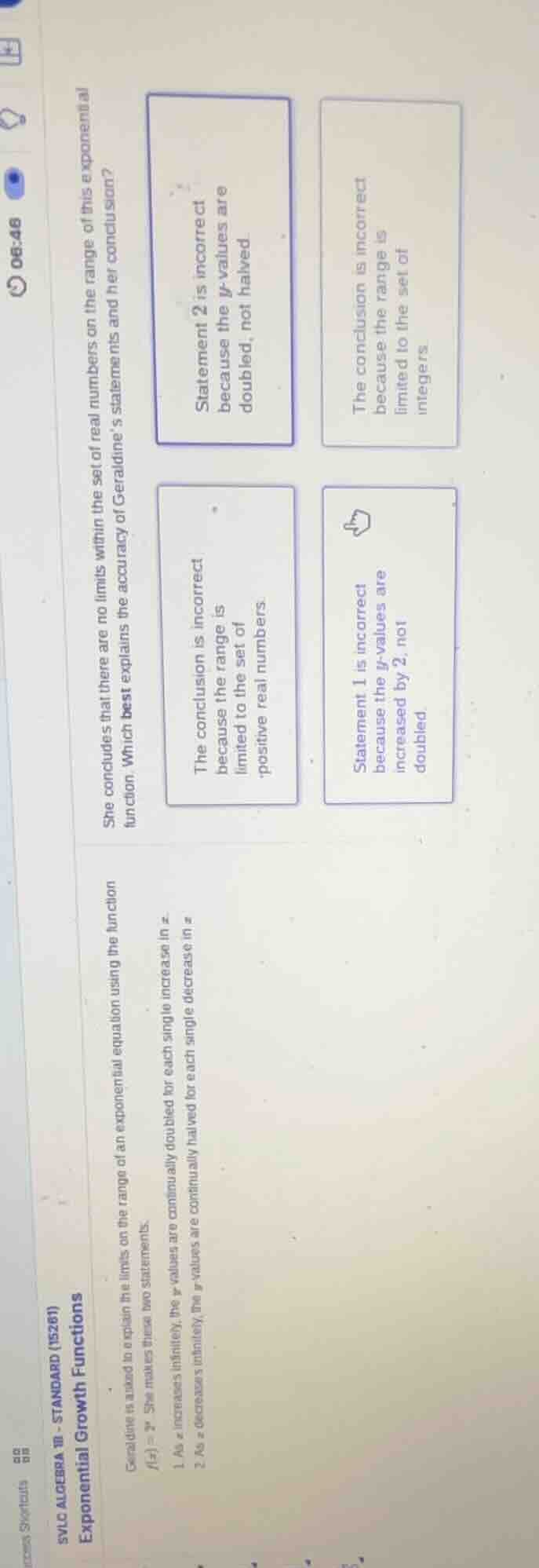
geraldine is asked to explain the limits on the range of an exponential equation using the function
$f(x)=2^x$. she makes these two statements.
- as $x$ increases infinitely, the $y$-values are continually doubled for each single increase in $x$.
- as $x$ decreases infinitely, the $y$-values are continually halved for each single decrease in $x$.
she concludes that there are no limits within the set of real numbers on the range of this exponential function. which best explains the accuracy of geraldines statements and her conclusion?
statement 1 is incorrect
because the $y$-values are
increased by 2, not
doubled
the conclusion is incorrect
because the range is
limited to the set of
positive real numbers
statement 2 is incorrect
because the $y$-values are
doubled, not halved
the conclusion is incorrect
because the range is
limited to the set of
integers
Step1: Analyze Geraldine's conclusion
Geraldine claims the exponential function \(f(x)=2^x\) has no range limits over real numbers. For \(f(x)=2^x\), any real \(x\) gives \(2^x > 0\), so the range is positive reals, not all reals.
Step2: Evaluate Statement 1
Statement 1 says "as \(x\) increases infinitely, \(y\)-values are doubled per single increase in \(x\)". For \(f(x)=2^x\), \(f(x+1)=2^{x+1}=2\times2^x=2f(x)\), so \(y\)-values double when \(x\) increases by 1. This statement is correct, so the claim that it is incorrect is wrong.
Step3: Evaluate Statement 2
Statement 2 says "as \(x\) decreases infinitely, \(y\)-values are halved per single decrease in \(x\)". For \(f(x)=2^x\), \(f(x-1)=2^{x-1}=\frac{2^x}{2}=\frac{f(x)}{2}\), so \(y\)-values are halved when \(x\) decreases by 1. This statement is correct, so the claim that it is incorrect is wrong.
Step4: Match to correct critique
The error in Geraldine's conclusion is that she ignores the range is limited to positive real numbers, not all real numbers.

Snap & solve any problem in the app
Get step-by-step solutions on Sovi AI
Photo-based solutions with guided steps
Explore more problems and detailed explanations
The conclusion is incorrect because the range is limited to the set of positive real numbers.