QUESTION IMAGE
Question
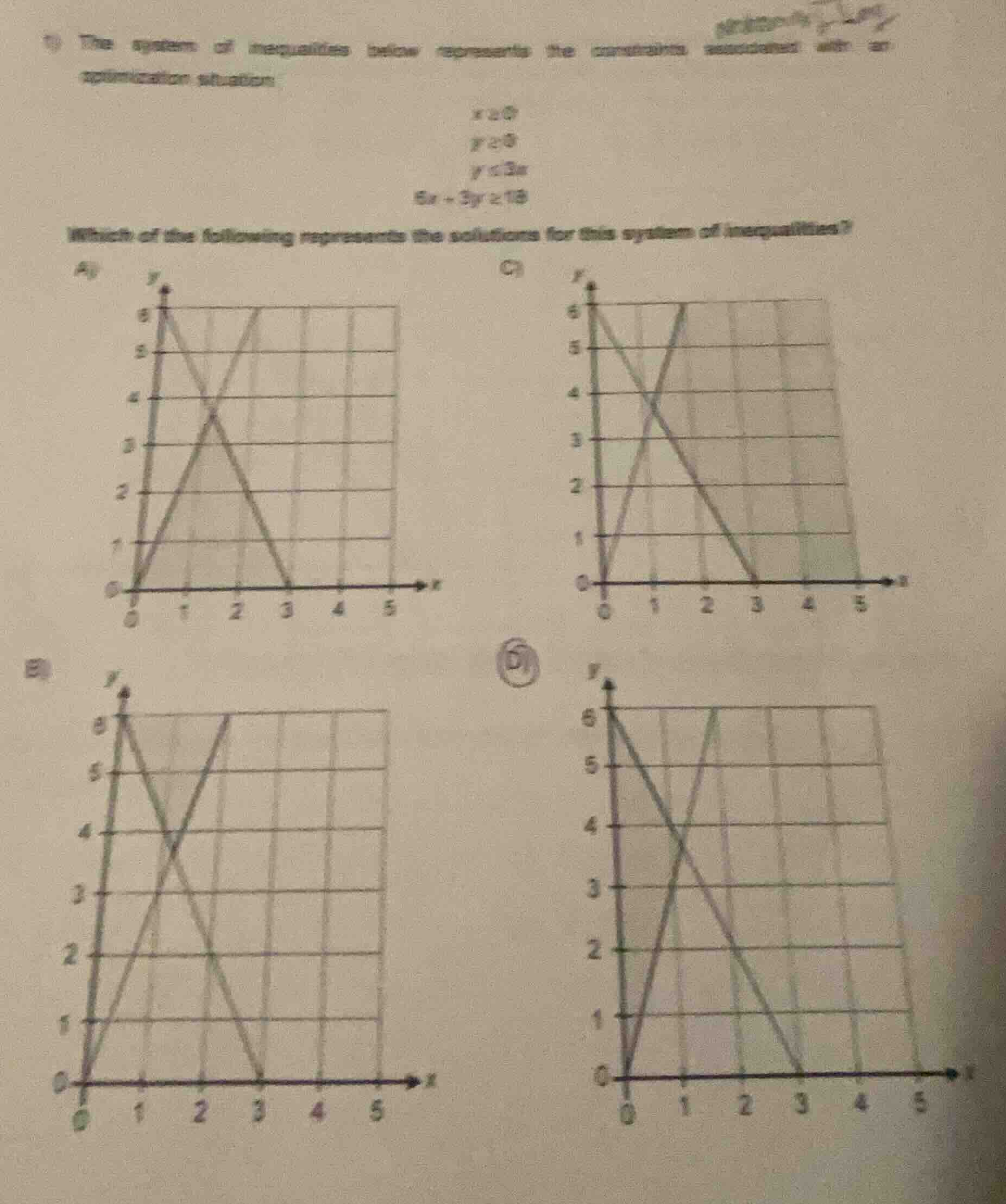
- the system of inequalities below represents the constraints associated with an optimization situation
$x \geq 0$
$y \geq 0$
$y \leq 3x$
$5x + 3y \leq 18$
which of the following represents the solutions for this system of inequalities?
a) graph
c) graph
b) graph
d) graph
Step1: Analyze \(x\geq0\) and \(y\geq0\)
The inequalities \(x\geq0\) and \(y\geq0\) mean the solution region is in the first quadrant (where both \(x\) and \(y\) are non - negative). All the given graphs have this property, so we move to the next inequality.
Step2: Analyze \(y\leq3x\)
The line \(y = 3x\) passes through the origin \((0,0)\) with a slope of \(3\). The inequality \(y\leq3x\) represents the region below (or on) the line \(y = 3x\). Let's check a point, say \((1,0)\): \(0\leq3\times1=3\), which is true. For the line \(y = 3x\), when \(x = 1\), \(y=3\); when \(x = 2\), \(y = 6\) (but we will also consider the next inequality).
Step3: Analyze \(5x + 3y\leq18\)
First, rewrite the inequality as an equation \(5x+3y = 18\) to find its intercepts.
- When \(x = 0\), \(3y=18\), so \(y = 6\). So the \(y\) - intercept is \((0,6)\).
- When \(y = 0\), \(5x=18\), so \(x=\frac{18}{5}=3.6\). But in the given graphs, the \(x\) - intercept of the line \(5x + 3y=18\) (or the boundary of \(5x + 3y\leq18\)) seems to be at \(x = 3\) (from the graphs). Wait, maybe we made a mistake. Let's solve \(5x+3y = 18\) for \(y\): \(y=\frac{18 - 5x}{3}=6-\frac{5}{3}x\). The slope of this line is \(-\frac{5}{3}\).
Now, let's check the intersection of \(y = 3x\) and \(5x+3y=18\). Substitute \(y = 3x\) into \(5x + 3y=18\):
\[
\]
Now, let's analyze each graph:
- For the line \(y = 3x\), the region \(y\leq3x\) should be below the line with slope \(3\).
- For the line \(5x + 3y=18\) (or \(y = 6-\frac{5}{3}x\)), the region \(5x + 3y\leq18\) is below this line.
Looking at the graphs, we need to find the region that is below \(y = 3x\) and below \(y=6-\frac{5}{3}x\) in the first quadrant.
Let's check the intercepts of \(5x + 3y = 18\): when \(x = 0\), \(y = 6\); when \(y = 0\), \(x=\frac{18}{5}=3.6\). But in the given options, the line \(5x + 3y = 18\) (the boundary) intersects the \(x\) - axis at \(x = 3\) (from the visual of the graphs). Wait, maybe there is a scaling issue. But from the graphs, the correct region should be the one where the intersection of the two non - axis lines and the axes encloses the region that satisfies all three inequalities.
Looking at the graphs, option D (the one with the circle) has the correct region:
- The line \(y = 3x\) (passing through the origin with a steep slope) and the line \(5x + 3y=18\) (with \(y\) - intercept \(6\) and \(x\) - intercept around \(3\)) enclose a region in the first quadrant that is below \(y = 3x\) and below \(5x + 3y = 18\).

Snap & solve any problem in the app
Get step-by-step solutions on Sovi AI
Photo-based solutions with guided steps
Explore more problems and detailed explanations
D (the graph with the circle, representing the region that satisfies \(x\geq0\), \(y\geq0\), \(y\leq3x\), and \(5x + 3y\leq18\))