QUESTION IMAGE
Question
transformations of the quadratic parent function translations
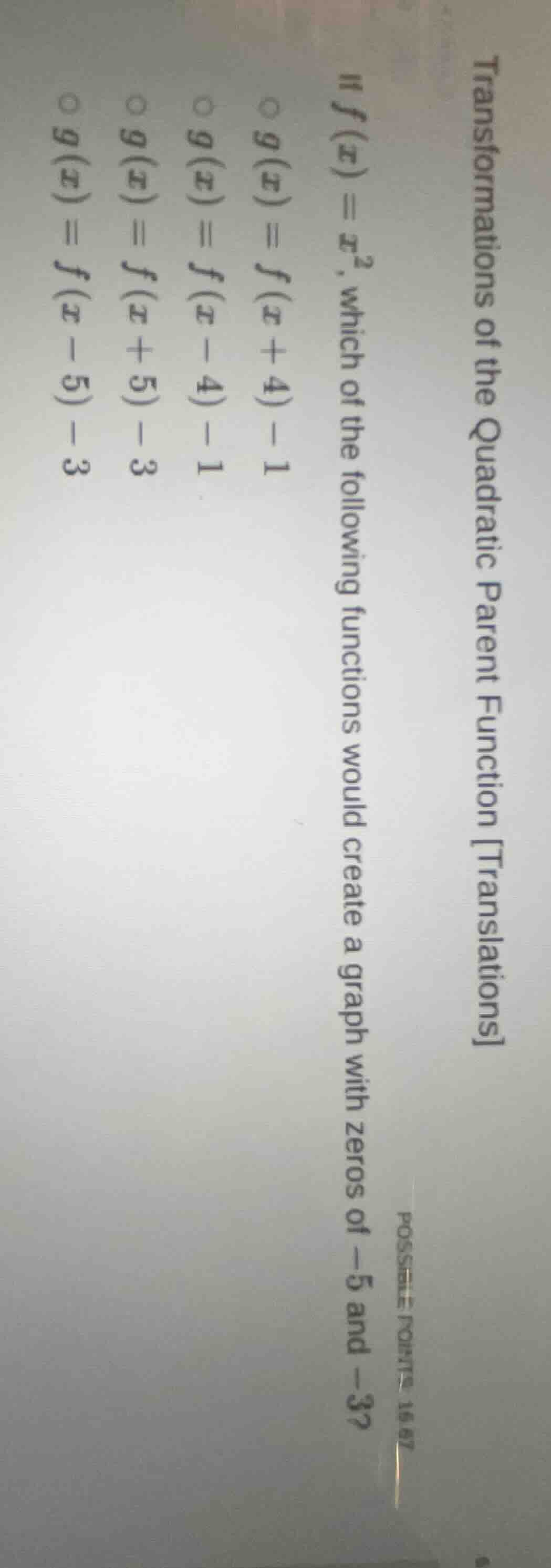
if ( f(x) = x^2 ), which of the following functions would create a graph with zeros of -5 and -3?
( circ ) ( g(x) = f(x + 4) - 1 )
( circ ) ( g(x) = f(x - 4) - 1 )
( circ ) ( g(x) = f(x + 5) - 3 )
( circ ) ( g(x) = f(x - 5) - 3 )
Step1: Recall the zero - transformation relation
If a function \(y = f(x)\) has a zero at \(x = a\), then the function \(y=f(x - a)\) has a zero at \(x = 0\) shifted to \(x=a\). For a quadratic function with zeros at \(x=- 5\) and \(x = - 3\), the factored form of the quadratic function \(g(x)\) should be \(g(x)=(x + 5)(x+3)\) (since if \(x=-5\), then \(x + 5=0\); if \(x=-3\), then \(x + 3=0\)). We know that \(f(x)=x^{2}\), and we want to find \(g(x)\) in terms of \(f(x)\) using transformations.
First, expand \((x + 5)(x + 3)=x^{2}+8x + 15\). But we can also think in terms of function transformations. The parent function \(f(x)=x^{2}\) has a vertex at \((0,0)\). The function with zeros at \(x=-5\) and \(x=-3\) has its vertex at \(x=\frac{-5+( - 3)}{2}=-4\) (the axis of symmetry of a quadratic function \(ax^{2}+bx + c\) is \(x =-\frac{b}{2a}\), for \((x + 5)(x + 3)=x^{2}+8x + 15\), \(a = 1\), \(b = 8\), so \(x=-\frac{8}{2}=-4\)) and \(y=f(-4)=(-4)^{2}=16\)? Wait, no, let's use the transformation rules.
The general form of a horizontal shift is \(f(x - h)\) which shifts the graph of \(f(x)\) \(h\) units to the right if \(h>0\) and \(|h|\) units to the left if \(h < 0\), and vertical shift is \(f(x)+k\) which shifts the graph \(k\) units up if \(k>0\) and \(|k|\) units down if \(k < 0\).
We know that \(f(x)=x^{2}\), and we want to find \(g(x)\) such that \(g(x)\) has zeros at \(x=-5\) and \(x=-3\). Let's find the equation of \(g(x)\) in terms of \(f(x)\).
If \(g(x)=f(x + 4)-1\), then \(g(x)=(x + 4)^{2}-1=x^{2}+8x+16 - 1=x^{2}+8x + 15=(x + 5)(x + 3)\), which has zeros at \(x=-5\) and \(x=-3\) (since when \(x=-5\), \((-5 + 5)(-5+3)=0\times(-2)=0\); when \(x=-3\), \((-3 + 5)(-3 + 3)=2\times0 = 0\)).
Let's check each option:
- Option 1: \(g(x)=f(x + 4)-1=(x + 4)^{2}-1=x^{2}+8x+16 - 1=x^{2}+8x + 15=(x + 5)(x + 3)\), zeros at \(x=-5\) and \(x=-3\).
- Option 2: \(g(x)=f(x - 4)-1=(x - 4)^{2}-1=x^{2}-8x + 16-1=x^{2}-8x + 15=(x - 3)(x - 5)\), zeros at \(x = 3\) and \(x = 5\), not what we want.
- Option 3: \(g(x)=f(x + 5)-3=(x + 5)^{2}-3=x^{2}+10x+25 - 3=x^{2}+10x + 22\), the discriminant \(\Delta=10^{2}-4\times1\times22=100 - 88 = 12\), roots are \(x=\frac{-10\pm\sqrt{12}}{2}=-5\pm\sqrt{3}\), not \(-5\) and \(-3\).
- Option 4: \(g(x)=f(x - 5)-3=(x - 5)^{2}-3=x^{2}-10x + 25-3=x^{2}-10x + 22\), discriminant \(\Delta=(-10)^{2}-4\times1\times22=100 - 88 = 12\), roots are \(x=\frac{10\pm\sqrt{12}}{2}=5\pm\sqrt{3}\), not \(-5\) and \(-3\).
Step2: Confirm the correct transformation
We found that \(g(x)=f(x + 4)-1\) gives the quadratic function with zeros at \(x=-5\) and \(x=-3\) because when we expand \(g(x)=(x + 4)^{2}-1=x^{2}+8x + 15=(x + 5)(x + 3)\), and setting \(g(x)=0\) gives \(x=-5\) or \(x=-3\).

Snap & solve any problem in the app
Get step-by-step solutions on Sovi AI
Photo-based solutions with guided steps
Explore more problems and detailed explanations
A. \(g(x)=f(x + 4)-1\)