QUESTION IMAGE
Question
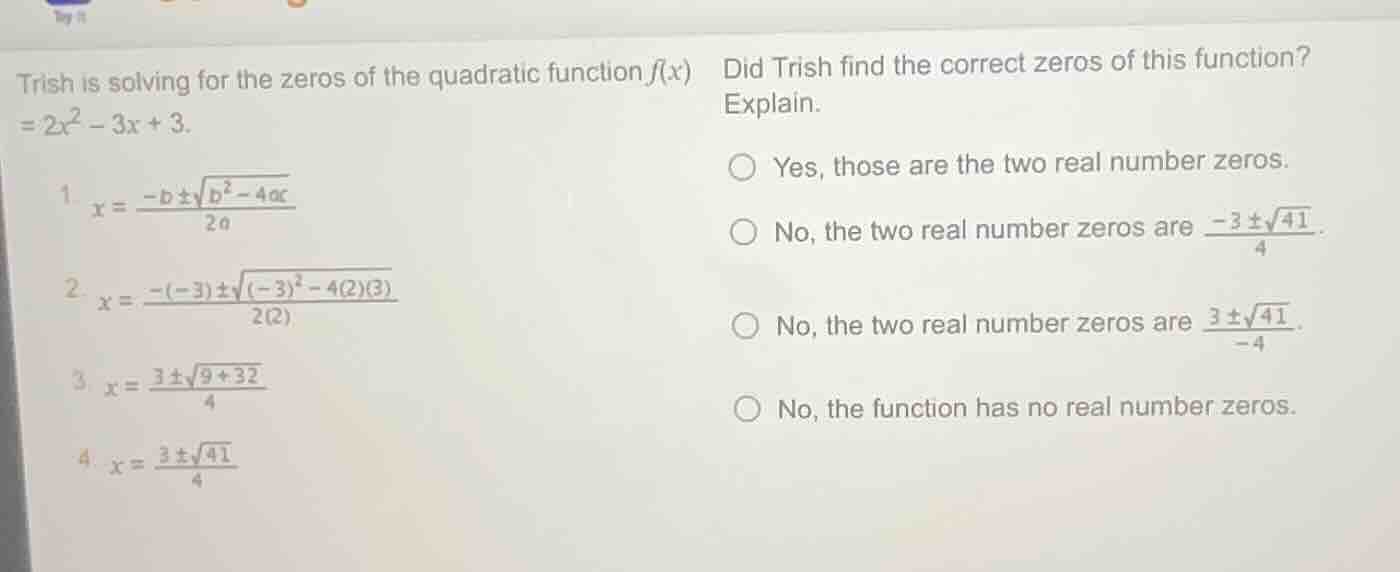
trish is solving for the zeros of the quadratic function $f(x) = 2x^2 - 3x + 3$.
1 $x = \frac{-b \pm \sqrt{b^2 - 4ac}}{2a}$
2 $x = \frac{-(-3) \pm \sqrt{(-3)^2 - 4(2)(3)}}{2(2)}$
3 $x = \frac{3 \pm \sqrt{9 + 32}}{4}$
4 $x = \frac{3 \pm \sqrt{41}}{4}$
did trish find the correct zeros of this function? explain.
\bigcirc yes, those are the two real number zeros.
\bigcirc no, the two real number zeros are $\frac{-3 \pm \sqrt{41}}{4}$.
\bigcirc no, the two real number zeros are $\frac{3 \pm \sqrt{41}}{-4}$.
\bigcirc no, the function has no real number zeros.
Step1: Recall discriminant formula
For quadratic \(ax^2 + bx + c\), discriminant \(D = b^2 - 4ac\). Here, \(a = 2\), \(b = -3\), \(c = 3\).
\[
D = (-3)^2 - 4(2)(3) = 9 - 24 = -15
\]
Wait, no—wait, Trish's step 2: she used \(b=-3\)? Wait, original function \(f(x)=2x^2 - 3x + 3\), so \(a = 2\), \(b=-3\), \(c = 3\). Wait, no, in quadratic formula, \(x=\frac{-b\pm\sqrt{b^2 - 4ac}}{2a}\). So \(b\) here is \(-3\)? Wait, no: \(2x^2 - 3x + 3\), so \(b=-3\)? Wait, no, standard form is \(ax^2 + bx + c\), so \(b\) is the coefficient of \(x\), which is \(-3\). Wait, but let's recalculate discriminant: \(b^2 - 4ac = (-3)^2 - 4(2)(3)=9 - 24 = -15\)? Wait, no, Trish's step 2: she wrote \(\sqrt{(-3)^2 - 4(2)(3)}\), but that's \(9 - 24 = -15\), but she in step 3 wrote \(9 + 32\), which is wrong. Wait, no, maybe I misread. Wait, original function: \(f(x)=2x^2 - 3x + 3\). So \(a = 2\), \(b = -3\), \(c = 3\). Then discriminant \(D = b^2 - 4ac = (-3)^2 - 423 = 9 - 24 = -15\). Wait, but discriminant is negative, so no real roots. Wait, Trish's calculation: in step 2, she has \(-(-3) = 3\), denominator \(2*2 = 4\), inside sqrt: \((-3)^2 - 423 = 9 - 24 = -15\), but she in step 3 wrote \(9 + 32\), which is incorrect. So the correct discriminant is negative, so no real zeros.
Step1: Calculate discriminant
For \(f(x) = 2x^2 - 3x + 3\), \(a = 2\), \(b = -3\), \(c = 3\).
Discriminant \(D = b^2 - 4ac = (-3)^2 - 4(2)(3) = 9 - 24 = -15\).
Step2: Analyze discriminant
A quadratic has real zeros only if \(D \geq 0\). Since \(D = -15 < 0\), the function has no real - number zeros. Trish made an error in calculating the discriminant (she incorrectly computed \(-4ac\) as \(+32\) instead of \(-24\)), leading to a wrong discriminant.

Snap & solve any problem in the app
Get step-by-step solutions on Sovi AI
Photo-based solutions with guided steps
Explore more problems and detailed explanations
No, the function has no real number zeros.