QUESTION IMAGE
Question
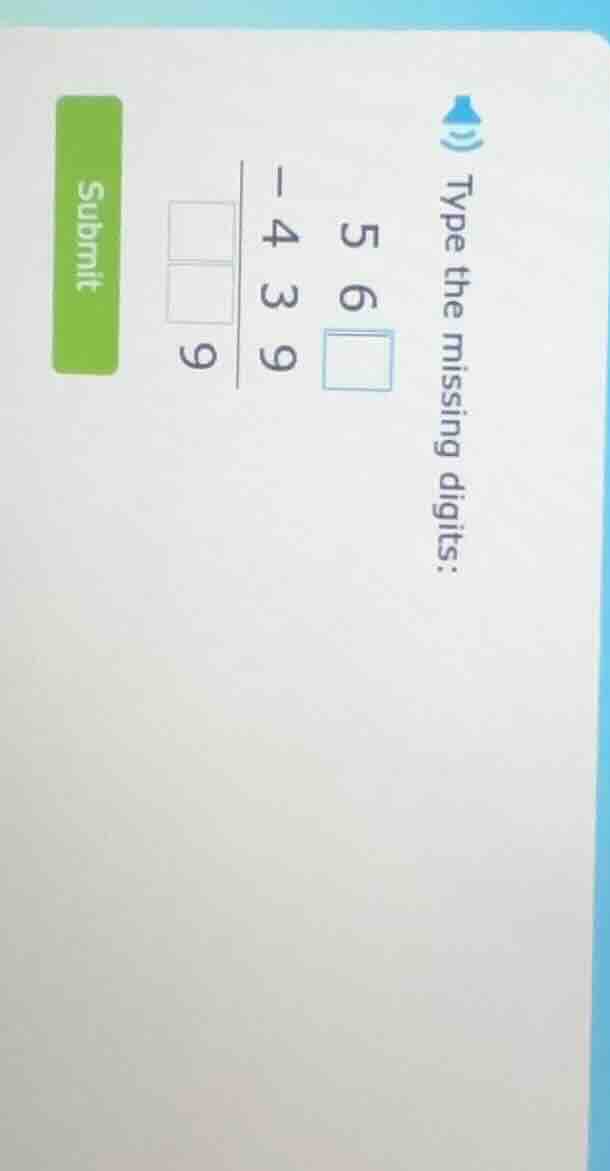
type the missing digits:
5 6 □
- 4 3 9
-------
□ □ 9
submit
Step1: Analyze the units place
Let the missing digit in the minuend's units place be \( x \). We know that in subtraction, \( x - 9 = 9 \) (but since we can't have a negative result, we must have borrowed 1 from the tens place). So, \( 10 + x - 9 = 9 \), which simplifies to \( x + 1 = 9 \), so \( x = 8 \). Wait, no, wait. Wait, the result's units place is 9, and the subtrahend's units place is 9. So \( \text{minuend units} - 9 = 9 \). But since we can't do \( a - 9 = 9 \) without borrowing, we borrow 1 from the tens place. So the minuend's units digit (let's call it \( u \)): \( (u + 10) - 9 = 9 \), so \( u + 10 = 18 \), so \( u = 8 \). So the minuend is 5 6 8.
Step2: Analyze the tens place
Now, the minuend's tens place was 6, but we borrowed 1, so it's 5. Now, the subtrahend's tens place is 3. So \( 5 - 3 = 2 \)? Wait, no, the result's tens place is the first square. Wait, the subtraction is:
Minuend: 5 6 \( u \)
Subtrahend: 4 3 9
Result: \( t \) \( s \) 9
Wait, let's do the subtraction properly. Let's denote the minuend as \( 56u \), subtrahend as 439, result as \( ts9 \).
So \( 56u - 439 = ts9 \)
First, units place: \( u - 9 = 9 \) (with borrowing). So \( u = 8 \) (as above, since \( 8 - 9 \) needs borrowing, so \( 18 - 9 = 9 \)).
Now, tens place: minuend's tens digit was 6, but we borrowed 1, so it's 5. Subtrahend's tens digit is 3. So \( 5 - 3 = 2 \). So the tens place of the result is 2.
Now, hundreds place: minuend's hundreds digit is 5, subtrahend's is 4. \( 5 - 4 = 1 \). So the hundreds place of the result is 1.
Wait, let's check: 568 - 439. Let's compute that. 568 - 400 = 168, 168 - 39 = 129. Wait, no, 568 - 439: 568 - 400 = 168, 168 - 39 = 129. Wait, but the result's units place is 9, tens is 2, hundreds is 1. So 1 2 9. Wait, but the problem shows the result as two squares and a 9. Wait, maybe the result is a two-digit number? Wait, no, 568 - 439 = 129, which is three digits. Wait, maybe the minuend is a three-digit number, subtrahend is three-digit, result is three-digit. Wait, the problem's layout:
Minuend: 5 6 [ ]
Subtrahend: - 4 3 9
Result: [ ] [ ] 9
So the result is a three-digit number: hundreds, tens, units (9). So 56u - 439 = 100a + 10b + 9.
We found u = 8, so 568 - 439 = 129. So a = 1, b = 2.
Wait, let's verify:
568
-439
----
129
Yes, that works. So the missing digits: the minuend's units digit is 8, the result's hundreds digit is 1, tens digit is 2.
Wait, the problem has three missing digits? Wait, the first square is in the minuend (units place), the next two squares are in the result (hundreds and tens place). So:
Minuend: 5 6 [8]
Subtrahend: -4 3 9
Result: [1] [2] 9
So the missing digits are 8 (in minuend), 1 (result hundreds), 2 (result tens). Wait, but the problem says "Type the missing digits:" and there are three squares? Wait, the image shows:
5 6 [ ]
-4 3 9
----
[ ] [ ] 9
So three missing digits: the first square (minuend units), the second square (result hundreds), the third square (result tens).
So solving:
Let minuend be 56x, subtrahend 439, result yz9.
So 56x - 439 = 100y + 10z + 9.
Units place: x - 9 = 9 (with borrowing), so x + 10 - 9 = 9 => x = 8.
Now, 568 - 439 = 129. So y = 1, z = 2.
So the missing digits are 8 (in 56x), 1 (in yz9's y), 2 (in yz9's z).

Snap & solve any problem in the app
Get step-by-step solutions on Sovi AI
Photo-based solutions with guided steps
Explore more problems and detailed explanations
The missing digits are 8 (in the minuend's units place), 1 (in the result's hundreds place), and 2 (in the result's tens place). So the filled numbers are: Minuend units: 8, Result hundreds: 1, Result tens: 2. So the missing digits are 8, 1, 2 (in order of the squares: first square (minuend units): 8, second square (result hundreds): 1, third square (result tens): 2).