QUESTION IMAGE
Question
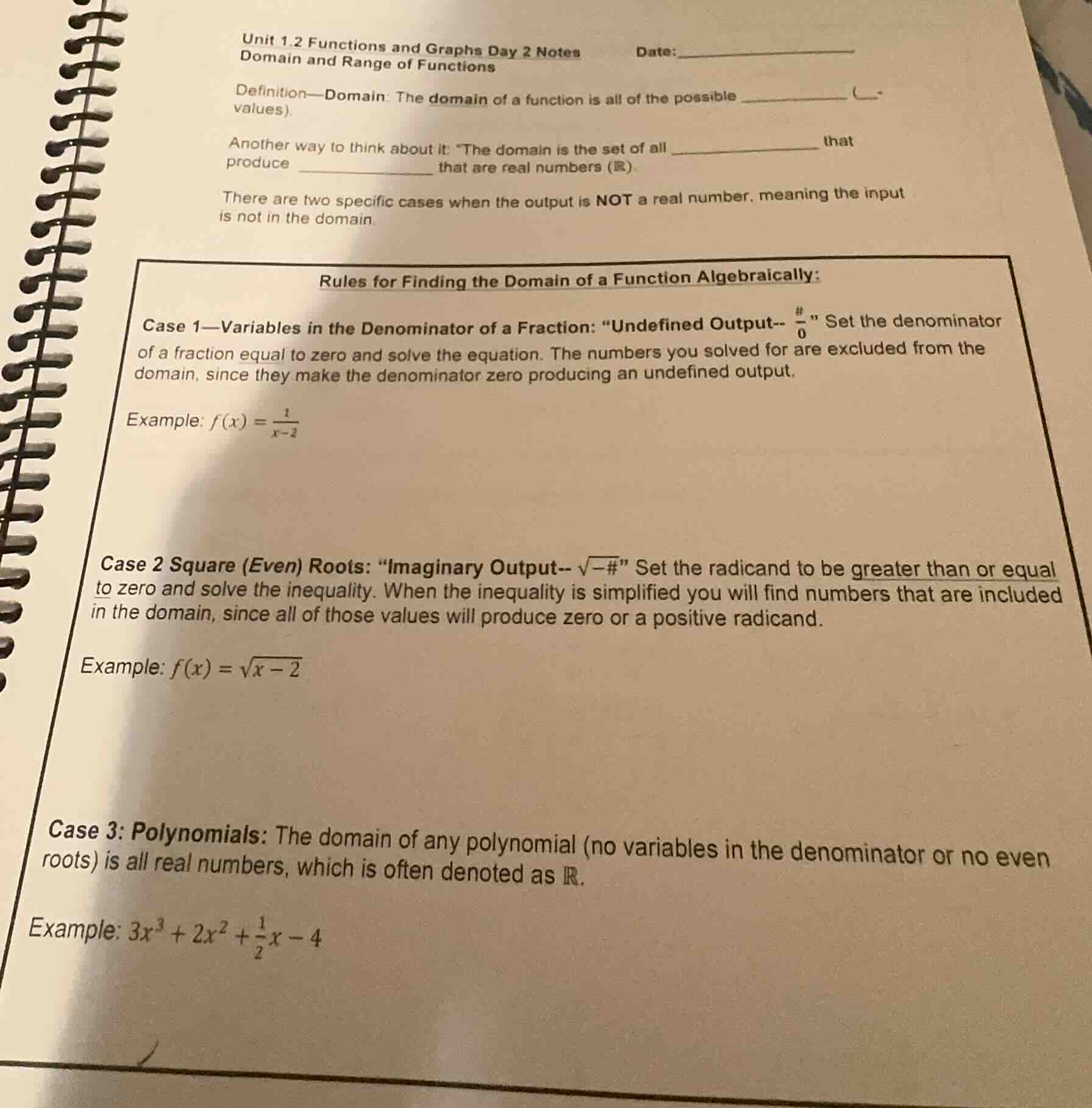
unit 1.2 functions and graphs day 2 notes date:________ domain and range of functions definition—domain: the domain of a function is all of the possible ___ (_-values). another way to think about it: “the domain is the set of all ________ that produce ________ that are real numbers (ℝ). there are two specific cases when the output is not a real number, meaning the input is not in the domain. rules for finding the domain of a function algebraically: case 1—variables in the denominator of a fraction: “undefined output-- $\frac{#}{0}$” set the denominator of a fraction equal to zero and solve the equation. the numbers you solved for are excluded from the domain, since they make the denominator zero producing an undefined output. example: $f(x) = \frac{1}{x - 2}$ case 2 square (even) roots: “imaginary output-- $sqrt{-#}$” set the radicand to be greater than or equal to zero and solve the inequality. when the inequality is simplified you will find numbers that are included in the domain, since all of those values will produce zero or a positive radicand. example: $f(x) = sqrt{x - 2}$ case 3: polynomials: the domain of any polynomial (no variables in the denominator or no even roots) is all real numbers, which is often denoted as ℝ. example: $3x^3 + 2x^2 + \frac{1}{2}x - 4$
To fill in the blanks about the domain of a function:
Definition—Domain:
The domain of a function is all of the possible \(\boldsymbol{\text{input}}\) (\(\boldsymbol{x}\)-values).
Another way to think about it:
"The domain is the set of all \(\boldsymbol{\text{input values (or } x\text{-values)}}\) that produce \(\boldsymbol{\text{output values (or } y\text{-values)}}\) that are real numbers (\(\mathbb{R}\))."
These definitions align with the context of functions (input values that make the function produce real - valued outputs) and the subsequent rules for finding the domain (which focus on ensuring outputs are real by restricting inputs).

Snap & solve any problem in the app
Get step-by-step solutions on Sovi AI
Photo-based solutions with guided steps
Explore more problems and detailed explanations
- First blank: input
- Second blank: \(x\)
- Third blank: input values (or \(x\)-values)
- Fourth blank: output values (or \(y\)-values)