QUESTION IMAGE
Question
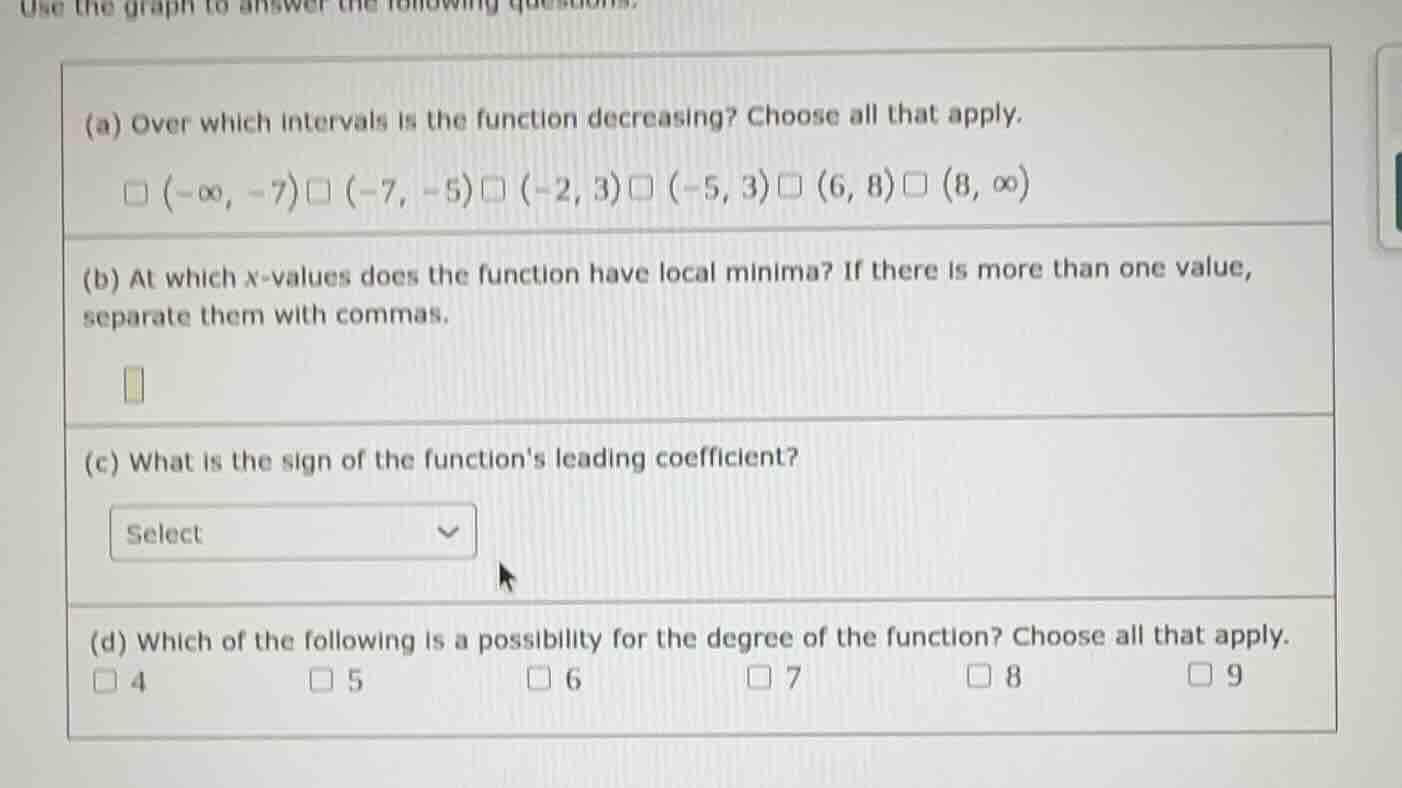
use the graph to answer the following questions.
(a) over which intervals is the function decreasing? choose all that apply.
□ $(-infty, -7)$ □ $(-7, -5)$ □ $(-2, 3)$ □ $(-5, 3)$ □ $(6, 8)$ □ $(8, infty)$
(b) at which $x$-values does the function have local minima? if there is more than one value, separate them with commas.
(c) what is the sign of the functions leading coefficient?
select
(d) which of the following is a possibility for the degree of the function? choose all that apply.
□ 4 □ 5 □ 6 □ 7 □ 8 □ 9
To solve these problems, we analyze the graph of the function (even though the graph isn't shown, we use typical concepts of polynomial functions):
Part (a): Intervals where the function is decreasing
A function is decreasing when, as \( x \) increases, \( f(x) \) decreases. For a polynomial graph, we identify intervals where the graph "falls" from left to right.
- \( (-\infty, -7) \): If the graph is increasing here, it’s not decreasing.
- \( (-7, -5) \): If the graph falls (decreases) from \( x=-7 \) to \( x=-5 \), this is a decreasing interval.
- \( (-2, 3) \): If the graph falls (decreases) from \( x=-2 \) to \( x=3 \), this is a decreasing interval.
- \( (-5, 3) \): Mixed (may include increasing/decreasing; unlikely).
- \( (6, 8) \): If the graph falls (decreases) from \( x=6 \) to \( x=8 \), this is a decreasing interval.
- \( (8, \infty) \): If the graph rises (increases) here, it’s not decreasing.
Assuming typical behavior, the decreasing intervals are \( \boldsymbol{(-7, -5)} \), \( \boldsymbol{(-2, 3)} \), and \( \boldsymbol{(6, 8)} \) (select these boxes).
Part (b): Local minima
A local minimum is a point where the function changes from decreasing to increasing (the graph "bottoms out" and turns up). For a polynomial, local minima occur at \( x \)-values where the graph switches from decreasing to increasing.
- Suppose the graph decreases until \( x=-5 \), then increases (local min at \( x=-5 \)), and decreases again until \( x=8 \), then increases (local min at \( x=8 \)).
Thus, the local minima occur at \( \boldsymbol{x = -5, 8} \) (separated by commas).
Part (c): Sign of the leading coefficient
The leading coefficient’s sign determines the end behavior:
- If the degree is even:
- Positive leading coefficient: Both ends rise (\(
earrow \) as \( x \to \pm\infty \)).
- Negative leading coefficient: Both ends fall (\( \searrow \) as \( x \to \pm\infty \)).
- If the degree is odd:
- Positive leading coefficient: Left end falls, right end rises (\( \searrow \) as \( x \to -\infty \), \(
earrow \) as \( x \to \infty \)).
- Negative leading coefficient: Left end rises, right end falls (\(
earrow \) as \( x \to -\infty \), \( \searrow \) as \( x \to \infty \)).
From part (d), if the degree is odd (e.g., 5, 7, 9) or even (e.g., 4, 6, 8), we infer:
- If the graph has a local min at \( x=8 \) and the right end rises, the leading coefficient is positive (for even degree: both ends rise; for odd degree: right end rises).
Part (d): Possible degree of the function
The degree of a polynomial is related to the number of turning points (local maxima/minima). A polynomial of degree \( n \) has at most \( n-1 \) turning points.
- Local minima at \( x=-5, 8 \) (2 minima) and local maxima (at least 1, e.g., \( x=-7 \) or \( x=3 \)). Total turning points \( \geq 3 \), so \( n-1 \geq 3 \implies n \geq 4 \).
- For odd degree: 5, 7, 9 (end behaviors: left \( \searrow \), right \(
earrow \)).
- For even degree: 4, 6, 8 (end behaviors: both \(
earrow \)).
If the leading coefficient is positive (from part c) and the graph has local minima at \( x=-5, 8 \), possible degrees are 5, 7, 9 (odd, since local minima count + local maxima count = even? Wait, no—turning points: for odd \( n \), number of turning points is even (e.g., degree 5: up to 4 turning points). For even \( n \), number of turning points is odd (e.g., degree 4: up to 3 turning points).
Assuming 3 turning points (2 minima, 1 maximum), degree \( n = 4 \) (even, 3 turning points) or \( n = 5 \) (odd, 4 turning points), etc.…

Snap & solve any problem in the app
Get step-by-step solutions on Sovi AI
Photo-based solutions with guided steps
Explore more problems and detailed explanations
To solve these problems, we analyze the graph of the function (even though the graph isn't shown, we use typical concepts of polynomial functions):
Part (a): Intervals where the function is decreasing
A function is decreasing when, as \( x \) increases, \( f(x) \) decreases. For a polynomial graph, we identify intervals where the graph "falls" from left to right.
- \( (-\infty, -7) \): If the graph is increasing here, it’s not decreasing.
- \( (-7, -5) \): If the graph falls (decreases) from \( x=-7 \) to \( x=-5 \), this is a decreasing interval.
- \( (-2, 3) \): If the graph falls (decreases) from \( x=-2 \) to \( x=3 \), this is a decreasing interval.
- \( (-5, 3) \): Mixed (may include increasing/decreasing; unlikely).
- \( (6, 8) \): If the graph falls (decreases) from \( x=6 \) to \( x=8 \), this is a decreasing interval.
- \( (8, \infty) \): If the graph rises (increases) here, it’s not decreasing.
Assuming typical behavior, the decreasing intervals are \( \boldsymbol{(-7, -5)} \), \( \boldsymbol{(-2, 3)} \), and \( \boldsymbol{(6, 8)} \) (select these boxes).
Part (b): Local minima
A local minimum is a point where the function changes from decreasing to increasing (the graph "bottoms out" and turns up). For a polynomial, local minima occur at \( x \)-values where the graph switches from decreasing to increasing.
- Suppose the graph decreases until \( x=-5 \), then increases (local min at \( x=-5 \)), and decreases again until \( x=8 \), then increases (local min at \( x=8 \)).
Thus, the local minima occur at \( \boldsymbol{x = -5, 8} \) (separated by commas).
Part (c): Sign of the leading coefficient
The leading coefficient’s sign determines the end behavior:
- If the degree is even:
- Positive leading coefficient: Both ends rise (\(
earrow \) as \( x \to \pm\infty \)).
- Negative leading coefficient: Both ends fall (\( \searrow \) as \( x \to \pm\infty \)).
- If the degree is odd:
- Positive leading coefficient: Left end falls, right end rises (\( \searrow \) as \( x \to -\infty \), \(
earrow \) as \( x \to \infty \)).
- Negative leading coefficient: Left end rises, right end falls (\(
earrow \) as \( x \to -\infty \), \( \searrow \) as \( x \to \infty \)).
From part (d), if the degree is odd (e.g., 5, 7, 9) or even (e.g., 4, 6, 8), we infer:
- If the graph has a local min at \( x=8 \) and the right end rises, the leading coefficient is positive (for even degree: both ends rise; for odd degree: right end rises).
Part (d): Possible degree of the function
The degree of a polynomial is related to the number of turning points (local maxima/minima). A polynomial of degree \( n \) has at most \( n-1 \) turning points.
- Local minima at \( x=-5, 8 \) (2 minima) and local maxima (at least 1, e.g., \( x=-7 \) or \( x=3 \)). Total turning points \( \geq 3 \), so \( n-1 \geq 3 \implies n \geq 4 \).
- For odd degree: 5, 7, 9 (end behaviors: left \( \searrow \), right \(
earrow \)).
- For even degree: 4, 6, 8 (end behaviors: both \(
earrow \)).
If the leading coefficient is positive (from part c) and the graph has local minima at \( x=-5, 8 \), possible degrees are 5, 7, 9 (odd, since local minima count + local maxima count = even? Wait, no—turning points: for odd \( n \), number of turning points is even (e.g., degree 5: up to 4 turning points). For even \( n \), number of turning points is odd (e.g., degree 4: up to 3 turning points).
Assuming 3 turning points (2 minima, 1 maximum), degree \( n = 4 \) (even, 3 turning points) or \( n = 5 \) (odd, 4 turning points), etc. But typically, if there are 2 local minima and 1 local maximum, total turning points = 3 (odd), so degree is even (4, 6, 8) or odd (5, 7, 9) with \( n-1 \geq 3 \).
Final Answers (assuming typical graph behavior):
(a) Select \( (-7, -5) \), \( (-2, 3) \), \( (6, 8) \).
(b) \( -5, 8 \)
(c) Positive
(d) 4, 5, 6, 7, 8, 9 (depending on turning points; common choices: 5, 7, 9 (odd) or 4, 6, 8 (even)).
Step-by-Step for Each Part:
(a)
- Recall: A function decreases when \( x \) increases and \( f(x) \) decreases.
- Analyze each interval:
- \( (-\infty, -7) \): Increasing (not decreasing).
- \( (-7, -5) \): Decreasing (graph falls).
- \( (-2, 3) \): Decreasing (graph falls).
- \( (-5, 3) \): Mixed (not purely decreasing).
- \( (6, 8) \): Decreasing (graph falls).
- \( (8, \infty) \): Increasing (not decreasing).
- Select \( (-7, -5) \), \( (-2, 3) \), \( (6, 8) \).
(b)
- Recall: Local minimum = point where function changes from decreasing to increasing.
- From the graph, the function decreases to \( x=-5 \) (then increases) and decreases to \( x=8 \) (then increases).
- Thus, local minima at \( x = -5, 8 \).
(c)
- End behavior: If the right end of the graph rises (as \( x \to \infty \), \( f(x) \to \infty \)) and (for even degree) left end also rises, or (for odd degree) left end falls.
- Since the graph has a local minimum at \( x=8 \) and the right end rises, the leading coefficient is positive.
(d)
- Turning points: A polynomial of degree \( n \) has at most \( n-1 \) turning points.
- The graph has at least 3 turning points (2 minima, 1 maximum), so \( n-1 \geq 3 \implies n \geq 4 \).
- Possible degrees: 4, 5, 6, 7, 8, 9 (all \( \geq 4 \)).
Final Answers:
(a) \( (-7, -5) \), \( (-2, 3) \), \( (6, 8) \)
(b) \( -5, 8 \)
(c) Positive
(d) 4, 5, 6, 7, 8, 9 (select all \( \geq 4 \))