QUESTION IMAGE
Question
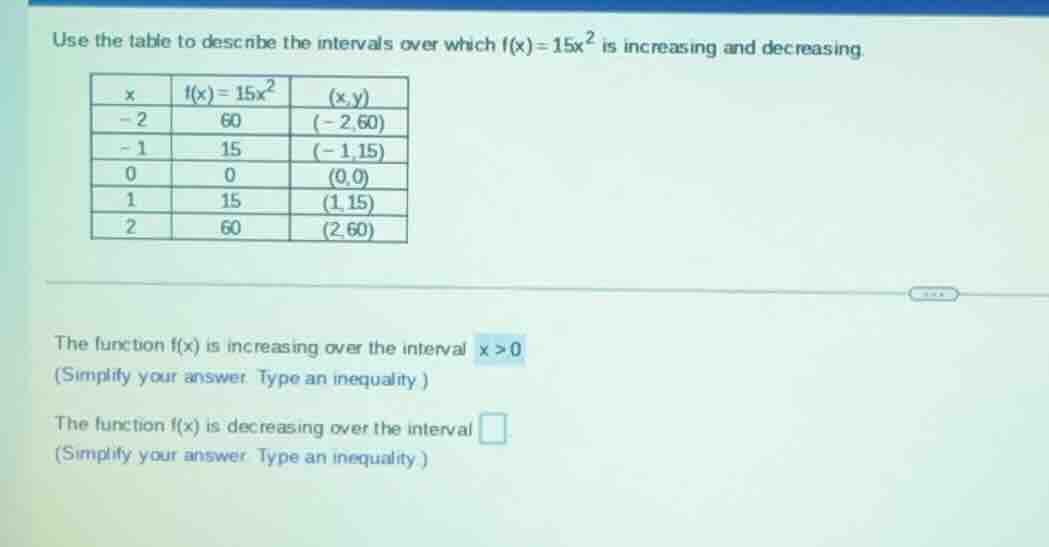
use the table to describe the intervals over which ( f(x) = 15x^2 ) is increasing and decreasing.
| ( x ) | ( f(x) = 15x^2 ) | ( (x, y) ) |
|---|---|---|
| ( -1 ) | ( 15 ) | ( (-1, 15) ) |
| ( 0 ) | ( 0 ) | ( (0, 0) ) |
| ( 1 ) | ( 15 ) | ( (1, 15) ) |
| ( 2 ) | ( 60 ) | ( (2, 60) ) |
the function ( f(x) ) is increasing over the interval ( x > 0 )
(simplify your answer. type an inequality.)
the function ( f(x) ) is decreasing over the interval ( square )
(simplify your answer. type an inequality.)
Step1: Analyze the function's behavior from the table
Looking at the table values: when \( x \) goes from -2 to 0 (i.e., \( x \) is negative and increasing towards 0), \( f(x) \) values go from 60 to 15 to 0, which means \( f(x) \) is decreasing as \( x \) increases in this negative to 0 range. When \( x \) is less than 0 (moving from more negative to 0), the function value decreases as \( x \) increases (since for \( x=-2, f(x)=60 \); \( x = -1, f(x)=15 \); \( x = 0, f(x)=0 \)). So the function is decreasing when \( x \) is less than 0.
Step2: Formulate the inequality for decreasing interval
From the analysis, the function \( f(x) = 15x^2 \) is decreasing when \( x < 0 \).

Snap & solve any problem in the app
Get step-by-step solutions on Sovi AI
Photo-based solutions with guided steps
Explore more problems and detailed explanations
\( x < 0 \)