QUESTION IMAGE
Question
use transformations to graph the function.
\\( r(x) = \sqrt{-x + 4} \\)
Step1: Identify the parent function
The parent function for square root functions is \( y = \sqrt{x} \), which has a domain \( x \geq 0 \) and starts at the point \( (0, 0) \), increasing slowly.
Step2: Rewrite the given function
Rewrite \( r(x) = \sqrt{-x + 4} \) as \( r(x) = \sqrt{-(x - 4)} \). This helps in identifying the transformations.
Step3: Analyze horizontal reflection
The negative sign inside the square root (affecting the \( x \)-term) indicates a horizontal reflection over the \( y \)-axis. For the parent function \( y = \sqrt{x} \), a horizontal reflection would transform it to \( y = \sqrt{-x} \), which reflects the graph over the \( y \)-axis, so the domain becomes \( x \leq 0 \) for \( y = \sqrt{-x} \), and it starts at \( (0, 0) \) but decreases (or is reflected) in the horizontal direction.
Step4: Analyze horizontal shift
The \( -4 \) inside the square root (with the \( x \)) indicates a horizontal shift. The general form for a horizontal shift of a function \( y = f(x) \) is \( y = f(x - h) \), where \( h \) is the shift. If \( h > 0 \), it's a shift to the right; if \( h < 0 \), it's a shift to the left. In our case, the function is \( y = \sqrt{-(x - 4)} \), so comparing to \( y = \sqrt{-x} \), we have \( h = 4 \), which means a shift to the right by 4 units.
Step5: Combine transformations
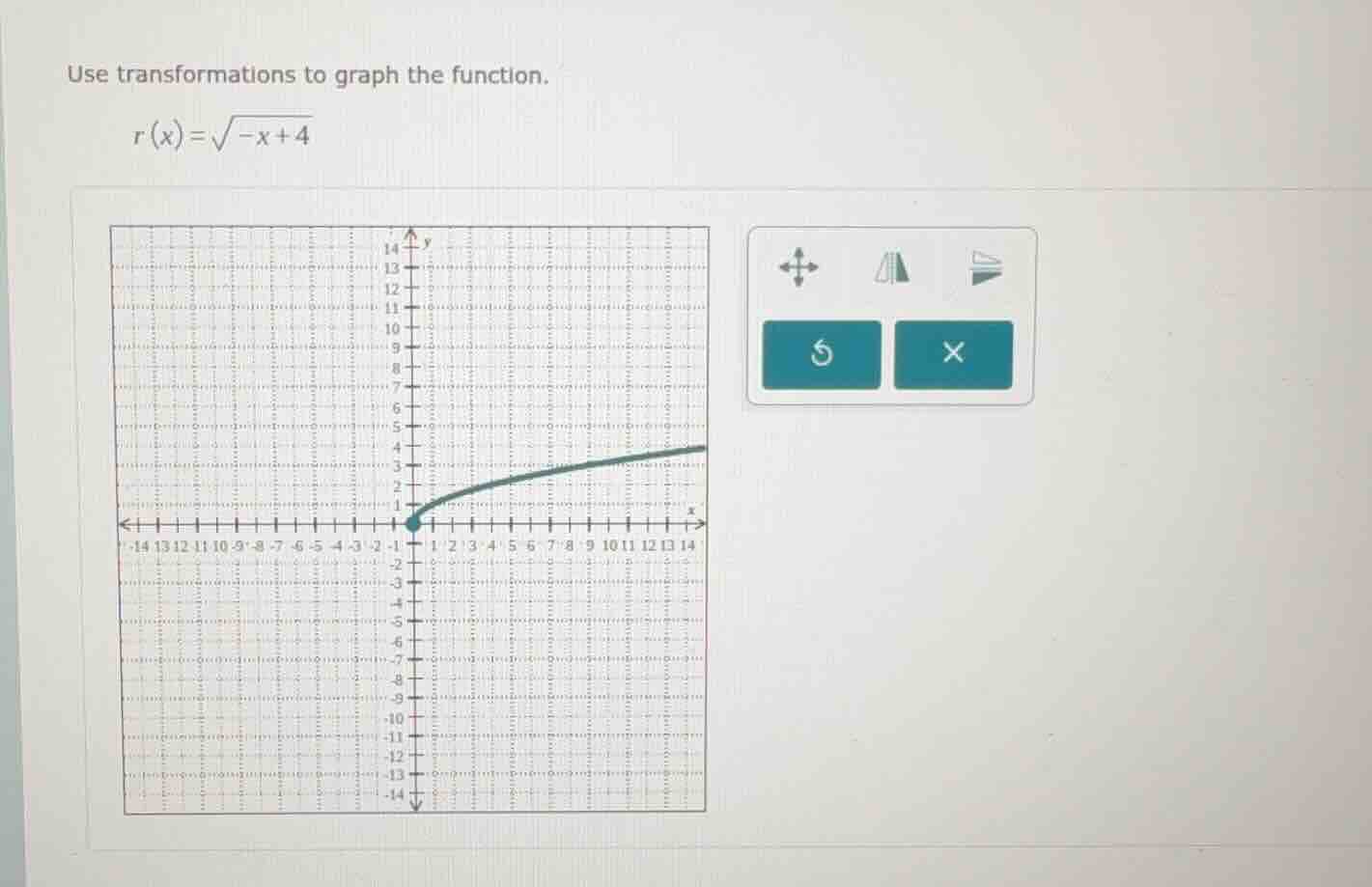
First, take the parent function \( y = \sqrt{x} \). Reflect it horizontally over the \( y \)-axis to get \( y = \sqrt{-x} \) (domain \( x \leq 0 \), starting at \( (0, 0) \), and the graph is a mirror image over the \( y \)-axis of \( y = \sqrt{x} \)). Then, shift this reflected graph 4 units to the right. Shifting \( y = \sqrt{-x} \) 4 units to the right: to shift a function \( y = f(x) \) 4 units to the right, we replace \( x \) with \( x - 4 \), so \( y = \sqrt{-( (x - 4) )} = \sqrt{-x + 4} \). The domain of \( y = \sqrt{-x + 4} \) is found by setting \( -x + 4 \geq 0 \), which gives \( -x \geq -4 \) or \( x \leq 4 \). So the starting point (the vertex of the square root graph) is when \( -x + 4 = 0 \), so \( x = 4 \), and \( y = 0 \). So the graph should start at \( (4, 0) \) and increase (since after reflection and shift, the direction: let's check a point. For \( y = \sqrt{-x + 4} \), when \( x = 4 \), \( y = 0 \); when \( x = 3 \), \( y = \sqrt{-3 + 4} = \sqrt{1} = 1 \); when \( x = 0 \), \( y = \sqrt{0 + 4} = 2 \); when \( x = -5 \), \( y = \sqrt{5 + 4} = 3 \). So the graph starts at \( (4, 0) \) and moves to the left (since \( x \) decreases) while \( y \) increases? Wait, no, wait: when \( x \) decreases (moves to the left from \( x = 4 \)), \( -x + 4 \) increases, so \( y \) increases. So the graph starts at \( (4, 0) \) and as \( x \) decreases (goes to the left), \( y \) increases. Wait, but the parent function \( y = \sqrt{x} \) starts at \( (0, 0) \) and as \( x \) increases, \( y \) increases. After reflecting over \( y \)-axis, \( y = \sqrt{-x} \) starts at \( (0, 0) \) and as \( x \) decreases (goes to the left), \( y \) increases (since \( -x \) increases). Then shifting 4 units to the right: the starting point \( (0, 0) \) of \( y = \sqrt{-x} \) shifts to \( (0 + 4, 0) = (4, 0) \). So now, the graph of \( y = \sqrt{-x + 4} \) starts at \( (4, 0) \) and as \( x \) decreases (moves left from 4), \( y \) increases, which matches the points we calculated (e.g., \( x = 3 \) (left of 4 by 1 unit) gives \( y = 1 \), \( x = 0 \) (left of 4 by 4 units) gives \( y = 2 \), \( x = -5 \) (left of 4 by 9 units) gives \( y = 3 \)).
To graph it:
- Start with the parent function \( y = \sqrt{x} \) (star…

Snap & solve any problem in the app
Get step-by-step solutions on Sovi AI
Photo-based solutions with guided steps
Explore more problems and detailed explanations
To graph \( r(x) = \sqrt{-x + 4} \) using transformations:
- Parent Function: Start with \( y = \sqrt{x} \) (domain \( x \geq 0 \), starts at \( (0, 0) \), increases).
- Horizontal Reflection: Reflect \( y = \sqrt{x} \) over the \( y \)-axis to get \( y = \sqrt{-x} \) (domain \( x \leq 0 \), starts at \( (0, 0) \), reflects horizontally).
- Horizontal Shift: Shift \( y = \sqrt{-x} \) 4 units to the right (replace \( x \) with \( x - 4 \)) to get \( y = \sqrt{-(x - 4)} = \sqrt{-x + 4} \). The domain becomes \( x \leq 4 \), and the graph starts at \( (4, 0) \), increasing as \( x \) decreases (left from \( x = 4 \)).
The key transformations are a horizontal reflection over the \( y \)-axis and a horizontal shift 4 units to the right of the parent square root function.