QUESTION IMAGE
Question
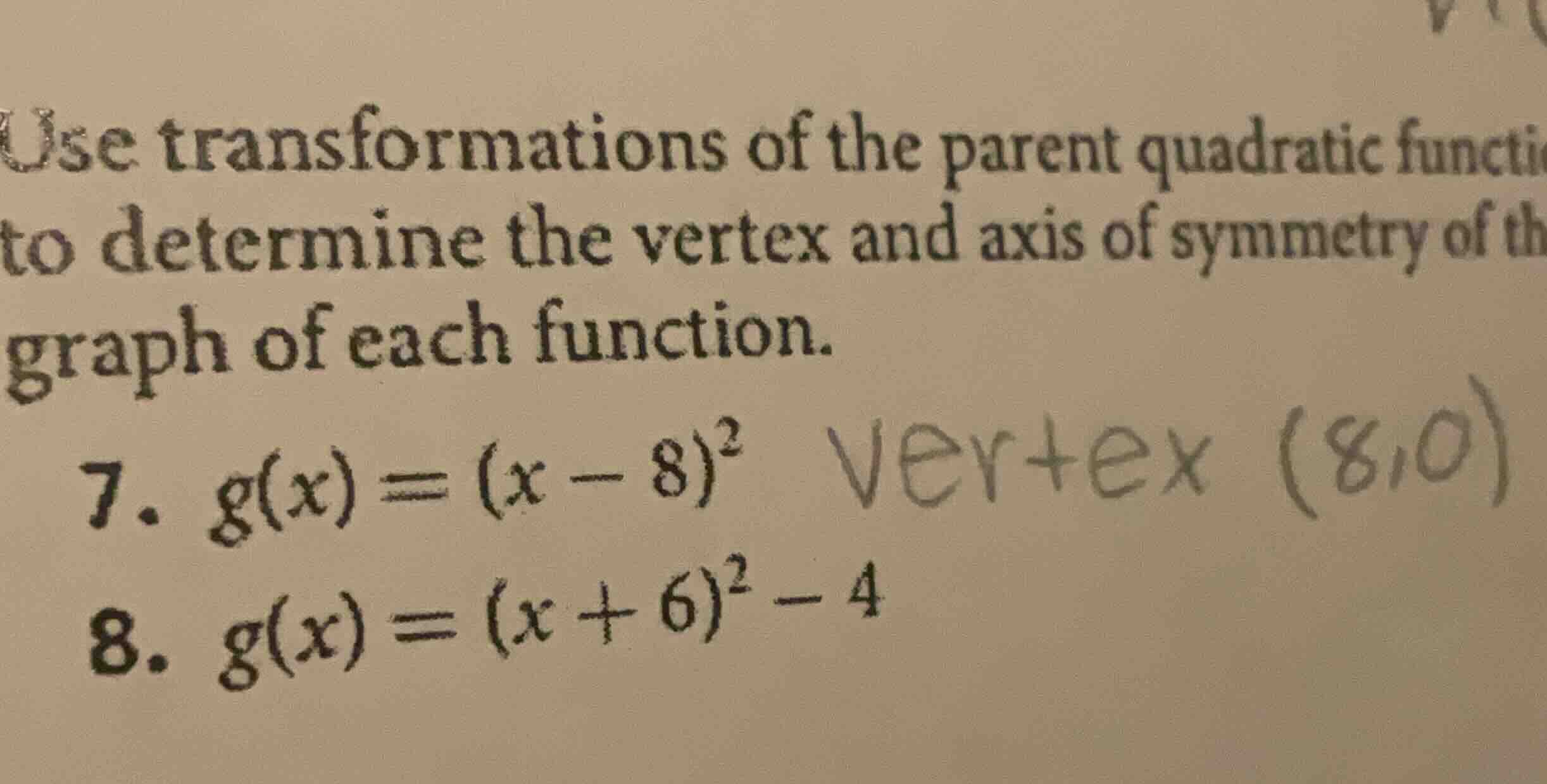
use transformations of the parent quadratic functi to determine the vertex and axis of symmetry of th graph of each function. 7. $g(x)=(x - 8)^2$ vertex $(8,0)$ 8. $g(x)=(x + 6)^2 - 4$
Problem 7: \( g(x) = (x - 8)^2 \)
Step 1: Recall the vertex form of a quadratic function
The vertex form of a quadratic function is \( f(x) = a(x - h)^2 + k \), where \((h, k)\) is the vertex of the parabola, and the axis of symmetry is the vertical line \( x = h \).
Step 2: Identify \( h \) and \( k \) for \( g(x) = (x - 8)^2 \)
For the function \( g(x) = (x - 8)^2 \), we can rewrite it as \( g(x) = 1(x - 8)^2 + 0 \). Comparing this with the vertex form \( f(x) = a(x - h)^2 + k \), we have \( a = 1 \), \( h = 8 \), and \( k = 0 \).
Step 3: Determine the vertex and axis of symmetry
Since \( h = 8 \) and \( k = 0 \), the vertex of the parabola is \((h, k) = (8, 0)\). The axis of symmetry is the vertical line passing through the vertex, so the axis of symmetry is \( x = 8 \).
Step 1: Recall the vertex form of a quadratic function
The vertex form of a quadratic function is \( f(x) = a(x - h)^2 + k \), where \((h, k)\) is the vertex of the parabola, and the axis of symmetry is the vertical line \( x = h \).
Step 2: Rewrite the function to match the vertex form
We can rewrite \( g(x) = (x + 6)^2 - 4 \) as \( g(x) = 1(x - (-6))^2 + (-4) \). Comparing this with the vertex form \( f(x) = a(x - h)^2 + k \), we have \( a = 1 \), \( h = -6 \), and \( k = -4 \).
Step 3: Determine the vertex and axis of symmetry
Since \( h = -6 \) and \( k = -4 \), the vertex of the parabola is \((h, k) = (-6, -4)\). The axis of symmetry is the vertical line passing through the vertex, so the axis of symmetry is \( x = -6 \).

Snap & solve any problem in the app
Get step-by-step solutions on Sovi AI
Photo-based solutions with guided steps
Explore more problems and detailed explanations
Vertex: \((8, 0)\), Axis of Symmetry: \( x = 8 \)