QUESTION IMAGE
Question
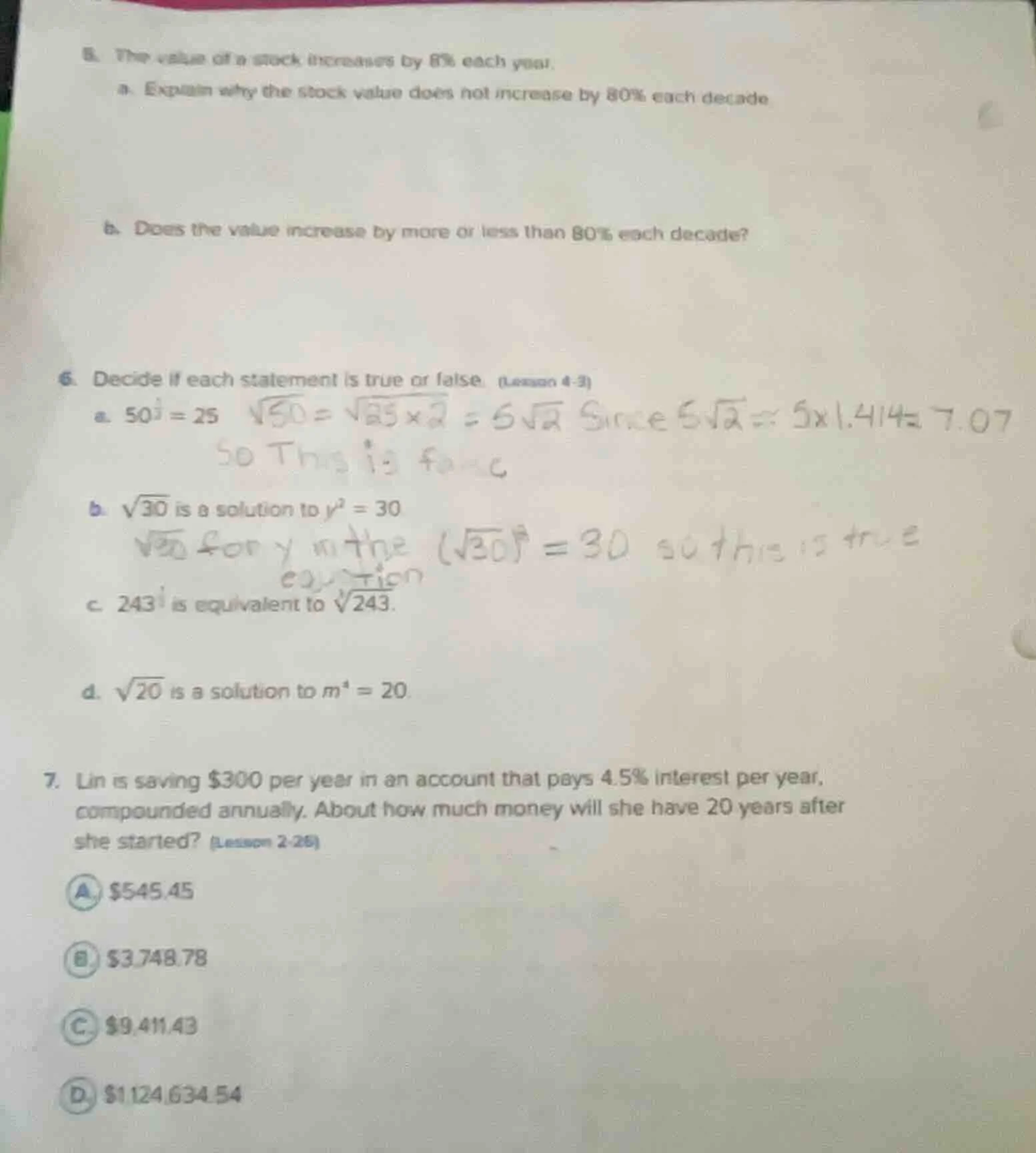
- the value of a stock increases by 8% each year.
a. explain why the stock value does not increase by 80% each decade.
b. does the value increase by more or less than 80% each decade?
- decide if each statement is true or false. (lesson 4-3)
a. $50^{\frac{1}{2}}=25$
b. $sqrt{30}$ is a solution to $y^{2}=30$
c. $243^{\frac{1}{3}}$ is equivalent to $sqrt3{243}$.
d. $sqrt{20}$ is a solution to $m^{4}=20$
- lin is saving $300 per year in an account that pays 4.5% interest per year, compounded annually. about how much money will she have 20 years after she started? (lesson 2-26)
a. $545.45
b. $3,748.78
c. $9,411.43
d. $1,124,634.54
For Question 5:
Step1: Define compound growth formula
Let initial value be $P$, growth rate $r=0.08$, time $t=10$.
Compound value: $P(1+r)^t$
Step2: Calculate total growth factor
$\text{Factor}=(1+0.08)^{10}=1.08^{10}\approx2.1589$
Step3: Calculate total growth percentage
$\text{Growth \%}=(2.1589-1)\times100\approx115.89\%$
Step4: Compare to 80% (part a/b)
Simple 8%/year for 10 years gives $10\times8\%=80\%$, but compound growth earns interest on accumulated value, so it is not simple addition. The total growth is more than 80%.
Step1: Evaluate $50^\frac{1}{2}$
$50^\frac{1}{2}=\sqrt{50}=5\sqrt{2}\approx7.07
eq25$, so false.
Step2: Test $\sqrt{30}$ for $y^2=30$
$(\sqrt{30})^2=30$, which matches the equation, so true.
Step3: Relate $243^\frac{1}{5}$ to roots
$a^\frac{1}{n}=\sqrt[n]{a}$, so $243^\frac{1}{5}=\sqrt[5]{243}$, so true.
Step4: Test $\sqrt{20}$ for $m^4=20$
$(\sqrt{20})^4=(20^\frac{1}{2})^4=20^2=400
eq20$, so false.
Step1: Use annuity future value formula
The formula for future value of an ordinary annuity is:
$$FV = P\times\frac{(1+r)^t - 1}{r}$$
where $P=300$, $r=0.045$, $t=20$.
Step2: Calculate $(1+r)^t$
$(1+0.045)^{20}=1.045^{20}\approx2.4117$
Step3: Compute numerator and fraction
$(2.4117-1)=1.4117$
$\frac{1.4117}{0.045}\approx31.3711$
Step4: Calculate final future value
$FV=300\times31.3711\approx9411.33$

Snap & solve any problem in the app
Get step-by-step solutions on Sovi AI
Photo-based solutions with guided steps
Explore more problems and detailed explanations
a. The stock grows via compound growth, not simple growth—each year's increase is applied to the already increased value, not the original principal, so the total growth is not just $10\times8\%$.
b. More than 80%
---