QUESTION IMAGE
Question
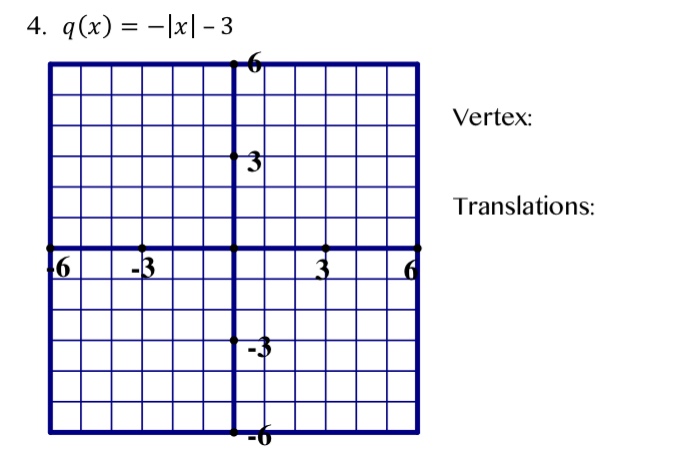
- $q(x) = -|x| - 3$
vertex:
translations:
Step1: Recall the parent function of absolute value
The parent function of absolute value is \( y = |x| \), whose vertex is at \( (0, 0) \).
Step2: Analyze the transformation of \( q(x)=-|x|-3 \)
For the function \( q(x)=-|x|-3 \), we first consider the reflection and then the vertical translation.
- The negative sign in front of \( |x| \) reflects the graph of \( y = |x| \) over the \( x \)-axis.
- The \( -3 \) at the end represents a vertical translation. For a function \( y = f(x)+k \), if \( k<0 \), it is a vertical shift down by \( |k| \) units. Here \( k = - 3 \), so it is a vertical shift down by 3 units.
Step3: Find the vertex
The vertex of the parent function \( y = |x| \) is \( (0,0) \). After reflecting over the \( x \)-axis (the \( x \)-coordinate of the vertex remains the same, and the \( y \)-coordinate is negated) and then shifting down 3 units, the new vertex is calculated as follows:
- After reflection: The vertex of \( y=-|x| \) is still \( (0,0) \) (because reflecting \( (0,0) \) over the \( x \)-axis gives \( (0,0) \)).
- After vertical shift: We shift the vertex \( (0,0) \) down 3 units. The \( x \)-coordinate remains 0, and the \( y \)-coordinate becomes \( 0 - 3=-3 \). So the vertex of \( q(x)=-|x|-3 \) is \( (0, - 3) \).
Step4: Describe the translations
- Reflection: Reflect over the \( x \)-axis (from \( y = |x| \) to \( y=-|x| \)).
- Vertical translation: Vertical shift down by 3 units (from \( y=-|x| \) to \( y=-|x|-3 \)).

Snap & solve any problem in the app
Get step-by-step solutions on Sovi AI
Photo-based solutions with guided steps
Explore more problems and detailed explanations
Vertex: \((0, - 3)\)
Translations: Reflect over the \(x\)-axis, then shift down 3 units.