QUESTION IMAGE
Question
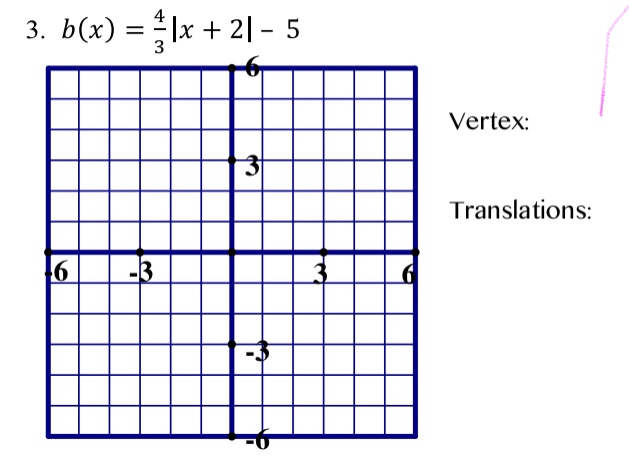
- $b(x) = \frac{4}{3}|x + 2| - 5$
vertex:
translations:
Step1: Recall vertex form of absolute value function
The general vertex form of an absolute value function is \( y = a|x - h| + k \), where \((h, k)\) is the vertex.
Step2: Identify \( h \) and \( k \) from \( b(x)=\frac{4}{3}|x + 2|-5 \)
Rewrite \( x + 2 \) as \( x - (-2) \). So comparing with \( y = a|x - h| + k \), we have \( h=-2 \) and \( k = -5 \). Thus the vertex is \((-2, -5)\).
Step3: Analyze translations from parent function \( y = |x| \)
- Horizontal translation: The \( + 2 \) inside the absolute value (rewritten as \( -(-2) \)) means a horizontal translation of 2 units to the left.
- Vertical translation: The \( - 5 \) outside the absolute value means a vertical translation of 5 units down.
- Vertical stretch: The coefficient \( \frac{4}{3} \) (which is greater than 1) means a vertical stretch by a factor of \( \frac{4}{3} \), but the question asks for translations, so we focus on shifts.

Snap & solve any problem in the app
Get step-by-step solutions on Sovi AI
Photo-based solutions with guided steps
Explore more problems and detailed explanations
Vertex: \((-2, -5)\)
Translations: 2 units left and 5 units down (with a vertical stretch by a factor of \(\frac{4}{3}\))