QUESTION IMAGE
Question
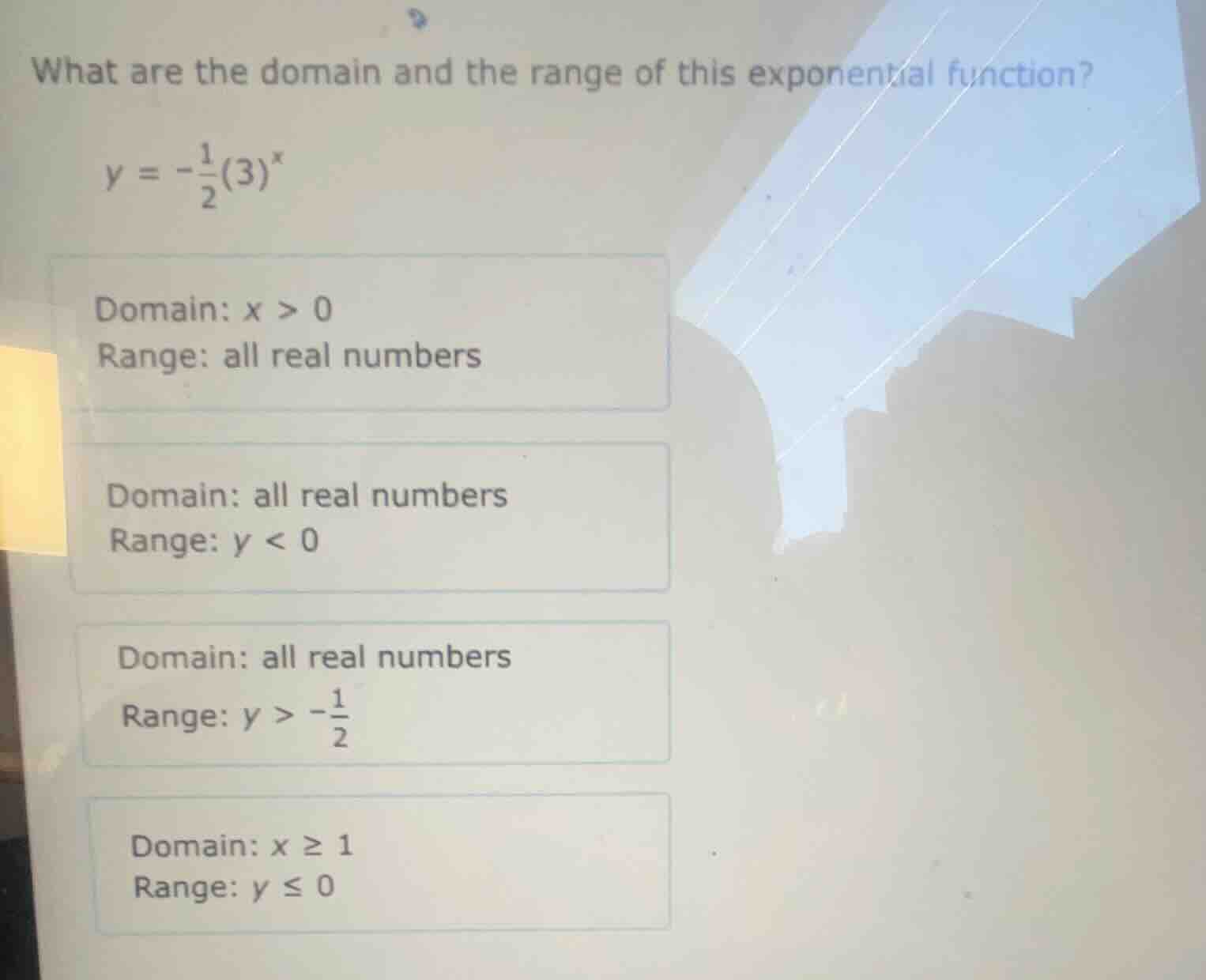
what are the domain and the range of this exponential function?
y = -\frac{1}{2}(3)^x
domain: x > 0
range: all real numbers
domain: all real numbers
range: y < 0
domain: all real numbers
range: y > -\frac{1}{2}
domain: x ≥ 1
range: y ≤ 0
Step1: Analyze the domain of the exponential function
For an exponential function of the form \( y = a(b)^x \), where \( a \) and \( b \) are constants and \( b>0, b
eq1 \), the domain is all real numbers because we can substitute any real number for \( x \) and the function will be defined. In the given function \( y = -\frac{1}{2}(3)^x \), the base \( 3>0 \), so \( x \) can be any real number. So the domain is all real numbers.
Step2: Analyze the range of the exponential function
First, recall the range of the basic exponential function \( y = 3^x \). The range of \( y = 3^x \) is \( y>0 \) because any positive number raised to a real power is positive. Now, let's look at the transformation. We have \( y = -\frac{1}{2}(3)^x \). Multiplying \( 3^x \) (which is always positive) by \( -\frac{1}{2} \) will reflect the graph over the x - axis and vertically compress it by a factor of \( \frac{1}{2} \). So if \( 3^x>0 \), then \( -\frac{1}{2}(3)^x<0 \) (because we are multiplying a positive number by a negative number). So the range of \( y = -\frac{1}{2}(3)^x \) is \( y < 0 \).

Snap & solve any problem in the app
Get step-by-step solutions on Sovi AI
Photo-based solutions with guided steps
Explore more problems and detailed explanations
Domain: all real numbers
Range: \( y < 0 \) (corresponding to the option: Domain: all real numbers; Range: \( y < 0 \))