QUESTION IMAGE
Question
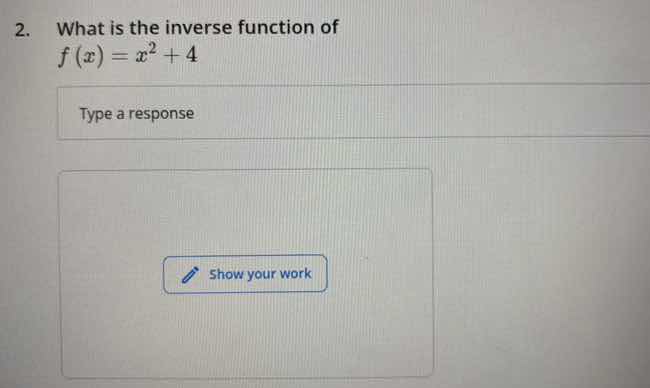
- what is the inverse function of \\( f(x) = x^2 + 4 \\)
Step1: Replace \( f(x) \) with \( y \)
We start by writing the function as \( y = x^2 + 4 \).
Step2: Swap \( x \) and \( y \)
To find the inverse, we interchange \( x \) and \( y \), so we get \( x = y^2 + 4 \).
Step3: Solve for \( y \)
First, subtract 4 from both sides: \( x - 4 = y^2 \). Then, take the square root of both sides. Since the original function \( f(x)=x^2 + 4 \) is not one - to - one over the entire real line, but if we consider the domain \( x\geq0 \) (for the principal square root) or \( x\leq0 \) (for the negative square root), we have \( y=\pm\sqrt{x - 4} \). However, if we assume the original function has a restricted domain (for example, if we consider the function \( f(x)=x^2 + 4 \) with domain \( x\geq0 \), then the inverse function is \( f^{-1}(x)=\sqrt{x - 4},x\geq4 \); if the domain of \( f(x) \) is \( x\leq0 \), then the inverse function is \( f^{-1}(x)=-\sqrt{x - 4},x\geq4 \)). If we don't restrict the domain of the original function, the function \( f(x)=x^2 + 4 \) does not have an inverse function over the set of all real numbers because it is not one - to - one (it fails the horizontal line test). But if we consider the function on a restricted domain where it is one - to - one (e.g., \( x\geq0 \) or \( x\leq0 \)):
Case 1: Domain of \( f(x) \) is \( x\geq0 \)
- Step 1: \( y=x^{2}+4 \)
- Step 2: \( x = y^{2}+4 \) (swap \( x \) and \( y \))
- Step 3: \( y^{2}=x - 4 \)
- Step 4: \( y=\sqrt{x - 4} \) (since \( y\geq0 \) as \( x\geq0 \) in the original function's domain, and \( x-4\geq0\Rightarrow x\geq4 \) for the inverse function's domain)
Case 2: Domain of \( f(x) \) is \( x\leq0 \)
- Step 1: \( y = x^{2}+4 \)
- Step 2: \( x=y^{2}+4 \)
- Step 3: \( y^{2}=x - 4 \)
- Step 4: \( y=-\sqrt{x - 4} \) (since \( y\leq0 \) as \( x\leq0 \) in the original function's domain, and \( x - 4\geq0\Rightarrow x\geq4 \) for the inverse function's domain)
If we assume that the problem expects the inverse considering the principal square root (assuming a restricted domain \( x\geq0 \) for \( f(x) \)):

Snap & solve any problem in the app
Get step-by-step solutions on Sovi AI
Photo-based solutions with guided steps
Explore more problems and detailed explanations
If \( f(x)=x^{2}+4 \) has a domain of \( x\geq0 \), then the inverse function is \( f^{-1}(x)=\sqrt{x - 4},x\geq4 \); if the domain of \( f(x) \) is \( x\leq0 \), the inverse function is \( f^{-1}(x)=-\sqrt{x - 4},x\geq4 \). If the domain of \( f(x) \) is not restricted, \( f(x) \) does not have an inverse function over \( \mathbb{R} \).