QUESTION IMAGE
Question
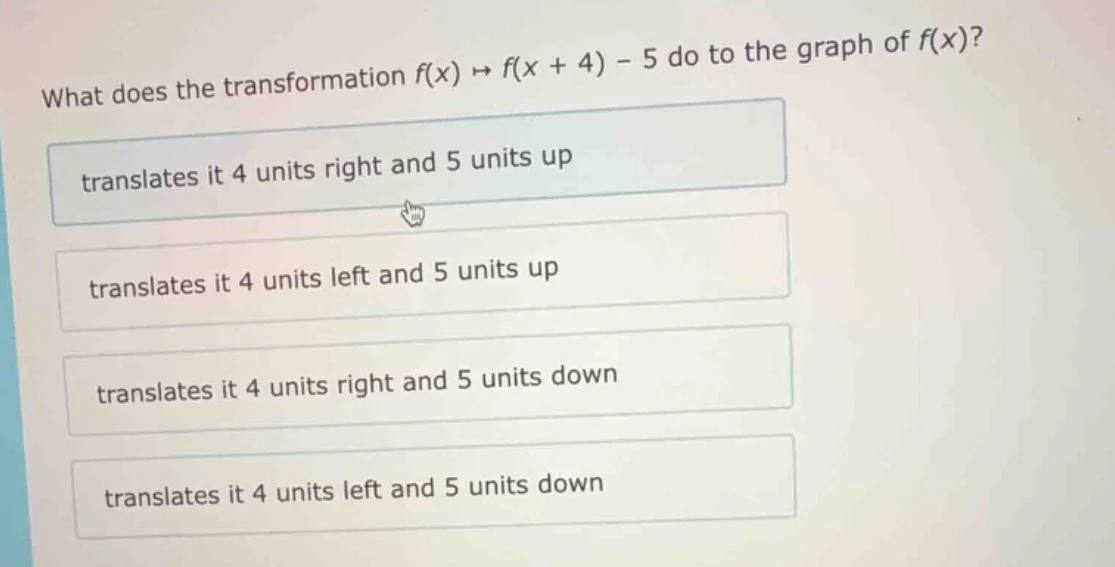
what does the transformation $f(x) \mapsto f(x + 4) - 5$ do to the graph of $f(x)$?
translates it 4 units right and 5 units up
translates it 4 units left and 5 units up
translates it 4 units right and 5 units down
translates it 4 units left and 5 units down
To determine the transformation of the graph of \( f(x) \) under \( f(x) \to f(x + 4) - 5 \), we use the rules for function transformations:
- Horizontal Shift: For a function \( f(x) \), the transformation \( f(x + h) \) represents a horizontal shift. If \( h>0 \), the graph shifts \( h \) units to the left; if \( h<0 \), it shifts \( |h| \) units to the right. In \( f(x + 4) \), \( h = 4>0 \), so the graph shifts 4 units to the left.
- Vertical Shift: For a function \( f(x) \), the transformation \( f(x) + k \) represents a vertical shift. If \( k>0 \), the graph shifts \( k \) units up; if \( k<0 \), it shifts \( |k| \) units down. In \( f(x + 4)-5 \), we can rewrite it as \( f(x + 4)+(-5) \), so \( k=-5<0 \), meaning the graph shifts 5 units down.
Combining these two transformations, the graph of \( f(x) \) is translated 4 units left and 5 units down.

Snap & solve any problem in the app
Get step-by-step solutions on Sovi AI
Photo-based solutions with guided steps
Explore more problems and detailed explanations
D. translates it 4 units left and 5 units down (assuming the options are labeled A, B, C, D with D being "translates it 4 units left and 5 units down")