QUESTION IMAGE
Question
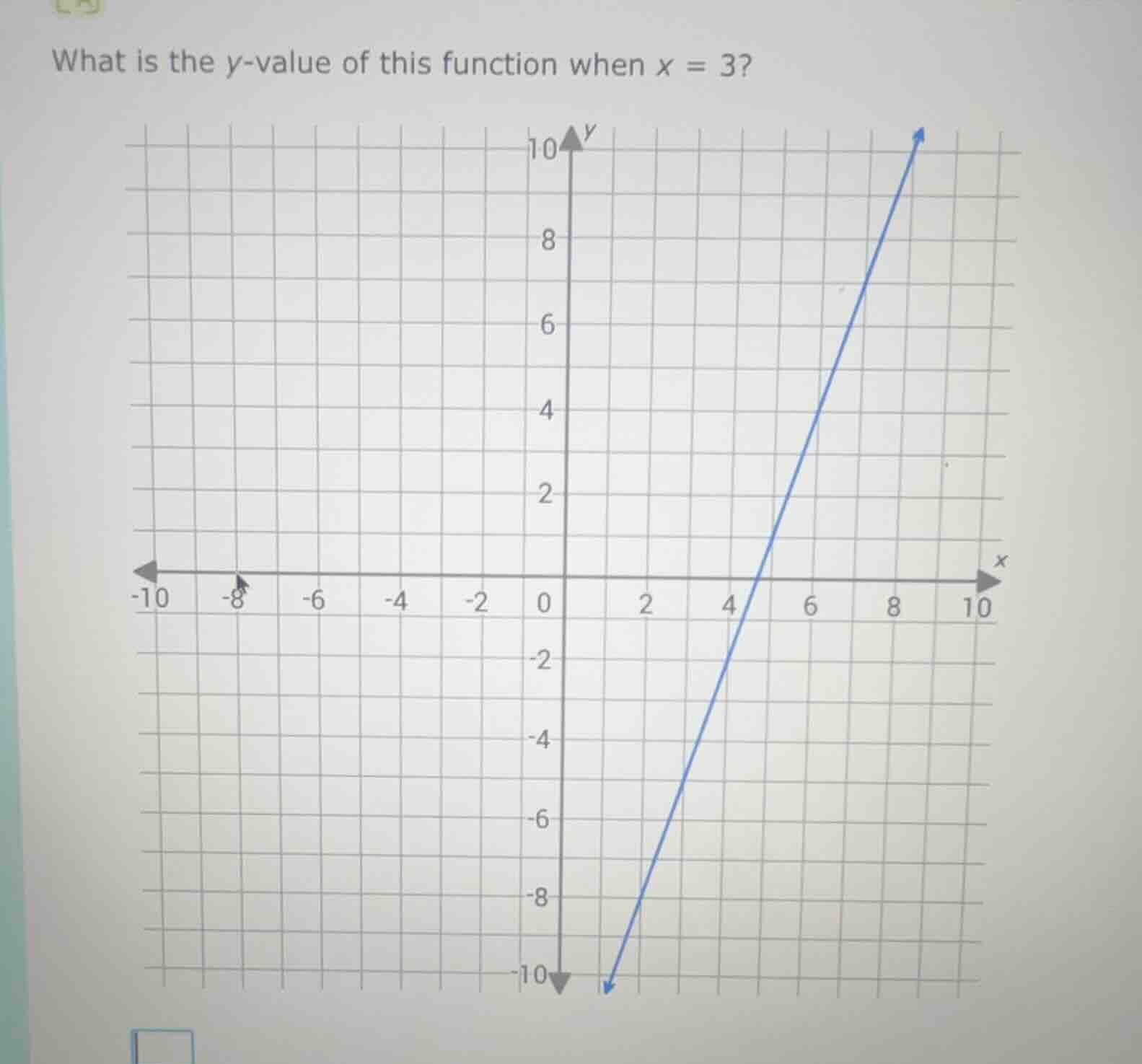
what is the y - value of this function when x = 3?
Step1: Identify the function's graph
The graph is a straight line, so it's a linear function. Let's find the slope first. We can see two points: when \( x = 5 \), \( y = 0 \) (wait, no, looking at the graph, when \( x = 5 \)? Wait, the line crosses the x-axis at \( x = 5 \)? Wait, no, the grid: each square is 1 unit. Let's take two points. Let's see, when \( x = 1 \), wait, no, the line goes through (0,0)? Wait, no, the line has a point at (1, -2)? Wait, no, let's check the slope. Let's take two clear points. Let's see, when \( x = 5 \), \( y = 0 \)? Wait, no, the x-intercept is at \( x = 5 \)? Wait, no, the graph: from the origin? Wait, no, the blue line: let's see, when \( x = 1 \), what's y? Wait, maybe better to find the equation. Let's take two points: (5, 0) and (0, 0)? No, that can't be. Wait, no, the line passes through (5, 0) and (1, -4)? Wait, no, let's count the grid. Each square is 1 unit. Let's take \( x = 5 \), \( y = 0 \); \( x = 1 \), \( y = -4 \). Wait, the slope \( m = \frac{y_2 - y_1}{x_2 - x_1} = \frac{0 - (-4)}{5 - 1} = \frac{4}{4} = 1 \)? Wait, no, that doesn't seem right. Wait, maybe the line passes through (5, 0) and (0, -5)? No, let's look again. Wait, the line: when \( x = 5 \), \( y = 0 \); when \( x = 1 \), \( y = -4 \)? Wait, no, let's check the coordinates. Let's take \( x = 3 \), we need to find y. Wait, maybe the line has a slope of 2? Wait, let's see, when \( x = 5 \), \( y = 0 \); when \( x = 6 \), \( y = 2 \); \( x = 7 \), \( y = 4 \); \( x = 8 \), \( y = 6 \); \( x = 9 \), \( y = 8 \); \( x = 10 \), \( y = 10 \). Wait, no, that's increasing. Wait, maybe the line is \( y = 2(x - 5) \), because when \( x = 5 \), \( y = 0 \). Let's check: when \( x = 6 \), \( y = 2(1) = 2 \); \( x = 7 \), \( y = 4 \); \( x = 8 \), \( y = 6 \); \( x = 9 \), \( y = 8 \); \( x = 10 \), \( y = 10 \). That matches the right side. Now, when \( x = 3 \), plug into \( y = 2(x - 5) \): \( y = 2(3 - 5) = 2(-2) = -4 \). Wait, but let's check the graph. At \( x = 3 \), moving 3 units left from \( x = 5 \), so y should be -4? Wait, but let's see the grid. At \( x = 3 \), the y-coordinate: let's count the squares. From \( x = 5 \) (y=0) to \( x = 3 \), that's 2 units left, so 2 units down (since slope is 2, rise over run is 2/1, so left 2, down 4? Wait, no, slope is 2, so for each x decrease by 1, y decreases by 2. So from \( x = 5 \) (y=0) to \( x = 4 \), y=-2; \( x = 3 \), y=-4. Yes, that makes sense.
Step2: Calculate y when x=3
Using the equation \( y = 2(x - 5) \), substitute \( x = 3 \):
\( y = 2(3 - 5) = 2(-2) = -4 \)

Snap & solve any problem in the app
Get step-by-step solutions on Sovi AI
Photo-based solutions with guided steps
Explore more problems and detailed explanations
-4