QUESTION IMAGE
Question
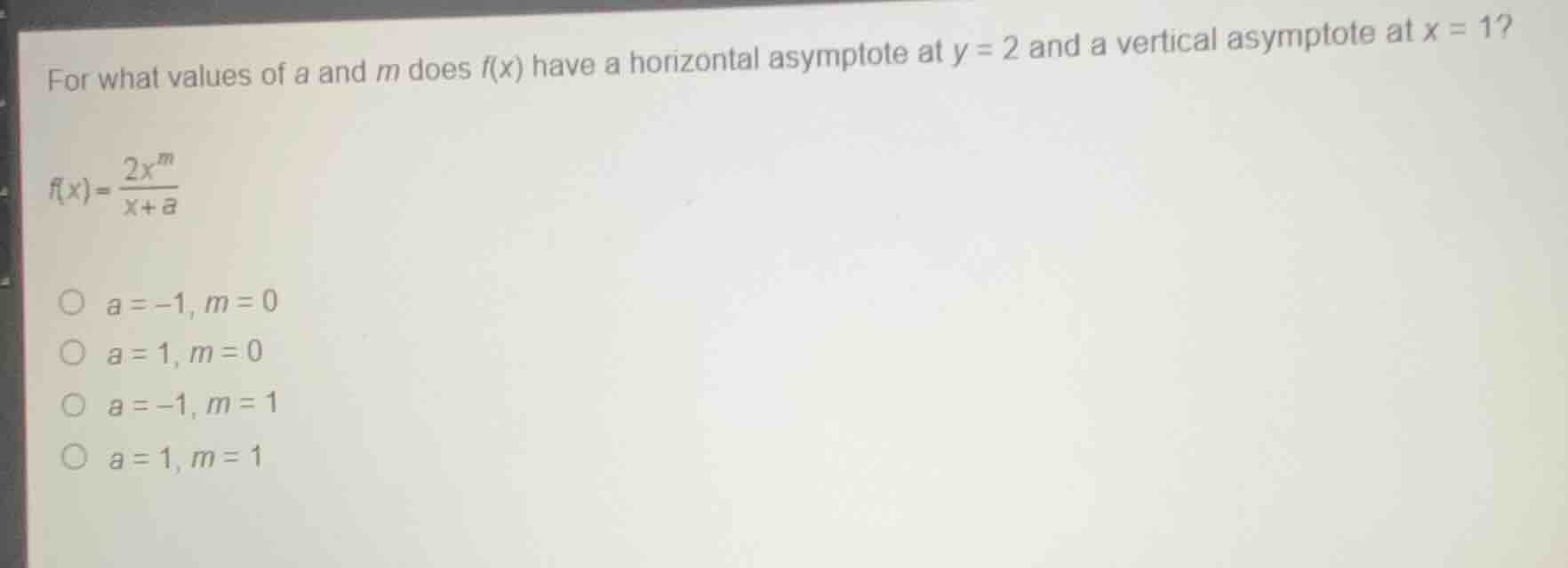
for what values of a and m does f(x) have a horizontal asymptote at y = 2 and a vertical asymptote at x = 1?
f(x) = \frac{2x^m}{x + a}
\bigcirc a = -1, m = 0
\bigcirc a = 1, m = 0
\bigcirc a = -1, m = 1
\bigcirc a = 1, m = 1
Step1: Find vertical asymptote condition
A rational function has a vertical asymptote where its denominator is zero. Set $x+a=0$, and we know the vertical asymptote is at $x=1$. Substitute $x=1$:
$1+a=0$
Step2: Solve for $a$
Rearrange the equation to solve for $a$:
$a=-1$
Step3: Find horizontal asymptote condition
A rational function $f(x)=\frac{p(x)}{q(x)}$ has a horizontal asymptote $y=\frac{\text{leading coefficient of } p(x)}{\text{leading coefficient of } q(x)}$ when the degrees of $p(x)$ and $q(x)$ are equal. For $f(x)=\frac{2x^m}{x+a}$, the degree of the denominator is 1, so the degree of the numerator $m$ must equal 1. The horizontal asymptote is $y=2$, which matches $\frac{2}{1}=2$ when $m=1$.

Snap & solve any problem in the app
Get step-by-step solutions on Sovi AI
Photo-based solutions with guided steps
Explore more problems and detailed explanations
C. $a=-1, m=1$