QUESTION IMAGE
Question
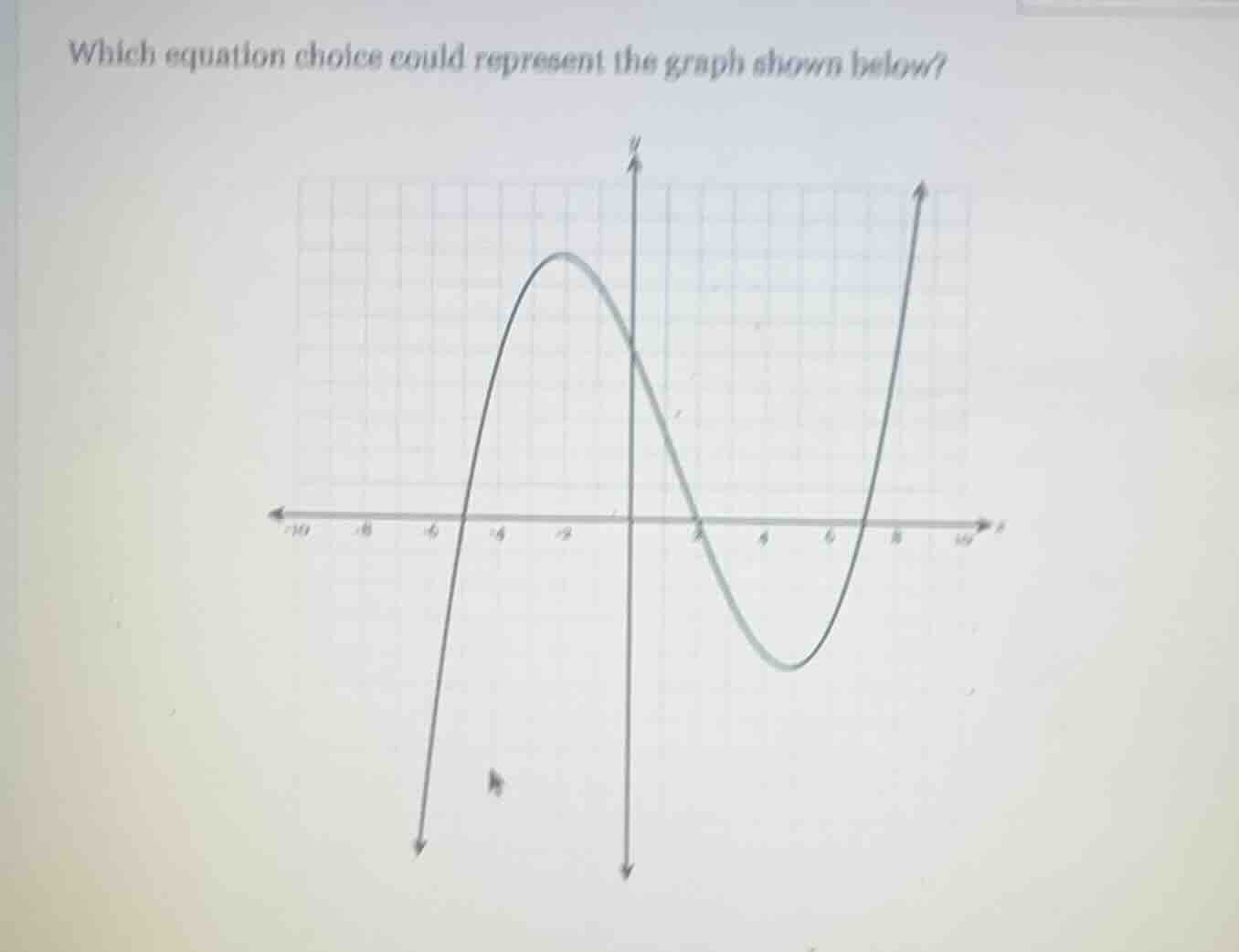
which equation choice could represent the graph shown below?
To solve this, we analyze the graph's features (degree, roots, leading coefficient, y - intercept) and match with polynomial equations. But since the options aren't provided, we'll outline the general approach:
Step 1: Determine the degree and end - behavior
The graph has two "turns" (local max and min), so it's a cubic (degree 3) or higher? Wait, no—wait, the left end goes down, right end up: so leading coefficient positive, and degree odd. Wait, but the graph has three real roots? Wait, the x - intercepts: let's assume the roots are at \(x=-5\) (approx), \(x = 2\) (approx), \(x = 7\) (approx)? Wait, no, looking at the grid: the graph crosses the x - axis at \(x=-5\) (maybe), \(x = 2\), \(x = 7\)? Wait, no, the leftmost x - intercept: between - 6 and - 4, say \(x=-5\), then \(x = 2\), then \(x = 7\). So a cubic function (degree 3) with roots \(r_1=-5\), \(r_2 = 2\), \(r_3=7\), and leading coefficient positive. So the equation would be \(y=a(x + 5)(x - 2)(x - 7)\), \(a>0\). Also, the y - intercept: when \(x = 0\), \(y=a(5)(-2)(-7)=70a\), so positive y - intercept.
Step 2: Analyze the shape
Since it's a cubic (degree 3) with positive leading coefficient (right end up, left end down), and three real roots. So we can check the options (if provided) by:
- Checking the number of real roots (x - intercepts).
- Checking the end - behavior (leading term's degree and coefficient).
- Checking the y - intercept (value when \(x = 0\)).
Since the options are not given, we can't provide a specific answer. But if we assume a sample option, say \(y=(x + 5)(x - 2)(x - 7)\), let's expand it:
Step 3: Expand the polynomial (for verification)
\[
\]
Check end - behavior: as \(x
ightarrow\infty\), \(y
ightarrow\infty\); \(x
ightarrow-\infty\), \(y
ightarrow-\infty\) (matches odd degree, positive leading coefficient). Y - intercept: when \(x = 0\), \(y = 70\) (positive, matches graph). Roots at \(x=-5\), \(x = 2\), \(x = 7\) (matches the x - intercepts we estimated from the graph).
If the options include a cubic function with roots around - 5, 2, 7 and positive leading coefficient, that's the one.
Since the original problem's options are missing, we can't give a definite answer, but the general method is as above. If you provide the options, we can proceed further.

Snap & solve any problem in the app
Get step-by-step solutions on Sovi AI
Photo-based solutions with guided steps
Explore more problems and detailed explanations
To solve this, we analyze the graph's features (degree, roots, leading coefficient, y - intercept) and match with polynomial equations. But since the options aren't provided, we'll outline the general approach:
Step 1: Determine the degree and end - behavior
The graph has two "turns" (local max and min), so it's a cubic (degree 3) or higher? Wait, no—wait, the left end goes down, right end up: so leading coefficient positive, and degree odd. Wait, but the graph has three real roots? Wait, the x - intercepts: let's assume the roots are at \(x=-5\) (approx), \(x = 2\) (approx), \(x = 7\) (approx)? Wait, no, looking at the grid: the graph crosses the x - axis at \(x=-5\) (maybe), \(x = 2\), \(x = 7\)? Wait, no, the leftmost x - intercept: between - 6 and - 4, say \(x=-5\), then \(x = 2\), then \(x = 7\). So a cubic function (degree 3) with roots \(r_1=-5\), \(r_2 = 2\), \(r_3=7\), and leading coefficient positive. So the equation would be \(y=a(x + 5)(x - 2)(x - 7)\), \(a>0\). Also, the y - intercept: when \(x = 0\), \(y=a(5)(-2)(-7)=70a\), so positive y - intercept.
Step 2: Analyze the shape
Since it's a cubic (degree 3) with positive leading coefficient (right end up, left end down), and three real roots. So we can check the options (if provided) by:
- Checking the number of real roots (x - intercepts).
- Checking the end - behavior (leading term's degree and coefficient).
- Checking the y - intercept (value when \(x = 0\)).
Since the options are not given, we can't provide a specific answer. But if we assume a sample option, say \(y=(x + 5)(x - 2)(x - 7)\), let's expand it:
Step 3: Expand the polynomial (for verification)
\[
\]
Check end - behavior: as \(x
ightarrow\infty\), \(y
ightarrow\infty\); \(x
ightarrow-\infty\), \(y
ightarrow-\infty\) (matches odd degree, positive leading coefficient). Y - intercept: when \(x = 0\), \(y = 70\) (positive, matches graph). Roots at \(x=-5\), \(x = 2\), \(x = 7\) (matches the x - intercepts we estimated from the graph).
If the options include a cubic function with roots around - 5, 2, 7 and positive leading coefficient, that's the one.
Since the original problem's options are missing, we can't give a definite answer, but the general method is as above. If you provide the options, we can proceed further.