QUESTION IMAGE
Question
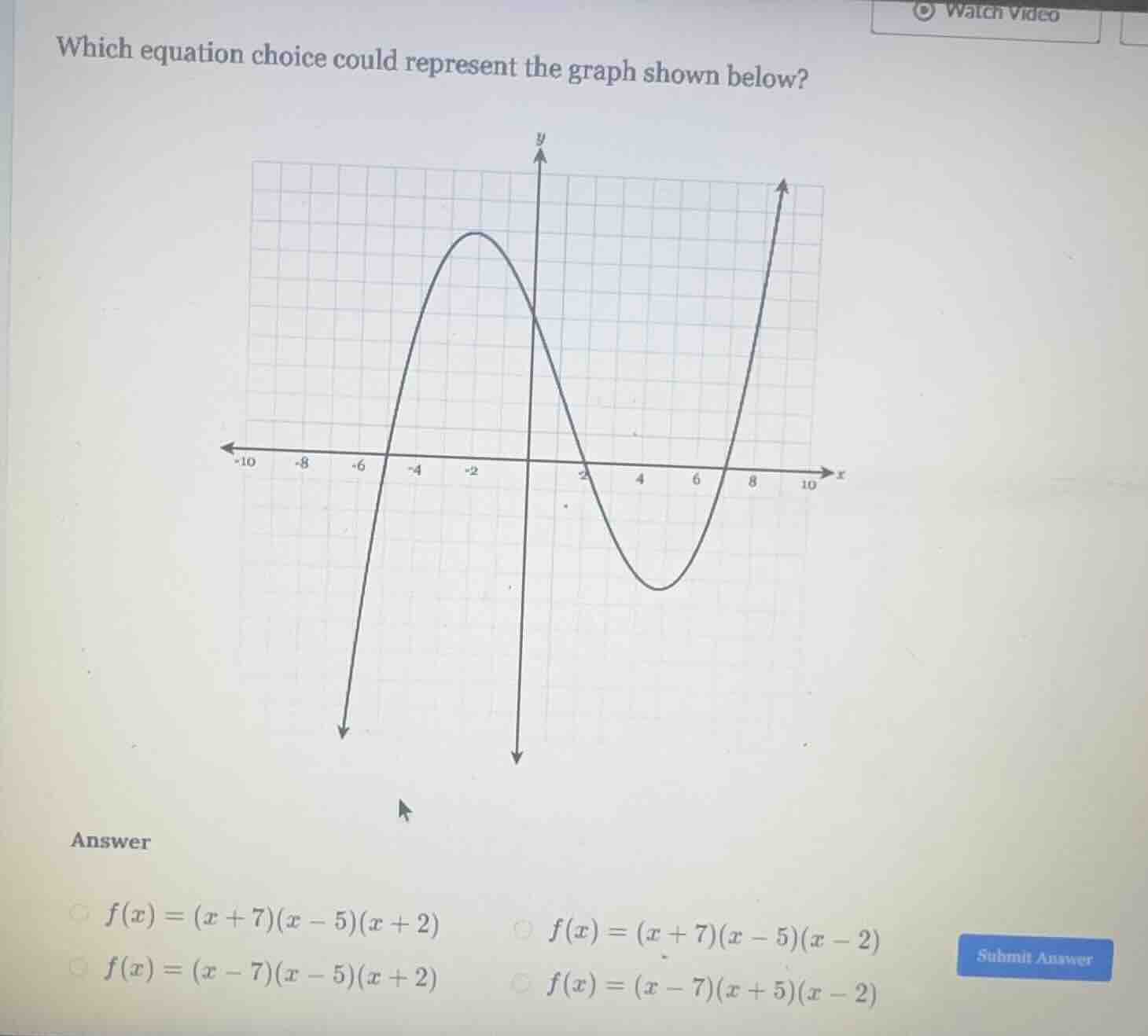
which equation choice could represent the graph shown below?
answer
$f(x) = (x + 7)(x - 5)(x + 2)$ $f(x) = (x + 7)(x - 5)(x - 2)$
$f(x) = (x - 7)(x - 5)(x + 2)$ $f(x) = (x - 7)(x + 5)(x - 2)$
Step1: Identify x-intercepts
From the graph, the x - intercepts (where the graph crosses the x - axis) are at \(x=-7\), \(x = 2\), and \(x = 5\)? Wait, no, looking at the graph, the roots (x - intercepts) are at \(x=-7\)? Wait, no, the graph crosses the x - axis at \(x=-5\)? Wait, no, let's re - examine. The graph crosses the x - axis at \(x=-7\)? Wait, no, the leftmost root is around \(x=-7\)? Wait, no, the graph crosses the x - axis at \(x=-7\)? Wait, no, the correct way: if a graph crosses the x - axis at \(x = a\), then \((x - a)\) is a factor. Wait, no, if the root is \(x = r\), then the factor is \((x - r)\). Wait, looking at the graph, the roots are at \(x=-7\)? No, wait the graph crosses the x - axis at \(x=-7\)? No, let's see the options. Wait, the graph has roots at \(x=-7\)? No, wait the graph crosses the x - axis at \(x=-7\)? No, the left - most intersection with x - axis is at \(x=-7\)? Wait, no, the graph crosses the x - axis at \(x=-7\)? Wait, no, let's look at the options. The roots of the polynomial \(f(x)\) are the x - intercepts. So if the graph crosses the x - axis at \(x=-7\), \(x = 2\), and \(x = 5\)? No, wait the correct roots: from the graph, the x - intercepts are at \(x=-7\) (left), \(x = 2\) (middle), and \(x = 5\) (right)? Wait, no, the graph crosses the x - axis at \(x=-7\)? No, wait the graph: when \(x=-7\), if we plug into the options. Wait, the correct approach: for a polynomial \(f(x)=(x - r_1)(x - r_2)(x - r_3)\), where \(r_1,r_2,r_3\) are the roots (x - intercepts). From the graph, the roots are \(x=-7\), \(x = 2\), and \(x = 5\)? No, wait the graph crosses the x - axis at \(x=-7\)? No, wait the left - most root is \(x=-7\)? Wait, no, the graph: let's see the options. Let's check the sign of the leading coefficient. The end behavior: as \(x
ightarrow+\infty\), \(f(x)
ightarrow+\infty\), and as \(x
ightarrow-\infty\), \(f(x)
ightarrow-\infty\) (since the leading term is \(x^3\), and the coefficient is positive? Wait, no, the degree is 3, so the end behavior is: if the leading coefficient is positive, as \(x
ightarrow+\infty\), \(f(x)
ightarrow+\infty\); as \(x
ightarrow-\infty\), \(f(x)
ightarrow-\infty\). Now, the roots: the graph crosses the x - axis at \(x=-7\), \(x = 2\), and \(x = 5\)? No, wait the graph crosses the x - axis at \(x=-7\)? No, let's check the options. Let's take the option \(f(x)=(x + 7)(x - 5)(x - 2)\). Wait, no, \((x + 7)=x-(-7)\), \((x - 5)=x - 5\), \((x - 2)=x - 2\). So the roots are \(x=-7\), \(x = 5\), \(x = 2\). Wait, but the graph: when \(x = 0\), let's check the y - intercept. The graph crosses the y - axis above 0. Let's check the option \(f(x)=(x + 7)(x - 5)(x - 2)\). Wait, no, the correct roots: from the graph, the roots are \(x=-7\), \(x = 2\), and \(x = 5\)? No, wait the graph: the left root is \(x=-7\), middle is \(x = 2\), right is \(x = 5\)? Wait, no, the graph: when \(x=-7\), the factor is \((x + 7)\), when \(x = 2\), the factor is \((x - 2)\), when \(x = 5\), the factor is \((x - 5)\). Wait, no, the option \(f(x)=(x + 7)(x - 5)(x - 2)\): let's check the end behavior. The leading term is \(x^3\), so as \(x
ightarrow+\infty\), \(f(x)
ightarrow+\infty\); as \(x
ightarrow-\infty\), \(f(x)
ightarrow-\infty\), which matches the graph. Now, let's check the roots: \(x=-7\), \(x = 2\), \(x = 5\). Wait, but the graph: does it cross at \(x=-7\), \(x = 2\), \(x = 5\)? Wait, the left - most intersection with x - axis is at \(x=-7\), then at \(x = 2\), then at \(x = 5\). Wait, no, the correct option: let's check the other options. Option D: \(f(x)=(x - 7)(x + 5)(x - 2)\):…

Snap & solve any problem in the app
Get step-by-step solutions on Sovi AI
Photo-based solutions with guided steps
Explore more problems and detailed explanations
\(f(x)=(x + 7)(x - 5)(x - 2)\) (Option B)