QUESTION IMAGE
Question
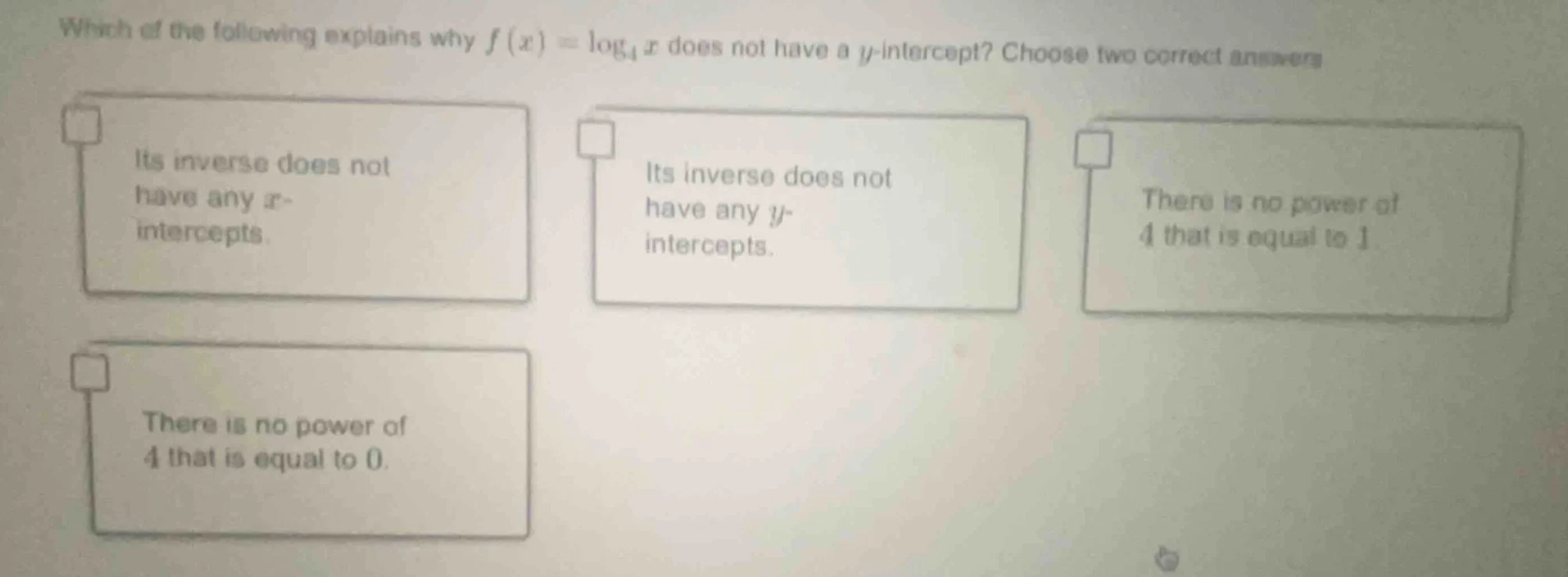
which of the following explains why $f(x)=\log_{4}x$ does not have a $y$-intercept? choose two correct answers
its inverse does not have any $x$-intercepts.
its inverse does not have any $y$-intercepts.
there is no power of 4 that is equal to 1.
there is no power of 4 that is equal to 0.
Step1: Define y-intercept condition
A y-intercept occurs at $x=0$, so we check $f(0)=\log_4 0$.
Step2: Rewrite log as exponential form
By definition, $\log_4 0 = y$ means $4^y=0$.
Step3: Analyze exponential function behavior
For any real $y$, $4^y>0$, so $4^y=0$ has no solution.
Step4: Relate to inverse function
The inverse of $f(x)=\log_4 x$ is $g(x)=4^x$. A y-intercept of $f(x)$ corresponds to an x-intercept of $g(x)$ (since inverse functions swap x and y). An x-intercept of $g(x)$ would satisfy $4^x=0$, which has no solution, so $g(x)$ has no x-intercepts.

Snap & solve any problem in the app
Get step-by-step solutions on Sovi AI
Photo-based solutions with guided steps
Explore more problems and detailed explanations
- Its inverse does not have any x-intercepts.
- There is no power of 4 that is equal to 0.