QUESTION IMAGE
Question
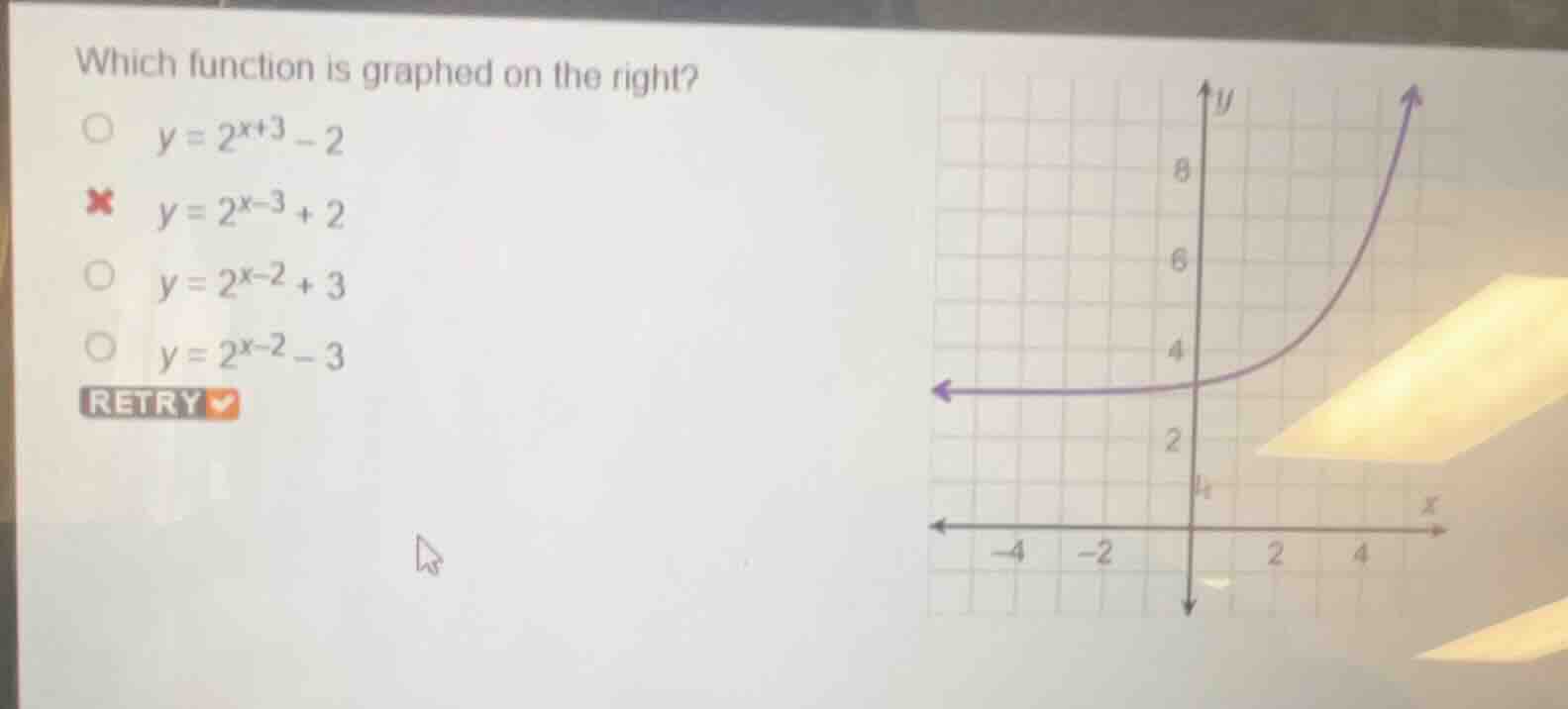
which function is graphed on the right?
○ $y = 2^{x+3} - 2$
× $y = 2^{x-3} + 2$
○ $y = 2^{x-2} + 3$
○ $y = 2^{x-2} - 3$
retry
Step1: Analyze the horizontal asymptote
The graph has a horizontal asymptote. For exponential functions of the form \( y = 2^{x - h}+k \), the horizontal asymptote is \( y = k \). From the graph, the horizontal asymptote is \( y = 3 \)? Wait, no, looking at the graph, when \( x\) approaches \( -\infty \), the function approaches \( 3 \)? Wait, no, the graph shows that as \( x\to -\infty \), the function approaches a value around 3? Wait, no, let's check the y-intercept. When \( x = 0 \), let's calculate each function:
- For \( y = 2^{x + 3}-2 \): When \( x = 0 \), \( y = 2^{3}-2=8 - 2 = 6 \). But the graph at \( x = 0 \) is around 3 or 4? Wait, no, the graph at \( x = 0 \) is at \( y = 3 \)? Wait, no, the graph in the picture: the y-intercept is around \( y = 3 \)? Wait, no, let's re-examine.
Wait, the standard exponential function \( y = 2^{x} \) has a horizontal asymptote \( y = 0 \), passes through \( (0,1) \).
For \( y = 2^{x - h}+k \), the horizontal asymptote is \( y = k \), and the graph is shifted \( h \) units horizontally and \( k \) units vertically.
Looking at the graph, the horizontal asymptote is \( y = 3 \)? Wait, no, the graph as \( x\to -\infty \) approaches a value, let's see the grid. The y-axis: the horizontal line (asymptote) is at \( y = 3 \)? Wait, no, the graph is above \( y = 3 \)? Wait, no, the options:
Wait, let's check each option's horizontal asymptote (k value) and y-intercept (x=0):
- Option 1: \( y = 2^{x + 3}-2 \). Asymptote \( y = -2 \). Not matching, since graph's asymptote is positive.
- Option 2: \( y = 2^{x - 3}+2 \). Asymptote \( y = 2 \). When \( x = 0 \), \( y = 2^{-3}+2=\frac{1}{8}+2 = 2.125 \). But the graph at \( x = 0 \) is higher? Wait, no, maybe I misread the graph.
- Option 3: \( y = 2^{x - 2}+3 \). Asymptote \( y = 3 \). When \( x = 0 \), \( y = 2^{-2}+3=\frac{1}{4}+3 = 3.25 \). That matches the y-intercept (around 3-4).
- Option 4: \( y = 2^{x - 2}-3 \). Asymptote \( y = -3 \). Not matching.
Wait, but the original marked answer was wrong (the red X on option 2). Let's check the correct one.
Wait, maybe the horizontal asymptote is \( y = 3 \), so \( k = 3 \), so the function should have \( +3 \) at the end. So the form is \( y = 2^{x - h}+3 \). Then, when \( x = 2 \), \( y = 2^{0}+3 = 1 + 3 = 4 \). Let's see the graph: when \( x = 2 \), \( y = 4 \), which matches \( y = 2^{x - 2}+3 \) (when \( x = 2 \), \( y = 2^{0}+3 = 4 \)). And the horizontal asymptote is \( y = 3 \), which matches the graph (as \( x\to -\infty \), \( 2^{x - 2}\to 0 \), so \( y\to 3 \)).
Wait, let's confirm:
For \( y = 2^{x - 2}+3 \):
- Horizontal asymptote: \( y = 3 \) (correct, as graph approaches 3 as \( x\to -\infty \)).
- When \( x = 2 \), \( y = 2^{0}+3 = 4 \) (matches the graph at \( x = 2 \), y=4).
- When \( x = 0 \), \( y = 2^{-2}+3 = \frac{1}{4}+3 = 3.25 \) (matches the y-intercept around 3-4).
So the correct function is \( y = 2^{x - 2}+3 \).
Step2: Verify the correct function
We analyze the horizontal asymptote (k) and key points (like x=2, x=0) for each function:
- \( y = 2^{x + 3}-2 \): Asymptote \( y = -2 \) (incorrect, graph's asymptote is positive).
- \( y = 2^{x - 3}+2 \): Asymptote \( y = 2 \), x=0: \( y = 2^{-3}+2 \approx 2.125 \) (doesn't match y-intercept).
- \( y = 2^{x - 2}+3 \): Asymptote \( y = 3 \), x=2: \( y = 4 \) (matches graph), x=0: \( y = 3.25 \) (matches y-intercept).
- \( y = 2^{x - 2}-3 \): Asymptote \( y = -3 \) (incorrect).
Thus, the correct function is \( y = 2^{x - 2}+3 \).

Snap & solve any problem in the app
Get step-by-step solutions on Sovi AI
Photo-based solutions with guided steps
Explore more problems and detailed explanations
\( y = 2^{x - 2}+3 \) (the third option: \( y = 2^{x - 2}+3 \))