QUESTION IMAGE
Question
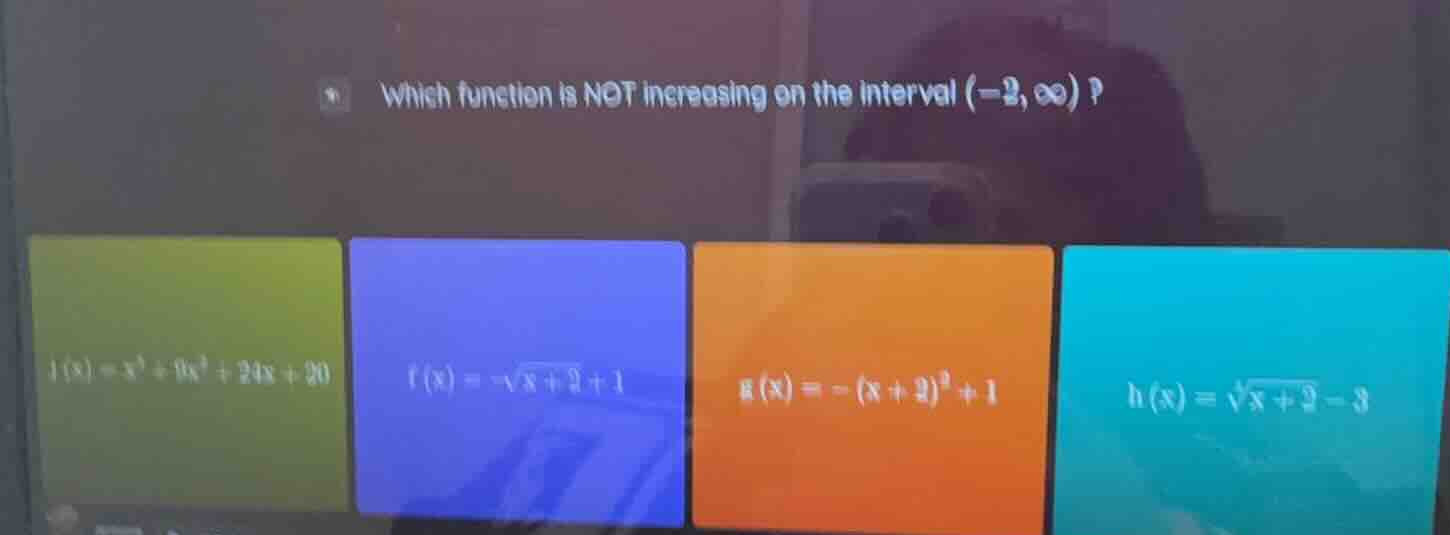
which function is not increasing on the interval $(-2, \infty)$?
$f(x)=x^3 + 9x^2 + 24x + 20$
$f(x)= -\sqrt{x + 2} + 1$
$g(x)= -(x + 2)^9 + 1$
$h(x)= \sqrt3{x + 2} - 3$
Step1: Analyze $f(x)=x^3+9x^2+24x+20$
Find derivative: $f'(x)=3x^2+18x+24=3(x^2+6x+8)=3(x+2)(x+4)$. For $x\in(-2,\infty)$, $(x+2)>0$, $(x+4)>0$, so $f'(x)>0$. Function is increasing.
Step2: Analyze $f(x)=-\sqrt{x+2}+1$
Find derivative: $f'(x)=-\frac{1}{2\sqrt{x+2}}$. For $x\in(-2,\infty)$, $\sqrt{x+2}>0$, so $f'(x)<0$. Function is decreasing.
Step3: Analyze $g(x)=-(x+2)^2+1$
Find derivative: $g'(x)=-2(x+2)$. For $x\in(-2,\infty)$, $(x+2)>0$, so $g'(x)<0$. Function is decreasing.
Step4: Analyze $h(x)=\sqrt[3]{x+2}-3$
Find derivative: $h'(x)=\frac{1}{3(x+2)^{\frac{2}{3}}}$. For $x\in(-2,\infty)$, $(x+2)^{\frac{2}{3}}>0$, so $h'(x)>0$. Function is increasing.
Step5: Identify non-increasing functions
We need functions NOT increasing on $(-2,\infty)$, which are the decreasing ones.

Snap & solve any problem in the app
Get step-by-step solutions on Sovi AI
Photo-based solutions with guided steps
Explore more problems and detailed explanations
$f(x) = -\sqrt{x+2} + 1$, $g(x) = -(x+2)^2 + 1$