QUESTION IMAGE
Question
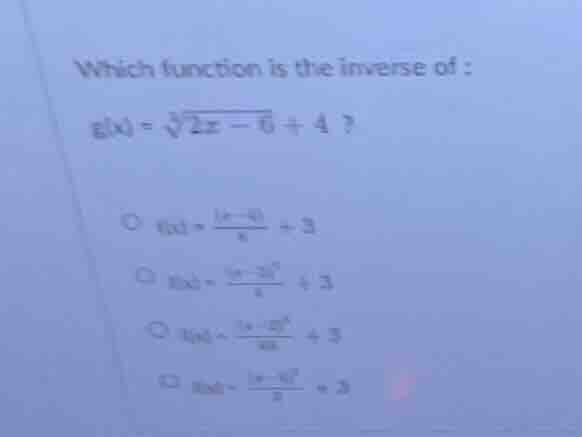
which function is the inverse of :
g(x) = \sqrt3{2x - 6} + 4 ?
\bigcirc f(x) = \frac{(x - 4)}{2} + 3
\bigcirc f(x) = \frac{(x - 3)^2}{2} + 3
\bigcirc f(x) = \frac{(x - 4)^3}{2} + 3
\bigcirc f(x) = \frac{(x - 4)^3}{2} + 3
Step1: Replace \( g(x) \) with \( y \)
We start by letting \( y = g(x) \), so we have \( y=\sqrt[3]{2x - 6}+4 \).
Step2: Solve for \( x \) in terms of \( y \)
First, subtract 4 from both sides: \( y - 4=\sqrt[3]{2x - 6} \).
Then, cube both sides to eliminate the cube root: \( (y - 4)^3=2x - 6 \).
Next, add 6 to both sides: \( (y - 4)^3+6 = 2x \).
Then, divide both sides by 2: \( x=\frac{(y - 4)^3+6}{2}=\frac{(y - 4)^3}{2}+3 \). Wait, maybe I made a miscalculation. Wait, let's re - do the steps.
Wait, original function: \( y=\sqrt[3]{2x - 6}+4 \)
Subtract 4: \( y - 4=\sqrt[3]{2x - 6} \)
Cube both sides: \( (y - 4)^3=2x - 6 \)
Add 6: \( (y - 4)^3+6 = 2x \)
Divide by 2: \( x=\frac{(y - 4)^3 + 6}{2}=\frac{(y - 4)^3}{2}+3\). Wait, but looking at the options, maybe there is a typo in my approach. Wait, maybe the original function is \( g(x)=\sqrt[3]{2(x - 3)}+4 \)? No, the original is \( g(x)=\sqrt[3]{2x - 6}+4=\sqrt[3]{2(x - 3)}+4 \).
Wait, let's try again. Let \( y=\sqrt[3]{2x - 6}+4 \)
Subtract 4: \( y - 4=\sqrt[3]{2x - 6} \)
Cube both sides: \( (y - 4)^3=2x - 6 \)
Then, \( 2x=(y - 4)^3 + 6 \)
\( x=\frac{(y - 4)^3+6}{2}=\frac{(y - 4)^3}{2}+3 \). Wait, but the options have \( \frac{(x - 4)^3}{2}+3 \) or similar. Wait, maybe the options are written with \( x \) instead of \( y \) when we swap.
After finding \( x \) in terms of \( y \), we swap \( x \) and \( y \) to get the inverse function. So the inverse function \( f(x) \) is obtained by replacing \( y \) with \( x \) in the expression for \( x \) in terms of \( y \).
So from \( x=\frac{(y - 4)^3+6}{2} \), swapping \( x \) and \( y \) gives \( y=\frac{(x - 4)^3+6}{2}=\frac{(x - 4)^3}{2}+3 \). Wait, but let's check the options. The fourth option (assuming the options are labeled as A, B, C, D and the fourth is \( f(x)=\frac{(x - 4)^3}{2}+3 \))
Wait, let's re - calculate:
\( y=\sqrt[3]{2x - 6}+4 \)
\( y - 4=\sqrt[3]{2x - 6} \)
\( (y - 4)^3=2x - 6 \)
\( 2x=(y - 4)^3+6 \)
\( x=\frac{(y - 4)^3 + 6}{2}=\frac{(y - 4)^3}{2}+3 \)
Now, replace \( y \) with \( x \): \( f(x)=\frac{(x - 4)^3}{2}+3 \)

Snap & solve any problem in the app
Get step-by-step solutions on Sovi AI
Photo-based solutions with guided steps
Explore more problems and detailed explanations
The inverse function is \( f(x)=\frac{(x - 4)^3}{2}+3 \) (assuming the last option is \( f(x)=\frac{(x - 4)^3}{2}+3 \))