QUESTION IMAGE
Question
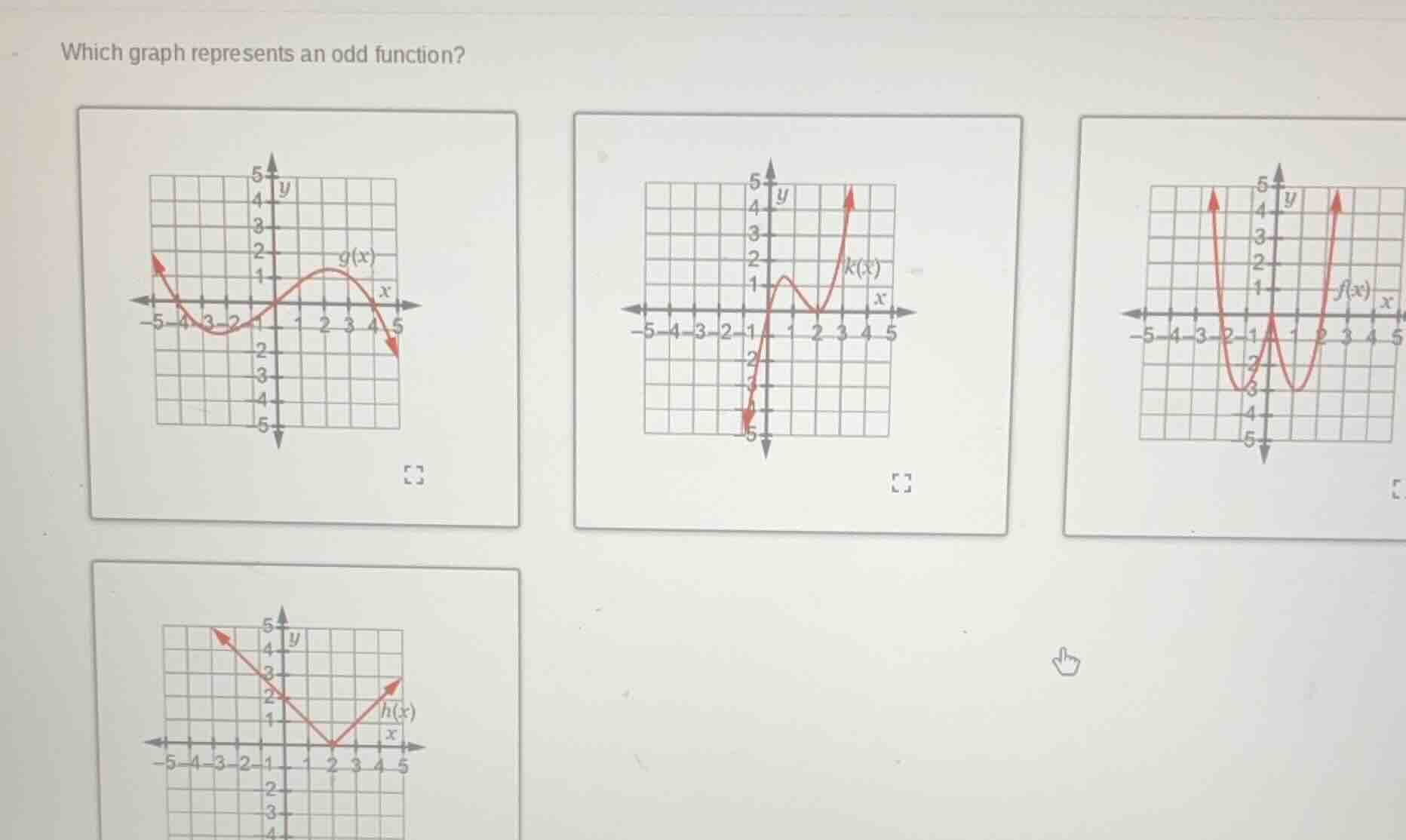
which graph represents an odd function?
Step1: Recall the definition of an odd function
An odd function satisfies the property \( f(-x) = -f(x) \) for all \( x \) in its domain. Geometrically, the graph of an odd function is symmetric about the origin. This means that if we rotate the graph 180 degrees about the origin, it maps onto itself. Also, for every point \((x, y)\) on the graph, the point \((-x, -y)\) should also be on the graph.
Step2: Analyze each graph
- Graph of \( g(x) \): Let's check symmetry about the origin. For example, take a point on the graph. If we consider a point \((x, y)\), does \((-x, -y)\) lie on the graph? Looking at the graph, we can see that it appears symmetric about the origin. Let's verify with a point. Suppose at \( x = 2 \), the function has a peak. At \( x=- 2 \), we should have a trough (since \( -y \) would be the value). From the graph, this seems to hold.
- Graph of \( k(x) \): This graph does not seem symmetric about the origin. For example, the behavior on the left side of the y - axis (negative x - values) and the right side (positive x - values) is not a mirror image about the origin. The graph has a different shape on the left and right, so it is not symmetric about the origin.
- Graph of \( f(x) \): This is a parabola opening upwards with vertex on the y - axis. The graph of \( f(x) \) is symmetric about the y - axis, which is the property of an even function (\( f(-x)=f(x) \)), not an odd function.
- Graph of \( h(x) \): This is a V - shaped graph (absolute - value - like) with vertex at \((2,0)\). It is symmetric about the vertical line \( x = 2 \), not about the origin. So it does not represent an odd function.

Snap & solve any problem in the app
Get step-by-step solutions on Sovi AI
Photo-based solutions with guided steps
Explore more problems and detailed explanations
The graph of \( g(x) \) (the first graph) represents an odd function.