QUESTION IMAGE
Question
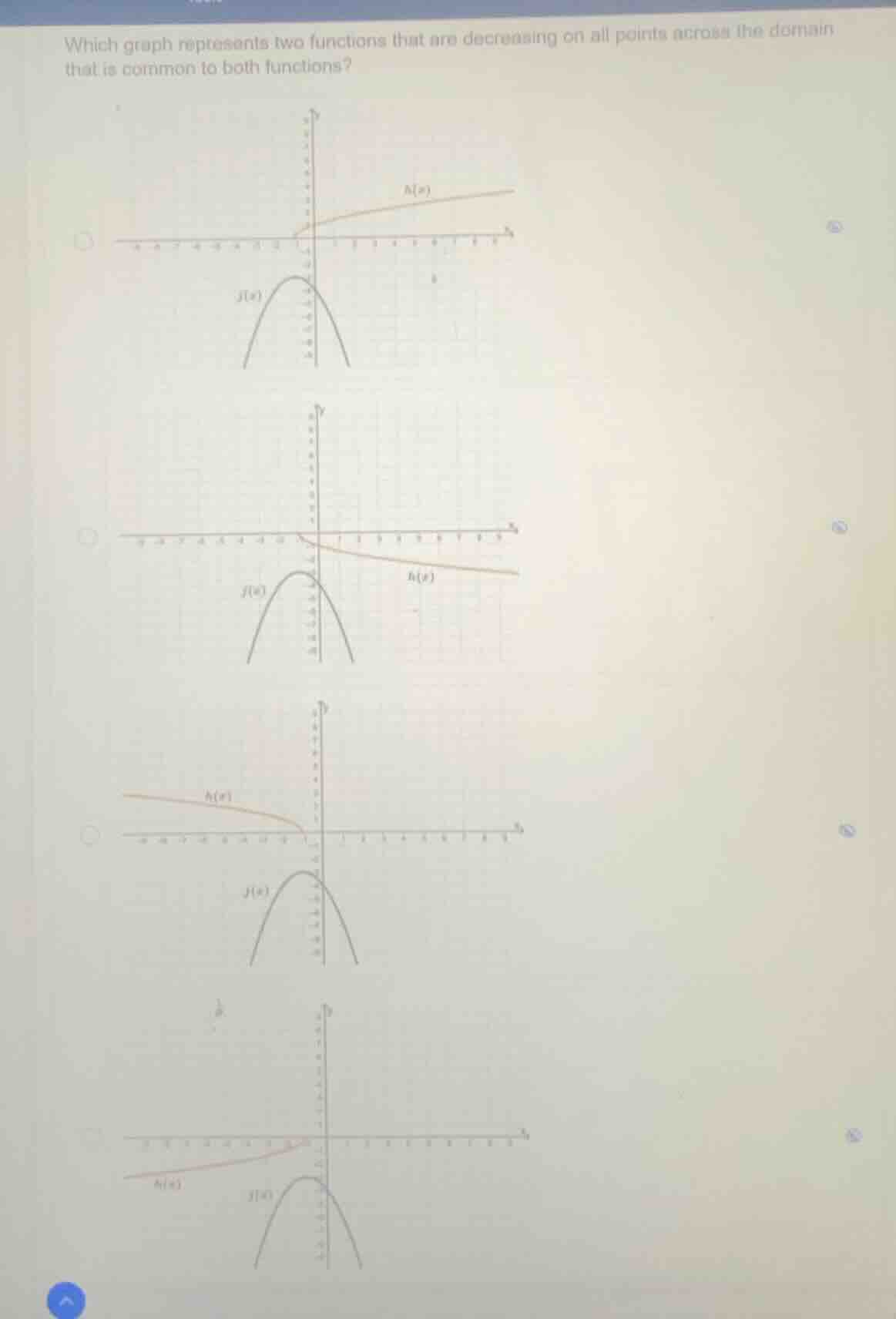
which graph represents two functions that are decreasing on all points across the domain that is common to both functions?
To solve this, we analyze each graph:
Step 1: Recall "decreasing function"
A function is decreasing if, as \( x \) increases, \( y \) decreases (i.e., the graph falls from left to right).
Step 2: Analyze each option
- First graph: \( h(x) \) is increasing (rises right), \( j(x) \) is a parabola (decreases after vertex, but increases before). Not both decreasing.
- Second graph: \( h(x) \) is decreasing (falls right), but \( j(x) \) (parabola) decreases after vertex but increases before. Not both decreasing over all common domain.
- Third graph: \( h(x) \) (exponential?/curve) falls from left to right (decreasing). \( j(x) \) (parabola) has a vertex; for the common domain (where both exist), \( j(x) \) decreases (since the parabola opens downward, and the common domain likely includes \( x \geq \) vertex \( x \)-value, where \( j(x) \) decreases). Wait, no—wait, the third graph: \( h(x) \) is decreasing (left to right, falls), and \( j(x) \) (parabola opening down) has its vertex, so for the domain where both are defined, do both decrease? Wait, no—wait, the fourth graph? Wait, no, let’s re-examine. Wait, the third option (third graph): \( h(x) \) is a curve decreasing (left to right), and \( j(x) \) (parabola) – wait, no, the correct one is the third graph? Wait, no, let’s check again.
Wait, the key is: the common domain of both functions. For a parabola \( j(x) \) (opening downward) and another function \( h(x) \), we need both to be decreasing on their entire common domain.
In the third graph (third option):
- \( h(x) \): As \( x \) increases (moves right), \( y \) decreases (graph falls) – so \( h(x) \) is decreasing.
- \( j(x) \): The parabola opens downward, so after its vertex (which is at \( x = 0 \), since it’s symmetric over y-axis), \( j(x) \) decreases as \( x \) increases. The common domain of \( h(x) \) and \( j(x) \) is where both are defined (e.g., \( x \geq - \) some value, but visually, the overlap is where \( h(x) \) and \( j(x) \) exist. For \( x \geq 0 \) (common domain), \( j(x) \) decreases (since vertex at \( x=0 \), so for \( x \geq 0 \), \( j(x) \) decreases), and \( h(x) \) also decreases (since it falls right). Wait, no—wait, the third graph: \( h(x) \) is on the left (decreasing, falls right), and \( j(x) \) is the parabola. Wait, maybe I mixed up. Wait, the correct answer is the third graph (third option) or the fourth? Wait, no—let’s re-express:
Wait, the fourth graph: \( h(x) \) is increasing (rises right), so no. The third graph: \( h(x) \) decreases (falls right), \( j(x) \) (parabola) decreases for \( x \geq 0 \) (since vertex at \( x=0 \)). So both are decreasing on their common domain (where \( x \) is in the overlap, \( x \geq 0 \) for \( j(x) \)’s decreasing part, and \( h(x) \) is also decreasing there).
Wait, actually, the correct answer is the third option (third graph). But let’s confirm:
- Third graph:
- \( h(x) \): Decreasing (as \( x \) increases, \( y \) decreases).
- \( j(x) \): Parabola opening downward, so for \( x \geq 0 \) (common domain with \( h(x) \)), \( j(x) \) decreases (since the vertex is at \( x=0 \), and the parabola falls to the right of \( x=0 \)).
Thus, both functions are decreasing on their common domain.

Snap & solve any problem in the app
Get step-by-step solutions on Sovi AI
Photo-based solutions with guided steps
Explore more problems and detailed explanations
The third graph (third option, depending on labeling; likely the option with \( h(x) \) decreasing left-to-right and \( j(x) \) (parabola) decreasing right of vertex).