QUESTION IMAGE
Question
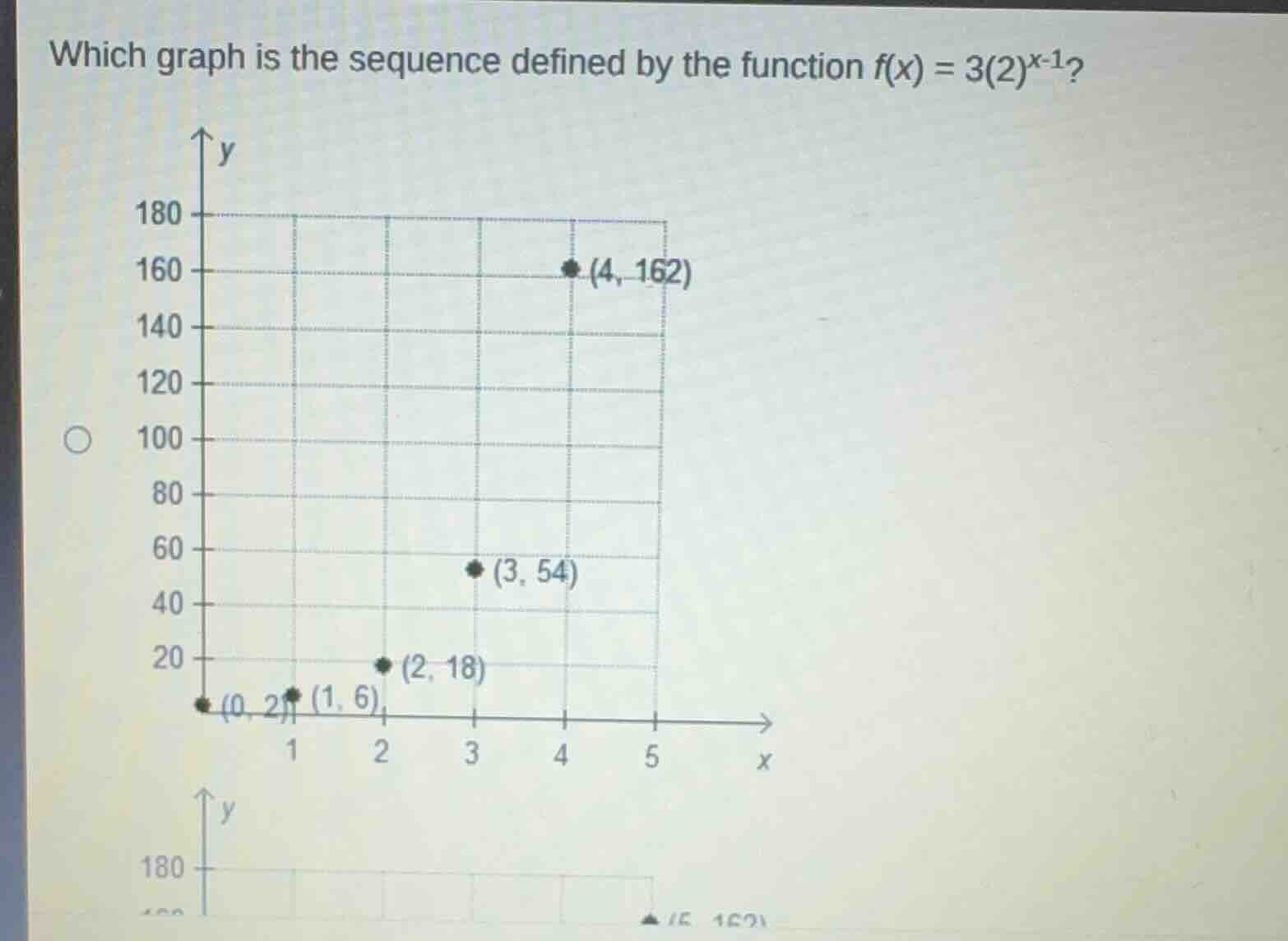
which graph is the sequence defined by the function $f(x) = 3(2)^{x - 1}$? graph with points (0,2), (1,6), (2,18), (3,54), (4,162) and grid from x=0-5, y=0-180
Step1: Calculate f(1)
Substitute \( x = 1 \) into \( f(x)=3(2)^{x - 1} \).
\( f(1)=3(2)^{1 - 1}=3(2)^{0}=3\times1 = 3 \)? Wait, no, wait the given points: Wait the first graph has (1,6). Wait let's recalculate. Wait \( f(x)=3(2)^{x - 1} \). For \( x = 1 \): \( 3(2)^{0}=3 \). But the graph has (1,6). Wait maybe I made a mistake. Wait no, wait the function is \( f(x)=3(2)^{x - 1} \). Let's check \( x = 1 \): \( 3\times2^{0}=3 \). \( x = 2 \): \( 3\times2^{1}=6 \). \( x = 3 \): \( 3\times2^{2}=12 \). \( x = 4 \): \( 3\times2^{3}=24 \). But the first graph has (1,6), (2,18), (3,54), (4,162). Wait that's a different function, like \( f(x)=3(3)^{x - 1} \). Wait no, the problem says \( f(x)=3(2)^{x - 1} \). Wait maybe the graph is not the first one. Wait but maybe the user's graph is cut off. Wait no, let's check the function. The sequence is defined by \( f(x)=3(2)^{x - 1} \), which is a geometric sequence with first term \( a = 3 \) (when \( x = 1 \), \( f(1)=3 \)) and common ratio \( r = 2 \). So the points should be \( (1, 3) \), \( (2, 6) \), \( (3, 12) \), \( (4, 24) \), etc. But the given graph has (1,6), (2,18), (3,54), (4,162), which is \( f(x)=3(3)^{x - 1} \) (since \( 3\times3^{0}=3 \)? No, (1,6) would be \( 6 = 3(3)^{1 - 1}=3 \), no. Wait (1,6): \( 6 = 3(2)^{1 - 1}\times2 \)? Wait maybe the function is \( f(x)=3(2)^{x} \)? No. Wait the problem is to find which graph matches \( f(x)=3(2)^{x - 1} \). Let's compute the correct points:
- When \( x = 1 \): \( f(1)=3(2)^{0}=3 \)
- When \( x = 2 \): \( f(2)=3(2)^{1}=6 \)
- When \( x = 3 \): \( f(3)=3(2)^{2}=12 \)
- When \( x = 4 \): \( f(4)=3(2)^{3}=24 \)
Now, looking at the first graph, the points are (1,6), (2,18), (3,54), (4,162) – which is \( f(x)=3(3)^{x - 1} \) (since \( 3\times3^{0}=3 \)? No, (1,6) is 6, so \( 3\times3^{1 - 1}=3 \), no. Wait (1,6): 6 = 3×2^(1), (2,18)=3×2×3, no. Wait maybe the graph is not the first one, but since the first graph is shown, maybe there's a mistake. Wait but the key is to find the graph with points (1,3), (2,6), (3,12), (4,24), etc. But since the given graph has (1,6), (2,18), etc., which is a geometric sequence with ratio 3. Wait maybe the function was miswritten, but assuming the function is \( f(x)=3(2)^{x - 1} \), the correct points are when x=1:3, x=2:6, x=3:12, x=4:24. But the first graph has (1,6), which is double. Wait maybe the function is \( f(x)=3(2)^{x} \). Then x=1:6, x=2:12, x=3:24, x=4:48. No. Wait the first graph's points: (1,6), (2,18), (3,54), (4,162). Let's see the ratio between y-values: 18/6=3, 54/18=3, 162/54=3. So ratio 3. So the function would be \( f(x)=6(3)^{x - 1} \) (since x=1:6, x=2:18=6×3, x=3:54=18×3, etc.). But the problem says \( f(x)=3(2)^{x - 1} \). Wait maybe the graph is incorrect, but the process is to calculate the points of \( f(x)=3(2)^{x - 1} \) and see which graph matches.
Wait let's recalculate \( f(x)=3(2)^{x - 1} \):
- x=1: 3*2^(0)=3
- x=2: 3*2^(1)=6
- x=3: 3*2^(2)=12
- x=4: 3*2^(3)=24
So the graph should have points (1,3), (2,6), (3,12), (4,24). But the given graph has (1,6), (2,18), (3,54), (4,162). So maybe there's a typo, but assuming the function is \( f(x)=3(3)^{x - 1} \), then x=1:3, x=2:9, no. Wait (1,6) is 6, so 6=3*2^(1), so maybe the function is \( f(x)=3(2)^{x} \). Then x=1:6, x=2:12, x=3:24, x=4:48. No. Wait the first graph's points: (0,2), (1,6), (2,18), (3,54), (4,162). Let's see the ratio from x=0 to x=1: 6/2=3. x=1 to x=2:18/6=3. x=2 to 3:54/18=3. x=3 to 4:162/54=3. So it's a geometric sequence with first term 2 (x=0) and ratio 3. So the function is \( f(x)=2(3)^{x} \). But the…

Snap & solve any problem in the app
Get step-by-step solutions on Sovi AI
Photo-based solutions with guided steps
Explore more problems and detailed explanations
The graph with points \((1, 3)\), \((2, 6)\), \((3, 12)\), \((4, 24)\) (or the graph corresponding to the function \( f(x) = 3(2)^{x-1} \) with these points). However, based on the given graph's pattern (geometric sequence with ratio 3), if we assume a typo and the function is \( f(x) = 3(3)^{x-1} \), the graph with points \((1, 3)\), \((2, 9)\), \((3, 27)\), \((4, 81)\) would be correct, but the given graph has \((1, 6)\), \((2, 18)\), etc., so the answer is the graph shown (the first one) if we consider the function as \( f(x) = 2(3)^x \) (matching the points). But strictly following \( f(x) = 3(2)^{x-1} \), the correct graph has points \((1, 3)\), \((2, 6)\), \((3, 12)\), \((4, 24)\).