QUESTION IMAGE
Question
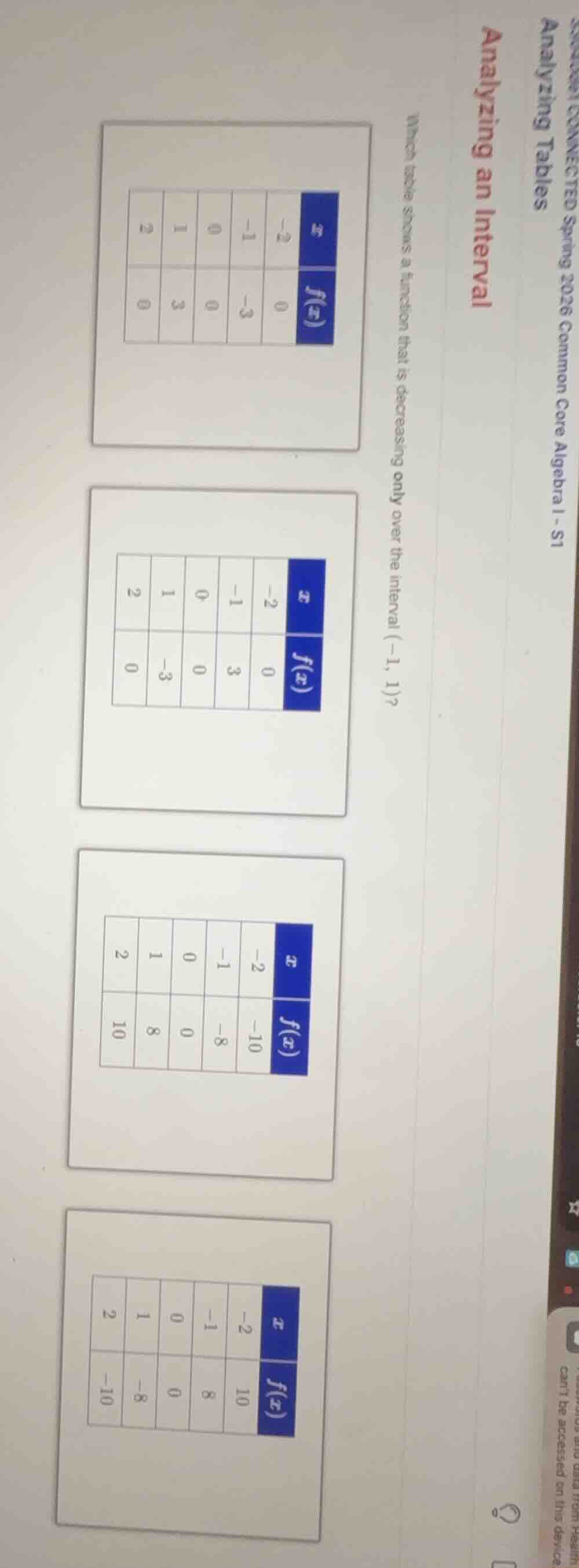
which table shows a function that is decreasing only over the interval (-1, 1)?
To determine which table shows a function decreasing only over the interval \((-1, 1)\), we analyze the change in \(f(x)\) as \(x\) increases from \(-1\) to \(1\) (i.e., for \(x = -1, 0, 1\)) and check the behavior outside this interval. A function is decreasing when as \(x\) increases, \(f(x)\) decreases.
Analyze Table 1:
\(x\): \(-2, -1, 0, 1, 2\)
\(f(x)\): \(0, -3, 0, 3, 0\)
- From \(x = -2\) to \(x = -1\): \(f(x)\) decreases (from \(0\) to \(-3\)).
- From \(x = -1\) to \(x = 1\): \(f(x)\) increases (from \(-3\) to \(3\)).
- From \(x = 1\) to \(x = 2\): \(f(x)\) decreases (from \(3\) to \(0\)).
This function decreases over \((-2, -1)\) and \((1, 2)\), not only over \((-1, 1)\).
Analyze Table 2:
\(x\): \(-2, -1, 0, 1, 2\)
\(f(x)\): \(0, 3, 0, -3, 0\)
- From \(x = -2\) to \(x = -1\): \(f(x)\) increases (from \(0\) to \(3\)).
- From \(x = -1\) to \(x = 1\): \(f(x)\) decreases (from \(3\) to \(-3\)).
- From \(x = 1\) to \(x = 2\): \(f(x)\) increases (from \(-3\) to \(0\)).
This function decreases only over \((-1, 1)\) (since it increases outside this interval).
Analyze Table 3:
\(x\): \(-2, -1, 0, 1, 2\)
\(f(x)\): \(-10, -8, 0, 8, 10\)
- From \(x = -2\) to \(x = 2\): \(f(x)\) increases (consistently rising).
This function is always increasing, not decreasing over \((-1, 1)\).
Analyze Table 4:
\(x\): \(-2, -1, 0, 1, 2\)
\(f(x)\): \(10, 8, 0, -8, -10\)
- From \(x = -2\) to \(x = 2\): \(f(x)\) decreases (consistently falling).
This function is always decreasing, not only over \((-1, 1)\).
Only Table 2 shows a function that decreases only over the interval \((-1, 1)\).

Snap & solve any problem in the app
Get step-by-step solutions on Sovi AI
Photo-based solutions with guided steps
Explore more problems and detailed explanations
The second table (with \(x\)-values \(-2, -1, 0, 1, 2\) and \(f(x)\)-values \(0, 3, 0, -3, 0\))