QUESTION IMAGE
Question
work: functions: graphing using table of values
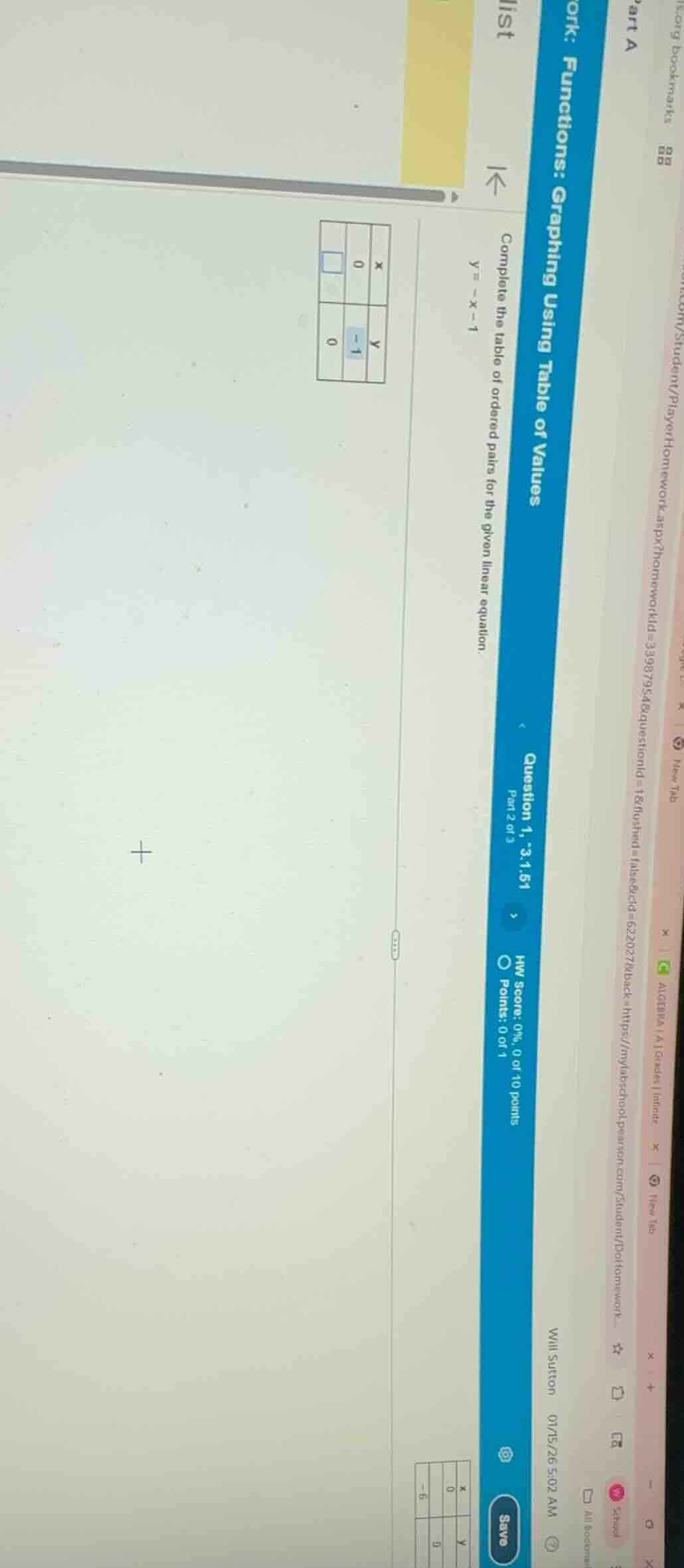
complete the table of ordered pairs for the given linear equation.
$y = -x - 1$
question 1, 3.1.51
part 2 of 3
hw score: 0%, 0 of 10 points
points: 0 of 1
Step1: Find x when y = 0
We have the equation \( y=-x - 1 \). Substitute \( y = 0 \) into the equation:
\( 0=-x - 1 \)
Add \( x \) to both sides: \( x=- 1 \)
Step2: Find y when x = 0 (already given, verify)
Substitute \( x = 0 \) into \( y=-x - 1 \):
\( y=-0 - 1=-1 \), which matches the given value.
Step3: Find x when y = 0 (from the second table, maybe? Wait, the first table has x with a blank and y with -1 (filled) and another y=0. Wait, the first table: x has a blank, y has -1 (when x=0) and then y=0 with x blank. Wait, let's re - examine. The first table:
| x | 0 | ? |
|---|
For the cell where \( y = 0 \), use \( y=-x - 1 \). So \( 0=-x - 1\), solving for \( x \):
Add \( x \) to both sides: \( x=-1 \)
For the second table (partially visible, x=0 and x=-6, y=0 and?):
When \( x=-6 \), substitute into \( y=-x - 1 \):
\( y=-(-6)-1=6 - 1 = 5 \)
When \( y = 0 \), we already know \( x=-1 \), but in the second table, x=0: substitute \( x = 0 \) into \( y=-x - 1 \), \( y=-1 \), but the second table has y=0? Wait, maybe the first table is to fill the x when y=0 (so x=-1) and the second table: when x = - 6, y=-(-6)-1=5; when y = 0, x=-1 (but the second table has x=0, y=-1 as we saw before).
But focusing on the first table (the one with x: 0,? and y: - 1, 0):
The blank in x (when y = 0) is - 1, and the blank in y (if x was something else, but no, the first table: x has 0 and a blank, y has - 1 and 0. So for y=0, x=-1.

Snap & solve any problem in the app
Get step-by-step solutions on Sovi AI
Photo-based solutions with guided steps
Explore more problems and detailed explanations
For the table with \( y=-x - 1 \), when \( y = 0 \), \( x=-1 \); when \( x = 0 \), \( y=-1 \) (which is already given). So the missing x - value when \( y = 0 \) is \(-1\), and if there was a missing y - value for another x (like x=-6 in the second table), \( y = 5 \). But based on the first table, the missing x (when y=0) is \(-1\).