QUESTION IMAGE
Question
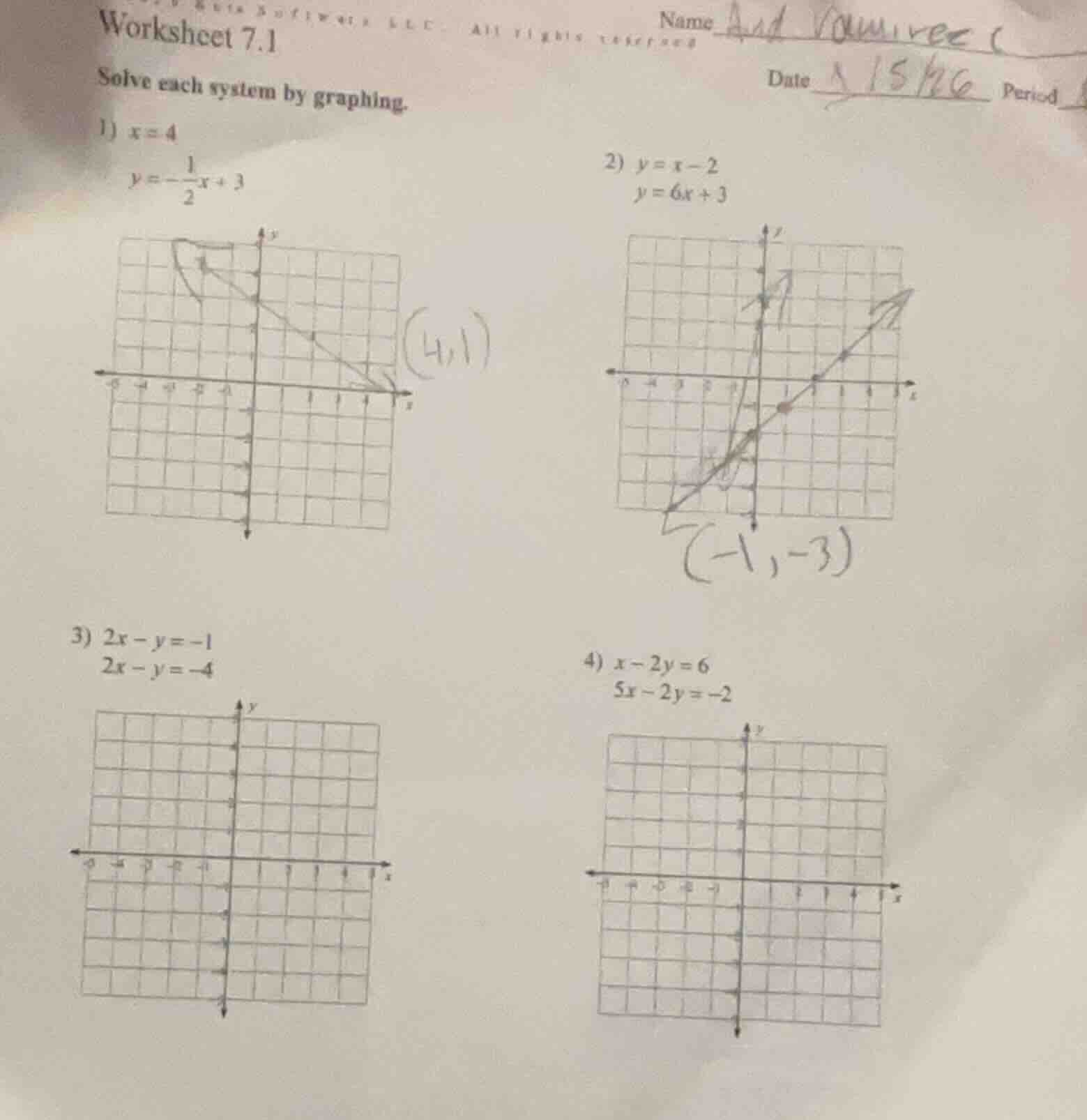
worksheet 7.1
solve each system by graphing.
- ( x = 4 )
( y = -\frac{1}{2}x + 3 )
- ( y = x - 2 )
( y = 6x + 3 )
- ( 2x - y = -1 )
( 2x - y = -4 )
- ( x - 2y = 6 )
( 5x - 2y = -2 )
Problem 1:
Step 1: Analyze the first equation \( x = 4 \)
This is a vertical line where all points have an \( x \)-coordinate of 4.
Step 2: Analyze the second equation \( y = -\frac{1}{2}x + 3 \)
This is a linear equation in slope - intercept form \( y=mx + b \), where the slope \( m=-\frac{1}{2} \) and the \( y \)-intercept \( b = 3 \). To find the intersection with \( x = 4 \), substitute \( x = 4 \) into the second equation.
Substitute \( x = 4 \) into \( y=-\frac{1}{2}x + 3 \):
\( y=-\frac{1}{2}(4)+3=-2 + 3=1 \)
Step 1: Analyze the two linear equations
The first equation \( y=x - 2 \) has a slope \( m = 1 \) and \( y \)-intercept \( b=-2 \). The second equation \( y = 6x+3 \) has a slope \( m = 6 \) and \( y \)-intercept \( b = 3 \).
To find the intersection, we can set the two equations equal to each other since at the intersection point, the \( y \)-values are equal.
Set \( x - 2=6x + 3 \)
Step 2: Solve for \( x \)
Subtract \( x \) from both sides: \( - 2=5x+3 \)
Subtract 3 from both sides: \( -2-3 = 5x\), so \( -5 = 5x \)
Divide both sides by 5: \( x=-1 \)
Step 3: Solve for \( y \)
Substitute \( x=-1 \) into \( y=x - 2 \) (we could also use the other equation). Then \( y=-1-2=-3 \)
Step 1: Rewrite the equations in slope - intercept form
For the first equation \( 2x-y=-1 \), we can rewrite it as \( y=2x + 1 \) (by solving for \( y \): \( y=2x + 1 \))
For the second equation \( 2x-y=-4 \), we can rewrite it as \( y=2x+4 \) (by solving for \( y \): \( y = 2x + 4 \))
Step 2: Analyze the slopes and \( y \)-intercepts
Both lines have the same slope \( m = 2 \) but different \( y \)-intercepts (\( b_1 = 1 \) and \( b_2=4 \)). Parallel lines (lines with the same slope and different \( y \)-intercepts) never intersect.

Snap & solve any problem in the app
Get step-by-step solutions on Sovi AI
Photo-based solutions with guided steps
Explore more problems and detailed explanations
The solution of the system \(
\) is \( (4,1) \)