QUESTION IMAGE
Question
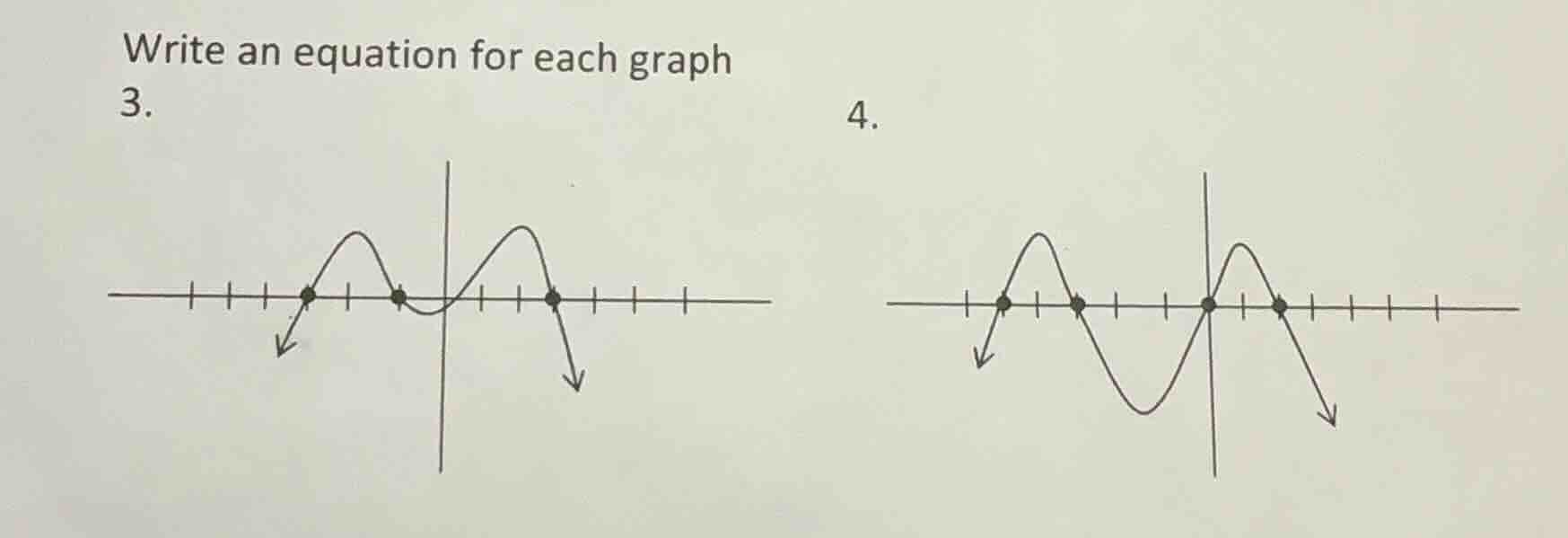
write an equation for each graph
3.
4.
To solve for the equations of the polynomial graphs, we use the fact that if a graph has a root at \( x = a \), then \( (x - a) \) is a factor. The multiplicity of the root (even or odd) determines the behavior of the graph at that root (touching or crossing the axis).
Problem 3
Step 1: Identify the roots and their multiplicities
- The graph crosses the \( x \)-axis at \( x = -4 \), \( x = -2 \), and \( x = 3 \) (odd multiplicities, so the graph crosses the axis here).
- The graph touches the \( x \)-axis at \( x = 0 \) (even multiplicity, so the graph touches the axis here).
Step 2: Form the factors
- For \( x = -4 \): factor is \( (x + 4) \)
- For \( x = -2 \): factor is \( (x + 2) \)
- For \( x = 0 \): factor is \( x^2 \) (even multiplicity, so squared)
- For \( x = 3 \): factor is \( (x - 3) \)
Step 3: Determine the leading coefficient
The end behavior (both ends down) implies the leading coefficient is negative (degree is even, and leading term is negative). Let’s assume the leading coefficient is \( -1 \) (simplest case).
Step 4: Write the equation
Combine the factors:
\[
y = -x^2(x + 4)(x + 2)(x - 3)
\]
Problem 4
Step 1: Identify the roots and their multiplicities
- The graph crosses the \( x \)-axis at \( x = -3 \), \( x = -1 \), and \( x = 2 \) (odd multiplicities, so the graph crosses the axis here).
- The graph touches the \( x \)-axis at \( x = 0 \) (even multiplicity, so the graph touches the axis here).
Step 2: Form the factors
- For \( x = -3 \): factor is \( (x + 3) \)
- For \( x = -1 \): factor is \( (x + 1) \)
- For \( x = 0 \): factor is \( x^2 \) (even multiplicity, so squared)
- For \( x = 2 \): factor is \( (x - 2) \)
Step 3: Determine the leading coefficient
The end behavior (both ends down) implies the leading coefficient is negative (degree is even, and leading term is negative). Let’s assume the leading coefficient is \( -1 \) (simplest case).
Step 4: Write the equation
Combine the factors:
\[
y = -x^2(x + 3)(x + 1)(x - 2)
\]
Final Answers
- \( \boldsymbol{y = -x^2(x + 4)(x + 2)(x - 3)} \)
- \( \boldsymbol{y = -x^2(x + 3)(x + 1)(x - 2)} \)

Snap & solve any problem in the app
Get step-by-step solutions on Sovi AI
Photo-based solutions with guided steps
Explore more problems and detailed explanations
To solve for the equations of the polynomial graphs, we use the fact that if a graph has a root at \( x = a \), then \( (x - a) \) is a factor. The multiplicity of the root (even or odd) determines the behavior of the graph at that root (touching or crossing the axis).
Problem 3
Step 1: Identify the roots and their multiplicities
- The graph crosses the \( x \)-axis at \( x = -4 \), \( x = -2 \), and \( x = 3 \) (odd multiplicities, so the graph crosses the axis here).
- The graph touches the \( x \)-axis at \( x = 0 \) (even multiplicity, so the graph touches the axis here).
Step 2: Form the factors
- For \( x = -4 \): factor is \( (x + 4) \)
- For \( x = -2 \): factor is \( (x + 2) \)
- For \( x = 0 \): factor is \( x^2 \) (even multiplicity, so squared)
- For \( x = 3 \): factor is \( (x - 3) \)
Step 3: Determine the leading coefficient
The end behavior (both ends down) implies the leading coefficient is negative (degree is even, and leading term is negative). Let’s assume the leading coefficient is \( -1 \) (simplest case).
Step 4: Write the equation
Combine the factors:
\[
y = -x^2(x + 4)(x + 2)(x - 3)
\]
Problem 4
Step 1: Identify the roots and their multiplicities
- The graph crosses the \( x \)-axis at \( x = -3 \), \( x = -1 \), and \( x = 2 \) (odd multiplicities, so the graph crosses the axis here).
- The graph touches the \( x \)-axis at \( x = 0 \) (even multiplicity, so the graph touches the axis here).
Step 2: Form the factors
- For \( x = -3 \): factor is \( (x + 3) \)
- For \( x = -1 \): factor is \( (x + 1) \)
- For \( x = 0 \): factor is \( x^2 \) (even multiplicity, so squared)
- For \( x = 2 \): factor is \( (x - 2) \)
Step 3: Determine the leading coefficient
The end behavior (both ends down) implies the leading coefficient is negative (degree is even, and leading term is negative). Let’s assume the leading coefficient is \( -1 \) (simplest case).
Step 4: Write the equation
Combine the factors:
\[
y = -x^2(x + 3)(x + 1)(x - 2)
\]
Final Answers
- \( \boldsymbol{y = -x^2(x + 4)(x + 2)(x - 3)} \)
- \( \boldsymbol{y = -x^2(x + 3)(x + 1)(x - 2)} \)