QUESTION IMAGE
Question
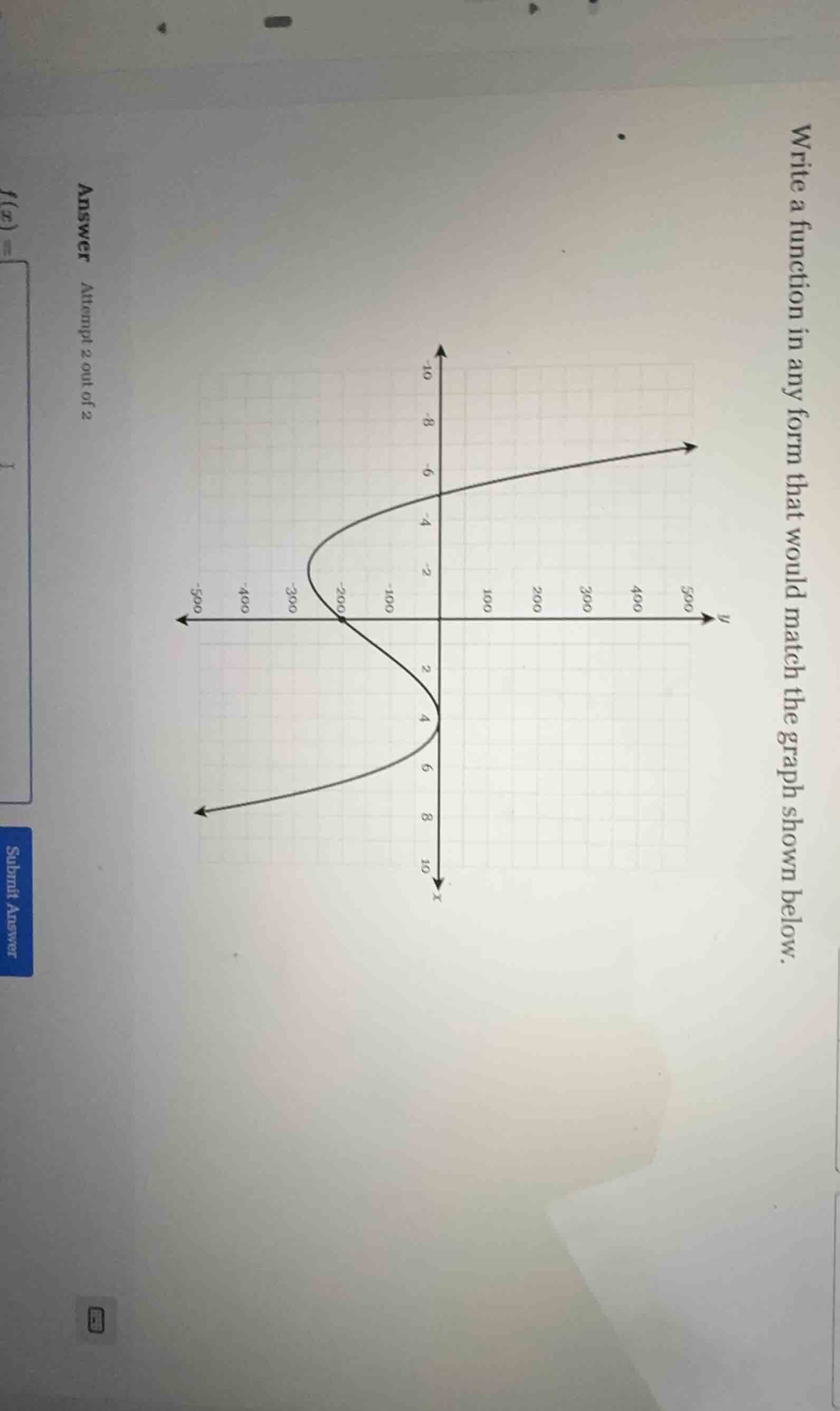
write a function in any form that would match the graph shown below.
Step1: Identify the type of function
The graph appears to be a cubic function (degree 3) since it has two turning points (a local maximum and a local minimum) and the end - behaviors are opposite (as \(x
ightarrow+\infty\), \(y
ightarrow+\infty\) and as \(x
ightarrow-\infty\), \(y
ightarrow-\infty\) for a cubic with a positive leading coefficient). Also, we can see that the graph passes through the points \((0, - 4)\) (the y - intercept) and \((-200,0)\) (a root) and touches or crosses the origin? Wait, no, looking at the axes: the x - axis has values like - 10, - 8, …, 0, 2, 4, … and the y - axis has - 500, - 400, …, 0, 100, 200, … Wait, maybe I misread the axes. Wait, the x - axis is vertical? No, standard coordinate system: x - axis is horizontal, y - axis is vertical. Wait, in the given graph, the horizontal axis is labeled y and the vertical axis is labeled x? That's a bit non - standard. Let's re - orient: Let's assume that the horizontal axis is the y - axis and the vertical axis is the x - axis. So the function is \(x = f(y)\) or \(y=f(x)\)? Wait, the label on the vertical axis is x (with arrows at top and bottom) and the horizontal axis is y (with arrows at left and right). So the graph is a function of \(y\) in terms of \(x\)? Wait, no, the problem says "Write a function in any form that would match the graph shown below". Let's look for roots and the shape.
Looking at the graph, when \(y = 0\), \(x=-4\) (since at \(y = 0\), the x - value is - 4? Wait, no, the vertical axis is x (values like - 10, - 8, - 6, - 4, - 2, 0, 2, 4, 6, 8, 10) and the horizontal axis is y (values like - 500, - 400, - 300, - 200, - 100, 0, 100, 200, 300, 400, 500). So the graph is a curve where when \(y=-200\), \(x = 0\); when \(y = 0\), \(x=-4\); and when \(x = 0\), \(y\) - value? Wait, maybe it's a cubic function in terms of \(x\) and \(y\). Let's consider the general form of a cubic function \(y=ax^{3}+bx^{2}+cx + d\). We know that the y - intercept (when \(x = 0\)): from the graph, when \(x = 0\), \(y=-4\), so \(d=-4\). Also, when \(y = 0\), \(x=-2\)? Wait, maybe the scale is different. Alternatively, let's assume that the graph has a root at \(x=-2\) (if we take the vertical axis as x and horizontal as y, when \(y = 0\), \(x=-2\)) and passes through \((0,-4)\). Wait, maybe a better approach: the graph looks like a cubic function. Let's suppose it's a cubic function \(y=a(x - h)^{3}+k\) (vertex form of a cubic, but cubics have a point of inflection). Alternatively, since it has a root at \(x=-2\) (let's assume) and passes through \((0,-4)\). Wait, maybe the graph is a cubic function \(y=\frac{1}{200}(x + 2)(x)(x - 0)\)? No, that might not be right. Wait, another way: the graph has a local maximum and a local minimum, so it's a cubic. Let's assume the function is \(y=\frac{1}{200}(x + 2)x(x - 0)-4\)? No, let's check the y - intercept. When \(x = 0\), \(y=-4\). Let's try to find the equation. Let's assume the function is a cubic of the form \(y=ax^{3}+bx^{2}+cx + d\). We know that \(d=-4\) (y - intercept). Also, when \(x=-2\), \(y = 0\) (from the graph, the point \((-2,0)\) is on the graph? Wait, the vertical axis (x - axis) has \(x=-2\) and the horizontal axis (y - axis) has \(y = 0\). So the point \((x=-2,y = 0)\) is on the graph. Also, when \(x = 0\), \(y=-4\). Let's assume the cubic has a root at \(x=-2\) and \(x = 0\) (double root? No, the graph crosses the x - axis at \(x=-2\) and touches or crosses at \(x = 0\)? Wait, when \(x = 0\), \(y=-4
eq0\), so \(x = 0\) is not a root. Wait, the point \((x = 0,y=-4)\) and \((x=-2,y = 0)\). Let's…

Snap & solve any problem in the app
Get step-by-step solutions on Sovi AI
Photo-based solutions with guided steps
Explore more problems and detailed explanations
\(y=\frac{1}{200}(x + 2)x^{2}-4\) (or expanded form \(y=\frac{1}{200}x^{3}+\frac{1}{100}x^{2}-4\))