QUESTION IMAGE
Question
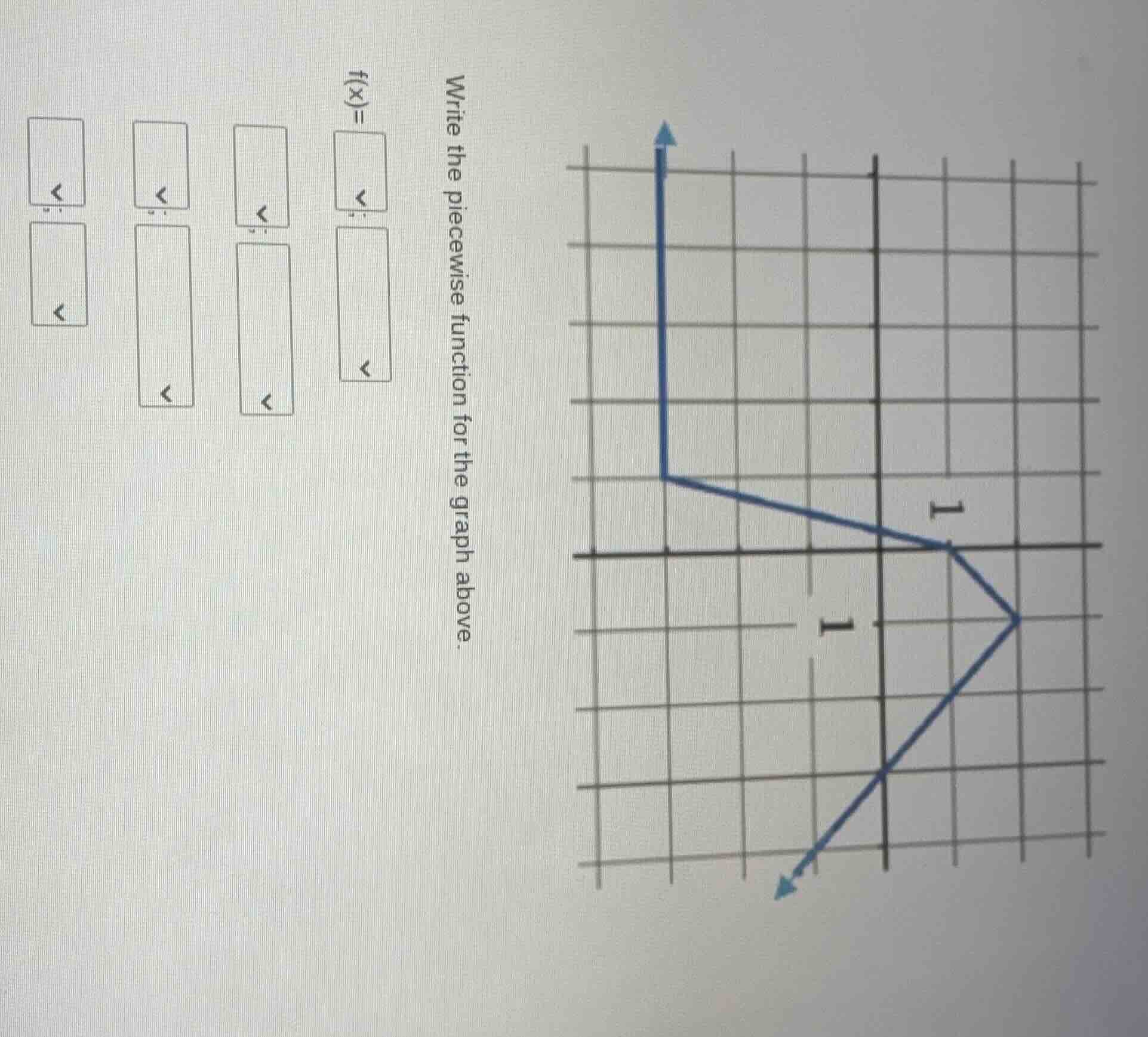
write the piecewise function for the graph above. f(x)= < > < < < < < <
Step1: Identify the segments
First, we analyze the graph. Let's assume the key points (from the grid, we need to determine the coordinates). Let's suppose the vertical segment, the first slant segment, and the second slant segment. Wait, actually, looking at the graph (assuming standard grid with x and y axes), let's find the equations for each piece.
First, the leftmost vertical segment: Wait, no, the blue graph has three parts? Wait, maybe I missee. Wait, the graph has a vertical line, then a slant line, then a V - shape? Wait, no, let's re - examine. Wait, maybe the graph is composed of three linear pieces? Wait, no, let's assume the coordinates. Let's suppose the first segment (left - most) is a vertical line? No, vertical lines have undefined slope, but piecewise functions for vertical lines are of the form \(x = a\), but here it's \(f(x)\), so maybe horizontal? Wait, no, the blue arrow is vertical? Wait, maybe the graph has three parts:
- A vertical line (but for \(f(x)\), vertical lines are not functions, so maybe a horizontal line? Wait, no, the first part is a vertical segment? Wait, maybe I made a mistake. Let's start over.
Wait, the graph: Let's assume the key points. Let's say the first segment (left) is a horizontal line? No, the blue line goes up vertically, then slants down, then has a V - shape? Wait, maybe the graph has three linear pieces:
- **First piece (left - most, vertical? No, must be a function, so vertical lines are not functions. Wait, maybe it's a horizontal line? No, the arrow is vertical. Wait, maybe the first part is a constant function (horizontal line). Wait, no, let's look at the grid. Let's assume the x - axis and y - axis with grid lines. Let's suppose the following:
Let's define the domains:
First, let's find the equations for each segment.
**Segment 1: Vertical? No, function, so must be a line with slope 0 (horizontal) or some slope. Wait, maybe the first segment is \(f(x)=2\) (assuming y = 2) for \(x \leq - 3\) (assuming the vertical part is at x=-3, but no, the arrow is up, so maybe \(x \leq a\) for a horizontal line. Wait, I think I need to re - interpret.
Wait, maybe the graph has three parts:
- A horizontal line (constant function) for \(x \leq - 3\) (assuming the left - most part is horizontal at y = 2).
- A line with slope \(m_1\) for \(-3 < x \leq 0\) (assuming x = - 3 is a key point, and x = 0 is another).
- A line with slope \(m_2\) for \(0 < x \leq 1\) and a line with slope \(m_3\) for \(x>1\) (the V - shape part).
Wait, let's calculate the slopes.
First, let's find two points on each segment.
Segment 1 (left - most, horizontal): Let's say the points are \((x,2)\) where \(x \leq - 3\). So \(f(x)=2\) for \(x \leq - 3\).
Segment 2 (middle, slanting down): Let's take two points. Suppose when \(x=-3\), \(y = 2\) and when \(x = 0\), \(y = 1\). The slope \(m=\frac{1 - 2}{0-(-3)}=\frac{-1}{3}=-\frac{1}{3}\). Using point - slope form \(y - y_1=m(x - x_1)\), with \((x_1,y_1)=(-3,2)\), we get \(y-2=-\frac{1}{3}(x + 3)\), which simplifies to \(y=-\frac{1}{3}x-1 + 2=-\frac{1}{3}x + 1\). So for \(-3 < x \leq 0\), \(f(x)=-\frac{1}{3}x + 1\).
Segment 3 (right - hand V - shape, first part): Let's take points (0,1) and (1,0). The slope \(m=\frac{0 - 1}{1 - 0}=-1\). Using point - slope form \(y - 1=-1(x - 0)\), so \(y=-x + 1\) for \(0 < x \leq 1\).
Segment 4 (right - hand V - shape, second part): Let's take points (1,0) and (2,1). The slope \(m=\frac{1 - 0}{2 - 1}=1\). Using point - slope form \(y-0 = 1(x - 1)\), so \(y=x - 1\) for \(x>1\).
Wait, but the problem…

Snap & solve any problem in the app
Get step-by-step solutions on Sovi AI
Photo-based solutions with guided steps
Explore more problems and detailed explanations
\[
f(x)=
\]