QUESTION IMAGE
Question
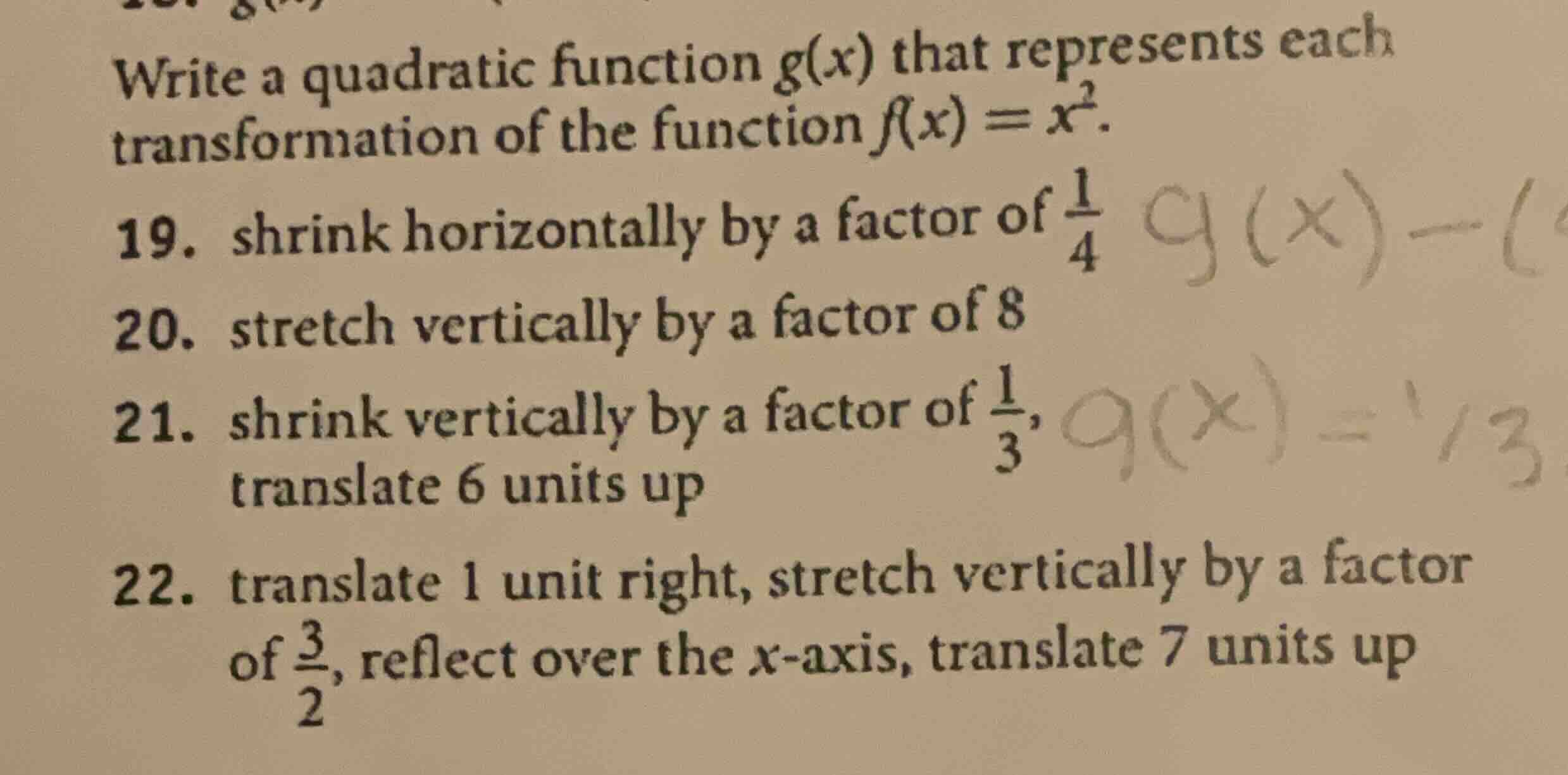
write a quadratic function g(x) that represents each transformation of the function f(x) = x². 19. shrink horizontally by a factor of 1/4 20. stretch vertically by a factor of 8 21. shrink vertically by a factor of 1/3, translate 6 units up 22. translate 1 unit right, stretch vertically by a factor of 3/2, reflect over the x - axis, translate 7 units up
Problem 19: Shrink horizontally by a factor of $\frac{1}{4}$
Step 1: Recall horizontal shrink rule
For a function \( y = f(x) \), a horizontal shrink by a factor of \( \frac{1}{k} \) (where \( k>1 \)) is given by \( y = f(kx) \). Here, the original function is \( f(x)=x^{2} \) and we are shrinking horizontally by a factor of \( \frac{1}{4} \), so \( k = 4 \) (since \( \frac{1}{k}=\frac{1}{4}\Rightarrow k = 4 \)).
Step 2: Apply the rule to \( f(x) \)
Substitute \( x \) with \( 4x \) in \( f(x)=x^{2} \). So \( g(x)=f(4x)=(4x)^{2} \).
Step 3: Simplify the expression
\( (4x)^{2}=16x^{2} \).
Step 1: Recall vertical stretch rule
For a function \( y = f(x) \), a vertical stretch by a factor of \( a \) (where \( a>1 \)) is given by \( y = a\cdot f(x) \). Here, \( a = 8 \) and \( f(x)=x^{2} \).
Step 2: Apply the rule to \( f(x) \)
Multiply \( f(x) \) by 8. So \( g(x)=8\cdot f(x)=8x^{2} \).
Step 1: Recall vertical shrink rule
For a function \( y = f(x) \), a vertical shrink by a factor of \( a \) (where \( 0 < a<1 \)) is given by \( y=a\cdot f(x) \). Here, \( a=\frac{1}{3} \) and \( f(x)=x^{2} \), so after vertical shrink, the function is \( \frac{1}{3}x^{2} \).
Step 2: Recall vertical translation rule
A vertical translation of \( k \) units up for a function \( y = h(x) \) is given by \( y=h(x)+k \). Here, \( k = 6 \) and \( h(x)=\frac{1}{3}x^{2} \).
Step 3: Apply the translation
Add 6 to \( \frac{1}{3}x^{2} \). So \( g(x)=\frac{1}{3}x^{2}+6 \).

Snap & solve any problem in the app
Get step-by-step solutions on Sovi AI
Photo-based solutions with guided steps
Explore more problems and detailed explanations
\( g(x) = 16x^{2} \)