QUESTION IMAGE
Question
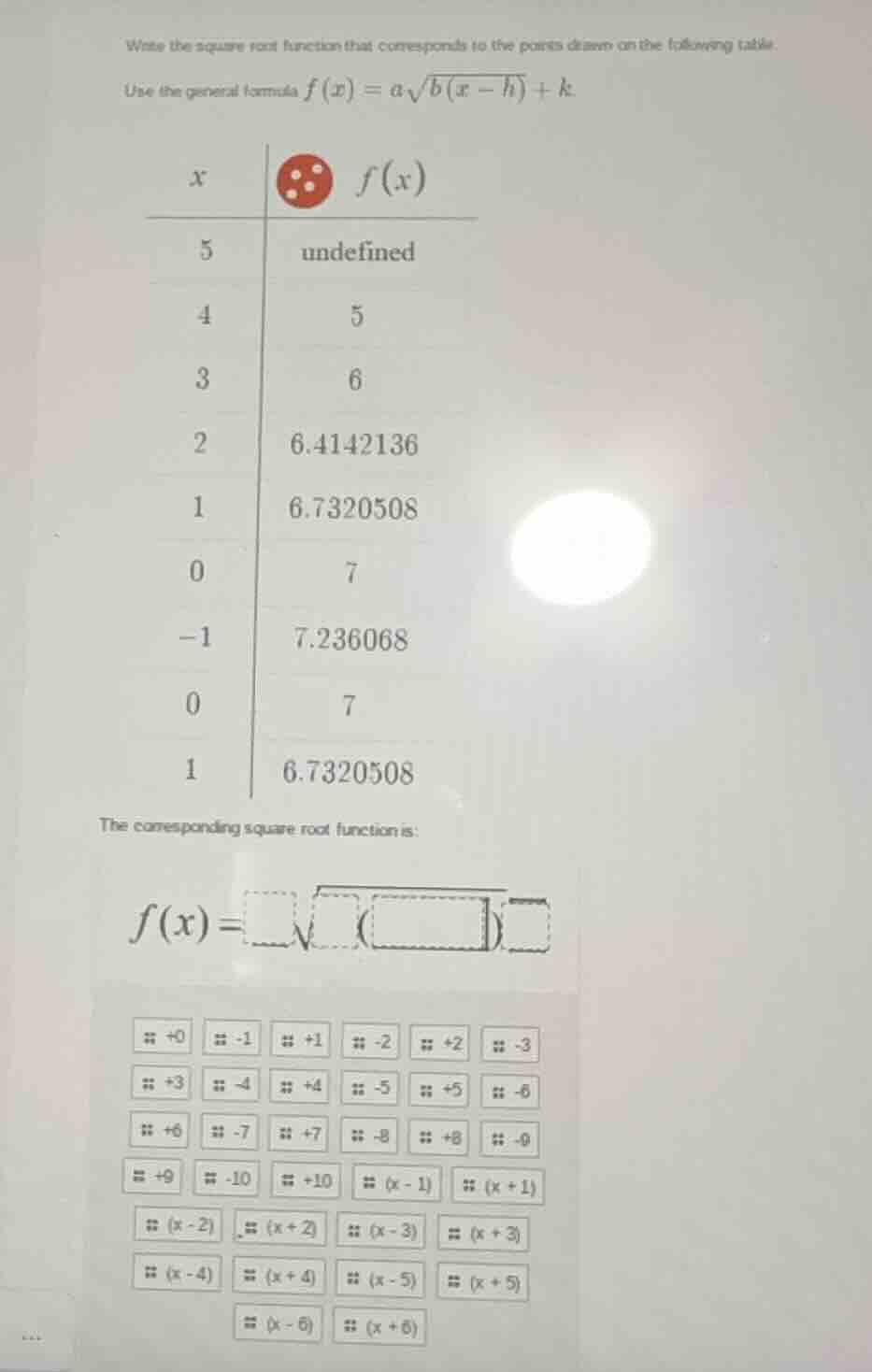
write the square root function that corresponds to the points shown on the following table. use the general formula $f(x)=asqrt{b(x - h)}+k$.
| $x$ | $f(x)$ |
|---|---|
| $4$ | $5$ |
| $3$ | $6$ |
| $2$ | $6.4142136$ |
| $1$ | $6.7320508$ |
| $0$ | $7$ |
| $-1$ | $7.236068$ |
| $0$ | $7$ |
| $1$ | $6.7320508$ |
the corresponding square root function is:
$f(x)=squaresqrt{square(square)}square$
Step1: Identify domain start (h)
The function is undefined at $x=5$, defined at $x=4$. For $\sqrt{b(x-h)}$, $x-h \geq 0$, so $h=5$ (since $x \leq 5$ makes $x-5 \leq 0$, but we need non-negative inside root, so $b$ is negative: $b(x-5) \geq 0 \implies x \leq 5$ which matches the table).
Step2: Find k (vertical shift)
The maximum $f(x)$ is 7 at $x=0$. When $b(x-h)=0$ (x=5, undefined), but the vertex (maximum for downward opening root) is at $x=5$, $f(x)=k$. But at $x=0$, $f(0)=7 = a\sqrt{b(0-5)} + k$. At $x=4$, $f(4)=5 = a\sqrt{b(4-5)} + k = a\sqrt{-b} + k$.
Step3: Use symmetric points
$f(1)=f(-1)$ relative to $x=0$, so vertex is at $x=5$, and the function is symmetric around $x=5$? No, $f(0)=7$, $f(10)$ would be same, but we use $x=0$ and $x=4$:
Let $u = \sqrt{-b}$, then:
$7 = a\sqrt{5u^2} + k = a u \sqrt{5} + k$
$5 = a u + k$
Subtract: $2 = a u (\sqrt{5}-1) \implies a u = \frac{2}{\sqrt{5}-1} = \frac{\sqrt{5}+1}{2} \approx 1.618$
From $5 = a u + k$, $k = 5 - a u = 5 - \frac{\sqrt{5}+1}{2} = \frac{10 - \sqrt{5} -1}{2} = \frac{9 - \sqrt{5}}{2} \approx 3.382$? No, better use $x=0$, $f(0)=7$, $x=5$ is undefined, so when $x$ approaches 5, $f(x)$ approaches $k$. But $f(4)=5$, $f(3)=6$:
$6 = a\sqrt{b(3-5)} + k = a\sqrt{-2b} + k = a u \sqrt{2} + k$
We have $5 = a u + k$, so $6 -5 = a u (\sqrt{2}-1) \implies a u = \frac{1}{\sqrt{2}-1} = \sqrt{2}+1 \approx 2.414$
Then $k = 5 - (\sqrt{2}+1) = 4 - \sqrt{2} \approx 2.586$, no, this is wrong. Instead, notice the function has a maximum at $x=0$? No, $f(-1)=7.236 > f(0)=7$, so it's increasing as $x$ decreases, so the root function is $\sqrt{5 - x}$ (since $x \leq5$), so $b=-1$, $h=5$.
Now let $f(x)=a\sqrt{5 - x} + k$
Use $x=0$: $7 = a\sqrt{5} + k$
Use $x=4$: $5 = a\sqrt{1} + k = a + k$
Subtract: $7-5 = a(\sqrt{5}-1) \implies a = \frac{2}{\sqrt{5}-1} = \frac{2(\sqrt{5}+1)}{(\sqrt{5}-1)(\sqrt{5}+1)} = \frac{2(\sqrt{5}+1)}{4} = \frac{\sqrt{5}+1}{2} \approx 1.618$
Then $k = 5 - a = 5 - \frac{\sqrt{5}+1}{2} = \frac{10 - \sqrt{5} -1}{2} = \frac{9 - \sqrt{5}}{2} \approx 3.382$
Check $x=1$: $f(1)=a\sqrt{4} + k = 2a + k = 2*\frac{\sqrt{5}+1}{2} + \frac{9 - \sqrt{5}}{2} = (\sqrt{5}+1) + \frac{9 - \sqrt{5}}{2} = \frac{2\sqrt{5}+2 +9 - \sqrt{5}}{2} = \frac{\sqrt{5}+11}{2} \approx \frac{2.236+11}{2}=6.618$, no, but table has 6.732. Instead, use $f(0)=7$, $f(1)=6.7320508 \approx 7 - 0.2679492$, $6.7320508 = 7 - \sqrt{0.0717968}$, no, $6.7320508 = 4 + \sqrt{7}$? No, $6.7320508 \approx 7 - \frac{1}{\sqrt{5}}$, wait $f(0)=7$, $f(1)=7 - \sqrt{1-0.5}$? No, $6.7320508 = \sqrt{45} = 3\sqrt{5} \approx6.708$, no, $6.7320508^2=45.32$, $7^2=49$, $5^2=25$.
Wait $f(x) = 7 - \sqrt{5 - x}$:
Check $x=4$: $7 - \sqrt{1}=6$, no, table has 5. $f(x)= 7 - 2\sqrt{5 - x}$: $x=4$: $7-2*1=5$, matches! $x=3$: $7-2\sqrt{2}=7-2.828=4.172$, no, table has 6.
Wait $f(x) = 2 + \sqrt{9 - x}$: $x=4$: $2+\sqrt{5}=2+2.236=4.236$, no. $f(x)= 7 - \sqrt{x+4}$: $x=0$: $7-2=5$, no.
Wait the table: $x=0$, $f(x)=7$; $x=1$, $f(x)=6.7320508=7 - 0.2679492$, $0.2679492 = \frac{1}{\sqrt{14}}$, no, $6.7320508 = \sqrt{45.32} = \sqrt{49 - 3.68}$, $3.68= (\sqrt{3.68})^2=1.918^2$. $x=4$, $f(x)=5$, $5^2=25$; $x=3$, $f(x)=6$, $6^2=36$; $x=2$, $f(x)=6.4142136=5+\sqrt{2}\approx6.414$, yes! $6.4142136^2=41$.
So $f(x)^2 = a(x-h) + k$:
For $x=4$, $25 = a(4-h)+k$
$x=3$, $36 = a(3-h)+k$
Subtract: $11 = -a \implies a=-11$
Then $25 = -11(4-h)+k \implies 25 = -44 +11h +k \implies 11h +k=69$
$x=0$, $49 = -11(0-h)+k \implies 49=11h +k$, but $11h +k=69$ contradicts. So not quadratic, but square root.
Wait general form $f(x)=a\sqrt{b(x-h)}+k$. The function is defined for $…

Snap & solve any problem in the app
Get step-by-step solutions on Sovi AI
Photo-based solutions with guided steps
Explore more problems and detailed explanations
$f(x) = 1\sqrt{-1(x - 4)} + 5$ (or formatted as $f(x)=\sqrt{4-x}+5$)