QUESTION IMAGE
Question
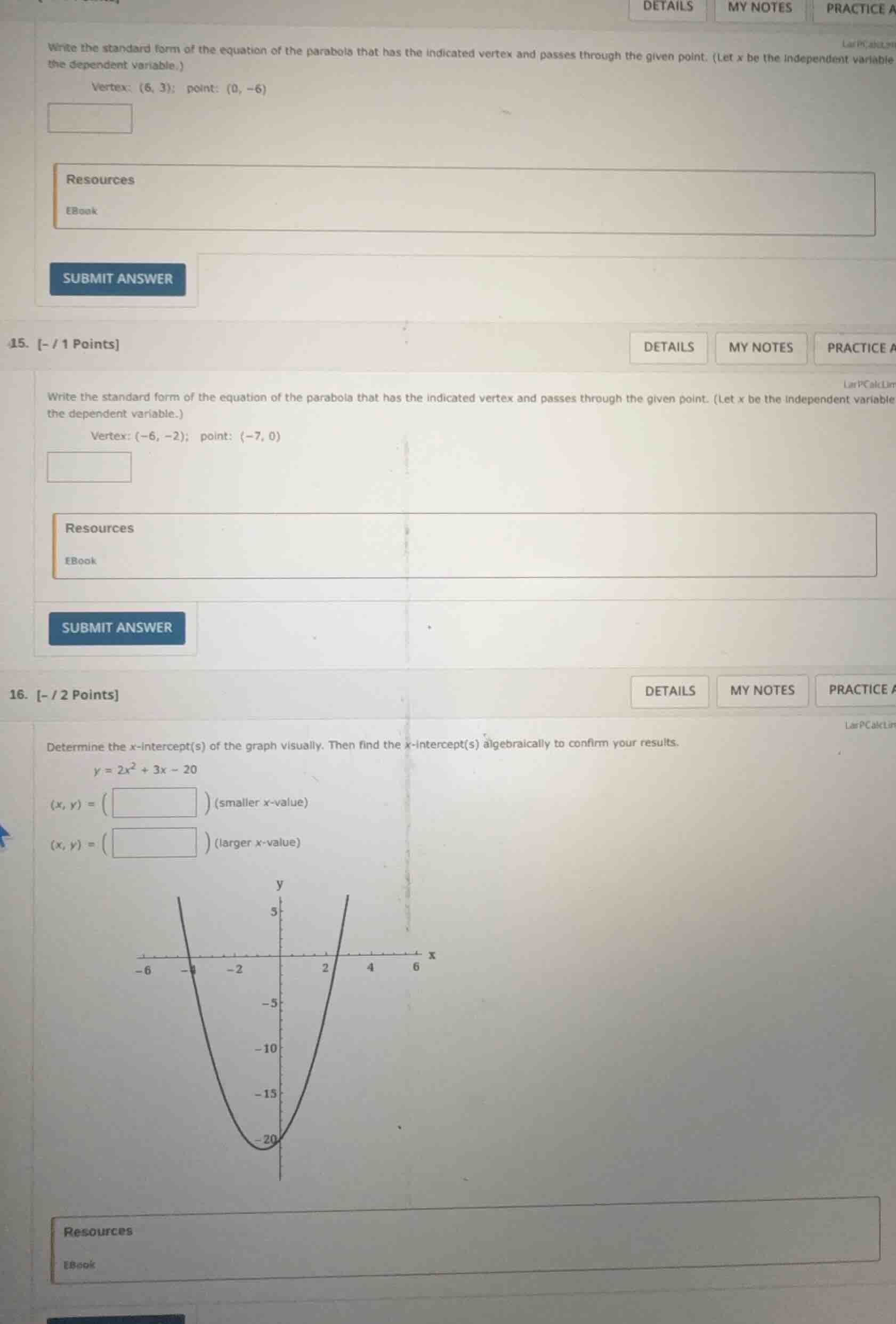
write the standard form of the equation of the parabola that has the indicated vertex and passes through the given point. (let x be the independent variable the dependent variable.)
vertex: (6, 3); point: (0, -6)
resources
ebook
- - / 1 points
write the standard form of the equation of the parabola that has the indicated vertex and passes through the given point. (let x be the independent variable the dependent variable.)
vertex: (-6, -2); point: (-7, 0)
resources
ebook
- - / 2 points
determine the x-intercept(s) of the graph visually. then find the x-intercept(s) algebraically to confirm your results.
( y = 2x^2 + 3x - 20 )
( (x, y) = (quad) ) (smaller x-value)
( (x, y) = (quad) ) (larger x-value)
resources
ebook
Problem 1 (Vertex: (6, 3); point: (0, -6))
Step1: Recall the standard form of a parabola
The standard form of a parabola with vertex \((h, k)\) is \(y = a(x - h)^2 + k\). Here, \(h = 6\) and \(k = 3\), so the equation becomes \(y = a(x - 6)^2 + 3\).
Step2: Substitute the point (0, -6) to find \(a\)
Substitute \(x = 0\) and \(y = -6\) into the equation:
\[
-6 = a(0 - 6)^2 + 3
\]
\[
-6 = 36a + 3
\]
Subtract 3 from both sides:
\[
-9 = 36a
\]
Divide both sides by 36:
\[
a = -\frac{9}{36}=-\frac{1}{4}
\]
Step3: Write the final equation
Substitute \(a = -\frac{1}{4}\) back into the standard form:
\[
y = -\frac{1}{4}(x - 6)^2 + 3
\]
We can expand this to the general standard form (quadratic form) if needed, but the vertex - form is also a standard form. Expanding:
\[
y = -\frac{1}{4}(x^{2}-12x + 36)+3
\]
\[
y = -\frac{1}{4}x^{2}+3x - 9 + 3
\]
\[
y = -\frac{1}{4}x^{2}+3x - 6
\]
Step1: Recall the standard form of a parabola
The standard form of a parabola with vertex \((h,k)\) is \(y=a(x - h)^2 + k\). Here, \(h=-6\) and \(k = - 2\), so the equation is \(y=a(x + 6)^2-2\).
Step2: Substitute the point (-7, 0) to find \(a\)
Substitute \(x=-7\) and \(y = 0\) into the equation:
\[
0=a(-7 + 6)^2-2
\]
\[
0=a(-1)^2-2
\]
\[
0=a - 2
\]
Add 2 to both sides:
\[
a=2
\]
Step3: Write the final equation
Substitute \(a = 2\) back into the standard form:
\[
y = 2(x + 6)^2-2
\]
Expanding:
\[
y=2(x^{2}+12x + 36)-2
\]
\[
y=2x^{2}+24x+72 - 2
\]
\[
y=2x^{2}+24x + 70
\]
Step1: Recall that x - intercepts occur when \(y = 0\)
Set \(y=0\), so we have the equation \(2x^{2}+3x - 20=0\).
Step2: Solve the quadratic equation
We can use the quadratic formula \(x=\frac{-b\pm\sqrt{b^{2}-4ac}}{2a}\) for a quadratic equation \(ax^{2}+bx + c = 0\). Here, \(a = 2\), \(b = 3\), and \(c=-20\).
First, calculate the discriminant \(\Delta=b^{2}-4ac=(3)^{2}-4\times2\times(-20)=9 + 160 = 169\)
Then, \(x=\frac{-3\pm\sqrt{169}}{2\times2}=\frac{-3\pm13}{4}\)
Step3: Find the two solutions
For the minus sign:
\[
x=\frac{-3-13}{4}=\frac{-16}{4}=-4
\]
For the plus sign:
\[
x=\frac{-3 + 13}{4}=\frac{10}{4}=\frac{5}{2}=2.5
\]

Snap & solve any problem in the app
Get step-by-step solutions on Sovi AI
Photo-based solutions with guided steps
Explore more problems and detailed explanations
\(y = -\frac{1}{4}(x - 6)^2 + 3\) (or \(y=-\frac{1}{4}x^{2}+3x - 6\))