QUESTION IMAGE
Question
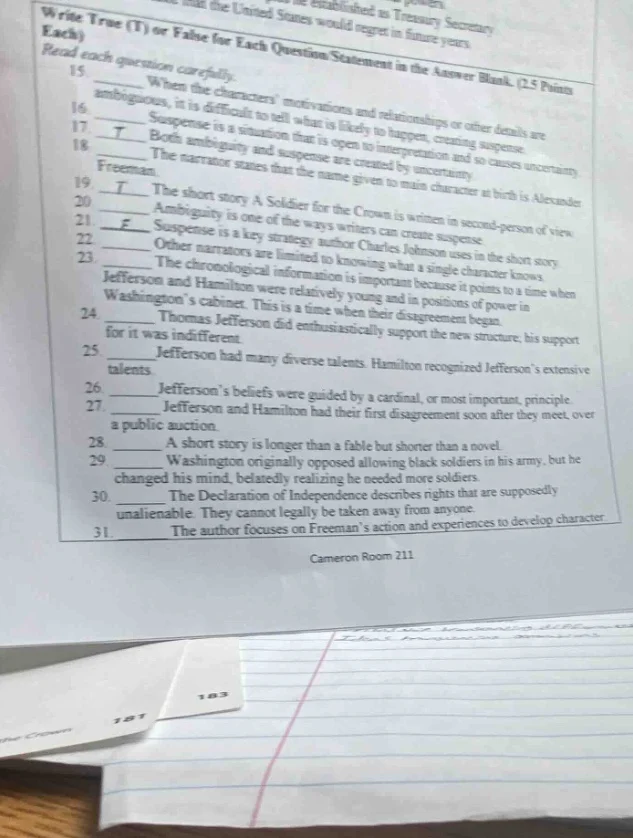
write true (t) or false for each question statement in the answer blank. (2.5 points each)
read each question carefully.
- when the characters’ motivations and relationships or other details are ambiguous, it is difficult to tell what is likely to happen, creating suspense.
- suspense is a situation that is open to interpretation and so causes uncertainty.
- both ambiguity and suspense are created by uncertainty.
- the narrative states that the name given to main character at birth is alexander freeman.
- the short story a soldier for the crown is written in second - person of view.
- ambiguity is one of the ways writers can create suspense.
- suspense is a key strategy author charles johnson uses in the short story.
- other narrators are limited to knowing what a single character knows.
- the chronological information is important because it points to a time when jefferson and hamilton were relatively young and in positions of power in washington’s cabinet. this is a time when their disagreement began.
- thomas jefferson did enthusiastically support the new structure; his support for it was indifferent.
- jefferson had many diverse talents. hamilton recognized jefferson’s extensive talents.
- jefferson’s beliefs were guided by a cardinal, or most important, principle.
- jefferson and hamilton had their first disagreement soon after they meet, over a public auction.
- a short story is longer than a fable but shorter than a novel.
- washington originally opposed allowing black soldiers in his army, but he changed his mind, belatedly realizing he needed more soldiers.
- the declaration of independence describes rights that are supposedly unalienable. they cannot legally be taken away from anyone.
- the author focuses on freeman’s action and experiences to develop character.
Response
ideological differences with Hamilton, not indifference.
- Hamilton acknowledged Jefferson's political and intellectual talents despite their rivalry.
- Jefferson's political stances were rooted in core principles like agrarian democracy and states' rights.
- Their first disagreements were private policy disputes, not public arguments.
- Short stories are defined as longer than fables (moral-focused brief tales) and shorter than novels.
- Washington initially opposed Black soldiers but reversed course due to manpower needs.
- The Declaration's unalienable rights are framed as inherent and non-removable by law.
- The narrative centers on Freeman's choices and experiences to develop their character.

Snap & solve any problem in the app
Get step-by-step solutions on Sovi AI
Photo-based solutions with guided steps
Explore more problems and detailed explanations
ideological differences with Hamilton, not indifference.
- Hamilton acknowledged Jefferson's political and intellectual talents despite their rivalry.
- Jefferson's political stances were rooted in core principles like agrarian democracy and states' rights.
- Their first disagreements were private policy disputes, not public arguments.
- Short stories are defined as longer than fables (moral-focused brief tales) and shorter than novels.
- Washington initially opposed Black soldiers but reversed course due to manpower needs.
- The Declaration's unalienable rights are framed as inherent and non-removable by law.
- The narrative centers on Freeman's choices and experiences to develop their character.